
/images/ppid_59c68470-image-179065752357750905.webp)
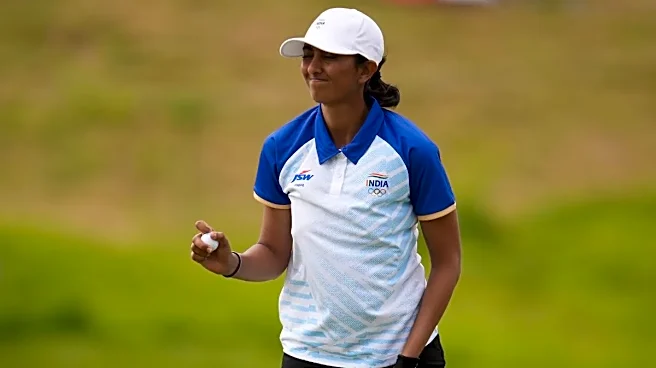
New Delhi, Sep 29 (PTI) The Women’s Golf Association of India (WGAI) has called for greater government support and grassroots infrastructure to make golf more accessible to young players, while rejecting the perception that the sport is meant only for the wealthy.
WGAI president Kavita Singh said the lack of basic facilities and equipment was holding back the sport and urged the government to provide better support to women golfers.
“We try to approach this with a balance. Sometimes the girls complain, and sometimes their complaints are valid. But the whole game is about rules; we don’t make our own rules,” Singh said during the press conference of the Hero Women’s Indian Open 2026 here on Tuesday.
She stressed that discipline and hard work, rather
than luck, were key to succeeding in golf.
“I tell the girls all the time: there must be discipline and hard work. In this game, there is no luck. As Gary Player said, the more I practise, the better I’ll get. It isn’t about luck,” she said.
Singh said the WGAI was also working to reduce the financial burden on players by providing resources such as mental and physical coaches.
“Right now, these girls are hiring mental coaches and physical coaches at their own expense. We want to change that, and starting this year, the board is working to bring these resources to them directly,” she said.
Recalling the difficulties faced by Indian women golfers during their first Olympic appearance in Rio, Singh said the sport’s elite image had translated into inadequate support for players.
“When our girls went to the Olympics for the first time, they hardly had anything. Officials told us, ‘This is a rich person’s game, why did you go? You are all rich people.’ I told them, ‘You are an official in the Government of India. I didn’t put this game into the Olympic Committee, the world did,'” she said.
Singh also raised concerns over the quality and availability of kits for players.
“They don’t get proper kits, either they are too small, too big, or they tear in a day. What should we do? They tell us, ‘This is Government of India, they have to do it, you cannot do it.’ I am truly fed up,” she said.
She cited Japan and South Korea as examples of countries that have made the sport more accessible by creating compact practice facilities.
“Why are there so many players coming out of Japan and Korea? They put nets on rooftops, and girls can go and hit balls under floodlights at night. You don’t need vast land or huge money for that,” Singh said.
“In our country, whether in villages or cities, you can build chipping, pitching or putting greens. We can provide the equipment, but in every other country, the government does this.”
Hero MotoCorp executive vice-president Sanjay Bhan also challenged the perception of golf as an elitist sport, comparing it with cricket’s aristocratic origins.
“People ask if this is a rich man’s game. What was cricket earlier? Nawabs, lords, kings and maharajas — cricket was also a rich person’s game. Why wasn’t that discarded? It was a British legacy,” Bhan said.
“Today, there is so much money in cricket, and everyone’s mindset has changed. What is wrong with golf? Calling it a ‘rich man’s game’ just shows a very narrow mindset.”
Bhan said wider public access to golf courses could help change the perception of the sport.
“In the United States, there are 16,000 golf courses and 90 per cent of them are public courses. That means local residents can play for free,” he said.
“Any sport is not inherently rich; it only becomes ‘rich’ by the way it is played and conducted.”
Bhan said Hero MotoCorp’s efforts with the WGAI were aimed at improving access to the sport and helping Indian players compete at the highest level.
“Our effort at Hero, alongside WGAI, is to give golf the access and stature it truly deserves, giving our players the opportunity to compete with the best in the world,” he said.
WGAI secretary general Champika Sayal said creating a level playing field and changing the perception of golf were essential for developing the sport in India.
“The first and most important thing we need is a level playing field, which we don’t have. Golf is a very special game, and currently, there is no vision for it,” Sayal said.
“When you don’t give a level playing field to children, labelling it an ‘elite game’ keeps the sport away from the youth of India. The Ministry has to change this perception.”
Sayal also underlined the potential for golf to create career and employment opportunities beyond playing.
“We have a huge country, so many people, and so much opportunity that can come out of a career for players, plus subsequent job opportunities within golf clubs and driving ranges,” she said.
“It is very important that the Skill Development Ministry and the Sports Ministry work in tandem to make sure this happens over the next five years. It is very, very crucial.” PTI SG AH
AH



/images/ppid_59c68470-image-179062252465583601.webp)

/images/ppid_59c68470-image-179064762591759094.webp)