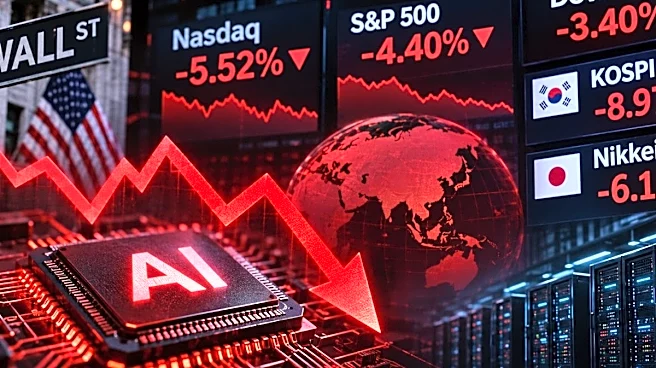

Global financial markets witnessed a massive selloff on Friday as panic over the future of the artificial intelligence (AI) boom triggered a sharp correction in technology stocks, wiping out nearly $2.5 trillion in US market value in a single session and sending Asian equities into a tailspin.
South Korea’s benchmark Kospi plunged nearly 9% at the opening bell, prompting the exchange to activate circuit breakers and suspend trading for 20 minutes. Japan’s Nikkei 225 also tumbled more than 6%, entering bear market territory after falling over 20% from its recent peak.
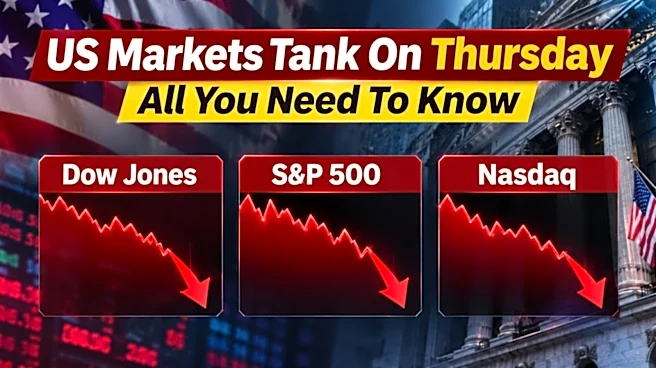
The rout followed a brutal session on Wall Street on Thursday, when the Nasdaq Composite plunged 5.52%, officially entering correction territory after closing more than 10% below
its October 6 record high.
The technology-heavy index suffered its worst single-day decline since April 2025, when US President Donald Trump’s sweeping tariff announcements triggered a global market meltdown. The broader S&P 500 and Dow Jones Industrial Average also recorded their steepest daily losses since that period.
The selloff marked a dramatic reversal from Wednesday’s post-midterm election rally. The Dow had surged 1,569 points in the previous session, while the Nasdaq gained 1.44%. However, the Dow subsequently plunged 1,833 points on Thursday, erasing all of Wednesday’s gains.
The latest correction reflects growing investor concerns that political developments in the United States could disrupt the rapid expansion of AI infrastructure, particularly data centre construction. Questions over the sustainability of massive AI investments and whether technology companies can generate adequate returns are adding to the pressure.
A major trigger for the latest selloff has been the Democratic victory in Texas’ gubernatorial election, which has raised questions about the future of data centre investments in one of the most important hubs of the US technology industry.
Texas has attracted massive investments from technology giants, including Google, Meta, Oracle and OpenAI, to expand data centre infrastructure and support the growing demand for AI computing capacity.
However, Texas Governor-elect Gina Hinojosa campaigned on imposing a temporary moratorium on data centre construction and removing certain tax incentives available to companies setting up such facilities.
The prospect of tighter restrictions has unsettled investors, who fear that political opposition could slow down the expansion of AI infrastructure and affect the earnings outlook of companies supplying chips, servers and other equipment.
The market reaction has been particularly severe for semiconductor manufacturers and companies often described as the ‘picks and shovels’ of the AI boom — businesses that supply the essential hardware and computing infrastructure powering artificial intelligence.
Interestingly, semiconductor and data centre-related stocks had already started declining during Wednesday’s broader market rally. The selling intensified on Thursday, eventually dragging the major US indices sharply lower.
Nvidia, chipmakers and AI infrastructure stocks suffer massive losses
Some of the biggest casualties of Thursday’s selloff were companies directly linked to AI infrastructure spending.
Nvidia shares plunged 9.3%, wiping out their gains for 2026. A closely watched semiconductor index tumbled 12.3%, marking its worst session in approximately six-and-a-half years.
The Nasdaq 100, which tracks 100 of the largest non-financial companies listed on the Nasdaq, sank 6.36%, registering its worst daily performance since March 2020, when the Covid-19 pandemic triggered a global market crash.
The selling was not restricted to chipmakers. Shares of Tesla and SpaceX fell 11% and 9%, respectively.
AI-focused cloud infrastructure providers also faced heavy selling. Shares of CoreWeave plunged around 10%, while Nebius declined approximately 15%. Both companies provide computing infrastructure and processing capacity to businesses seeking to capitalise on the AI boom.
The correction has been particularly painful for investors who entered these stocks near their recent peaks. CoreWeave shares have fallen around 76% from their June 2025 peak, shortly after the company went public, while Nebius has lost approximately 58% from its peak in June 2026.
Earnings disappointments add to pressure on technology stocks
Investors are also becoming increasingly unforgiving of companies that miss earnings estimates or issue weaker-than-expected forecasts.
Qualcomm shares tumbled 9.5% on Thursday after the company missed market estimates and warned that higher memory chip costs were hurting sales.
The development followed similar concerns raised by Intel last week, highlighting the growing cost pressures facing the semiconductor industry.
The earnings-related weakness has added another dimension to the AI stock correction. Investors are increasingly scrutinising not just the long-term potential of artificial intelligence but also the immediate financial performance, margins and capital requirements of companies involved in the technology ecosystem.
Wall Street’s fear gauge VIX surges 70%
The scale of Thursday’s selloff was reflected in the sharp spike in market volatility. Wall Street’s CBOE Volatility Index (VIX), popularly known as the market’s fear gauge, surged about 70%, its biggest single-day jump in nearly two years, reaching its highest level in seven months.
Selling was widespread, with all 11 sectors of the S&P 500 ending Thursday’s session in negative territory.
The growing uncertainty also triggered demand for safer investments. US government bonds rallied as investors reassessed the outlook for AI spending and global economic growth.
The yield on the benchmark 10-year US Treasury note fell to 4.84%, its lowest level in two months. Bond yields and prices move in opposite directions, meaning the decline in yields reflected increased buying interest in government debt.
From AI investment optimism to fears of overbuilding
The latest market turmoil also highlights how quickly investor sentiment towards the AI infrastructure trade has changed.
On Wednesday, shares of major technology companies such as Amazon, Meta and Google rallied amid expectations that potential restrictions on data centre expansion could reduce their capital expenditure requirements and improve profitability.
However, investors appeared to reconsider that optimism during Thursday’s session, increasingly viewing restrictions on data centre construction as a potential threat to the broader AI ecosystem rather than simply a way to control spending.
At the heart of the debate is whether technology companies are investing too aggressively in computing infrastructure and whether future demand will be sufficient to justify the enormous expenditure.
Data centres have become essential infrastructure for artificial intelligence, cloud computing and the broader internet economy. However, the unprecedented pace of construction has raised concerns about overcapacity, rising electricity requirements, water consumption and the possibility that companies could end up with more computing capacity than the market ultimately needs.