


Raat Akeli Hai – The Bansal Murders Movie Review: Another Friday, another murder mystery! Yes, joining the league of a host of bloody and hyper-violent thrillers is Raat Akeli Hai – The Bansal Murders, a spiritual sequel of the 2020 film, Raat Akeli Hai. Once again, the plot pivots on a fateful anti-climactic event that unfolds in an eerie, cold night in the heartland. But make no mistake. Don’t expect the subtexts, the layers, the nuance, the complexities of its prequel here. Honey Trehan’s Raat Akeli Hai – The Bansal Murders is a far too simple and one-tone whodunit.
The film revolves around Inspector Jatil Yadav, who returns to unearth yet another mishap in a rich, powerful family where silence and secrets loom large. As the title suggests,
this is the story of the famous Bansal clan, which owns a media conglomerate called the Prabhat Group and is currently embroiled in a fight over its assets. On one hand is Rajesh Chand Bansal, who owns Newrise TV, and on the other is Meera Bansal and her family running Prabhat Manthan newspaper.
Without wasting any time, the narrative’s tone is set from the very first scene. One morning, when Meera is busy with her usual meditation routine, she’s interrupted by the constant and violent cawing of crows outside her palatial farmhouse. When she rushes outside, she’s left petrified. It’s a dystopic vista. Multitudes of crows are seen lying dead, some gasping for breath and struggling to take flight. Next to this scene lies the bloody head of a pig wrapped in a piece of Prabhat Manthan newspaper. Jatil and his team are called to investigate.
But the family seems unfazed. There are some rituals being performed on the eve of Meera’s son’s death anniversary. These rituals are carried on by their ‘kul guru’ Geeta maa. It’s evident that she controls and dominates their lives. Jatil is ordered to handle the case with special diligence as his superior, DGP Sameer Verma, is friends with Rajesh Chand. All fingers point at him, thanks to their family feud. But a few nights later, almost everyone in the farmhouse is brutally killed, barring Meera and two others.
They’re hacked and bludgeoned by a machete. Some of them have their brains smashed, some have their throats slit. Meera blames Aarav, her habitual drug-addict cousin, for this mass homicide. But there’s more than what meets the eyes. As you begin to suspect everyone alive as the culprit, we’re introduced to Dr Panicker, the forensic expert, and SP Chauhan, who’s suddenly brought to head the investigation as Jatil is dismissed for not being able to stop a homicide that took place right under his nose.
Raat Akeli Hai – The Bansal Murders has every ingredient of a classic whodunit. But it’s the weight of its lofty ambition and to some extent, the execution, that lead it to falter. Ultimately, the film remains narratively linear and straightforward, offering little in terms of thematic or intellectual provocation. The maker resorts to some interesting leitmotifs here – there’s a cult, a godwoman, the rich-poor divide, the role of media in shaping bias and the ruthlessness of those in power corridors. But none of it is explored enough to percolate into the narrative and take it to its pinnacle.
They simply remain incoherent sub-tracks that make promises but barely deliver. Yes, there are plot points that are unpredictable to some extent but they unnecessarily stretch the duration and render very little substance to its depth. There are references made to Jatil’s psyche and being and his anxiety is also mentioned a few times. His relationship with Radha is also seen evolving, but it remains restricted and relegated to the periphery. Honey decides to just about scratch the surface and this is exactly what makes Raat Akeli Hai – The Bansal Brothers a weak successor of its prequel.
The 2020 film worked on multiple thematic levels beneath its whodunit surface. At its core, it was about patriarchal powers controlling women’s bodies, desires and choices and how their sexual and emotional autonomy was treated as transgressions. It also made a subtle reference to the institution of marriage which often is less about companionship and more of a transaction. Its quietness was violent, deafening. As for our protagonist Jatil, he was dealing with isolation basis caste and class. But none of these motifs find a resonance here. It’s a whodunit that plays it too safe.
While it’s understood that Jatil has found his way out from the shackles of prejudice and personal insecurity, it’s strange that none of his inner moral dilemmas are explored and dissected here. The Jatil-Radha dynamic had so much potential but that remains an uncharted territory. However, credit lies where it’s due. Honey makes sure that even in a man’s world, the women are given agency. Be it Meera, Dr Panicker, Radha or Jatil’s mother, they’re on an equal footing with the men. They’re driven by motives – good and bad – and hold their ground even in dire situations.
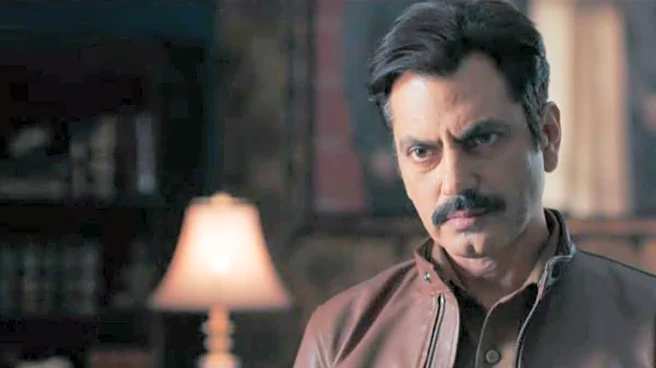
The chilly winters of Uttar Pradesh acts as a beautiful narrative device to heighten the ominous energy and claustrophobic setting. It’s not just a backdrop; it’s an active emotional force, reinforcing the idea that social hierarchies are ruthlessly rigid. And what help elevate the narrative are the performances. Nawazuddin Siddiqui as Jatil Yadav ably carries the film on his shoulders. He resorts to restraint and delivers a controlled performance.
Thankfully, both the mood of the narrative and the actor resist the temptation to turn the role into a showcase of bravado. And the credit for the same goes to writer Smita Singh, who had offered Nawazuddin one of his most loved and acclaimed characters, Ganesh Gaitonde in Sacred Games. While Ganesh reflected a skewed masculinity, Jatil is the complete opposite. We only wish that his vulnerabilities and ambiguities also got the opportunity to shine through.
Chitrangda Singh as Meera Bansal has an interesting character arc and does a lot of emotional heavy lifting. She doesn’t show her cards too quickly and keeps you guessing till the very end. Deepti Naval, unfortunately, is wasted. For an actor of her stature and calibre, she deserved a role that does justice to her talent and oeuvre. Her Geeta maa had so much potential to cause mayhem but she largely remains ornamental. Revathy as Dr Panicker adds some character to the story.
Ila Arun as Jatil’s mother is stupendous. As a nagging and sometimes bitter mother who’s constantly after her son to find a girl and get married, she brings in some moments of levity. She keeps her character quirks intact. The makers deserve credit for building an unconventional mother-son dynamic, they’re not virtuously obsessed with each other. In one scene, Jatil, in fact, subtly refers to her as the ‘kaala saaya’ in his life. She’s bickering, progressive and savage, but at the same time, adheres to the template of a small-town mother.
Radhika Apte as Radha has nothing much to do and her presence could at best be described as a cameo. Rajat Kapoor and Sanjay Kapoor too suffer due to undercooked characters. So, is Raat Akeli Hai – The Bansal Murders worth a watch? Well, you could but make sure that you don’t go in with high expectations. It’s inconsistent, but gains weight from its atmosphere. It can best be compared to a labyrinth-like puzzle but once you get to it, you realise that it’s rather simplistic. So, a better suggestion would be for you to rewatch its prequel.
/images/ppid_59c68470-image-177094509331581965.webp)

/images/ppid_59c68470-image-177094504615411398.webp)
/images/ppid_a911dc6a-image-177094403738091205.webp)