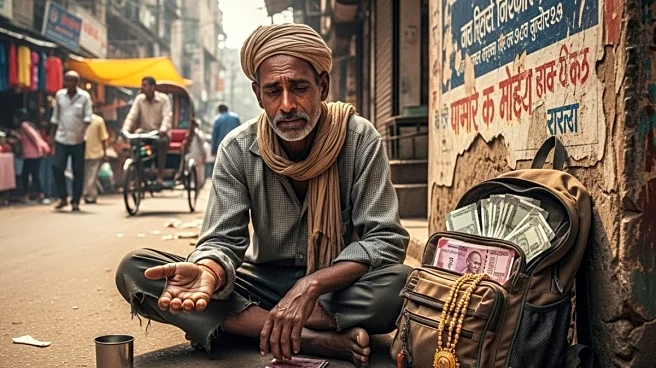


He was a regular at Indore’s bustling Sarafa jewellery market. The leprosy-stricken man would slide through the lanes on a wooden cart with a torn, shabby bag on his back, begging from passers-by. While people bought and sold precious metals and stones in the local shops, 50-year-old Mangilal had quietly struck gold.
When the women and child development department “rescued” him during an anti-begging drive—begging is banned in Indore, celebrated as India’s cleanest city for a decade—they discovered that the man was richer than many of his donors.
He owned three houses, ran a money-lending business which earned him over Rs 1,000 a day, and rented out a small fleet of autorickshaws. He came to beg daily in his car, steered around by a driver.
Or
take Bharat Jain, for example. Known as the world’s richest beggar, he operates in Mumbai and earns about Rs 2,500 daily. He has a net worth of about Rs 7.5 crore. Jain owns a posh two-bedroom flat and rents out two shops, creating extra income.
Clearly, begging is not always the last resort of survival in India, it is also business. In many cases, big business, as it is run by crime syndicates with the backing of police and politicians. In Lucknow, for instance, syndicates reportedly control more than 14,000 beggars as part of a multi-crore illegal business, trafficking men, women, and children and assigning them specific zones where earnings are collected daily.
Besides being a horrific predicament for the individual’s self-esteem (especially when it is a child), begging is destructive for the self-image of the entire nation. It is the grotesque ramp walk of its poverty and moral inability to look out for not just the poorest of the poor, but those vulnerable to exploitation by shadowy syndicates.
It hampers education campaigns, poses serious health and sanitation hazards, and puts children at grave risk of being sucked into a life of crime and drugs.
Local kingpins or handlers manage organised begging operations across cities. Profits can be significant. When a begging racket was busted in Hyderabad, the police found that the handlers each earned up to Rs 3 lakh per month.
The worst fallouts of begging are kidnapping and trafficking of children and luring missing kids into such rackets. In October 2024, the Odisha police rescued a five-year-old boy kidnapped by a begging mafia from Balangir and trafficked to Hyderabad. Padmini Majhi and Duryodhan Bariha were arrested for the abduction.
The Chennai police, with help from activists, rescued three babies in July 2024 who were being used for begging at traffic signals in Mylapore. Three women and an elderly couple were detained for investigation by the state child welfare committee. Not much is known about the outcome of the probe.
According to the 2011 Census, India had about 4.13 lakh (413,000) beggars and vagrants nationwide, West Bengal being at the top with over 81,000. The Socio-Economic and Caste Census (SECC) 2011 estimated 6.62 lakh rural households were dependent on begging.
Current figures are blurry. Social activists estimate 4-5 lakh could be engaged in begging, most of them children.
Laws like the Bombay Prevention of Begging Act, 1959, have not been effective because of weak implementation. Also, they often criminalise victims rather than perpetrators.
Internationally, UAE imposes strict penalties on begging. Denmark and Sweden enforce anti-begging laws with welfare support, and Luxembourg has a ban on begging.
Back home, Indore is the only city seriously fighting the menace. It announced an almsgiving ban from January 1, 2025, and fines donors. Indore backs up the drive with a massive awareness campaign and a sound rehabilitation programme for beggars.
No surge in GDP or place in the top five or three economies of the world can play down the inglorious sight of children made to openly beg on the streets without any state intervention to stop it. It is time the Centre and all Indian states take up the fight against begging on mission mode.



/images/ppid_a911dc6a-image-177073402422810189.webp)