

/images/ppid_59c68470-image-178444002807275188.webp)
/images/ppid_a911dc6a-image-178447507633673226.webp)


When rockets head into space, they usually carry satellites, scientific instruments or research equipment. But India’s latest private space mission is taking something far more unexpected along for the ride: a lab-grown diamond lotus crafted in Bengaluru.
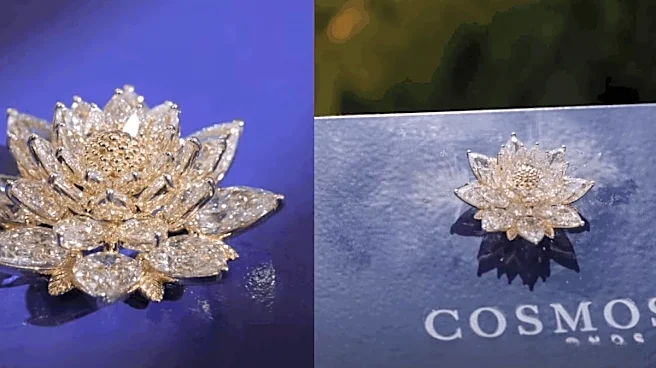
Named Cosmic Bloom, the artistic creation is set to travel aboard Skyroot Aerospace’s Vikram-1, India’s first privately developed orbital rocket. More than just a piece of jewellery, the lotus represents a unique blend of Indian craftsmanship, technology and culture, making it one of the most unusual payloads ever launched from the country.
The Diamond Lotus is a meticulously designed lotus made using lab-grown diamonds. The lotus, meticulously designed with 32 lab-grown pear-cut diamonds totalling
16.95 carats and mounted on an 18-carat gold structure fixed to an aluminium plate, carries deep cultural symbolism. For centuries, the lotus has represented purity, creation, and enlightenment in Indian philosophy and mythology.
Its journey to space is expected to make it the world’s first diamond artefact to travel beyond Earth, marking a milestone not only for India’s growing private space industry but also for Indian design.
The story begins with founder Sanjana T’s own search for ethical wedding jewellery in 2020. Frustrated by opaque pricing and concerns over mined diamonds, she founded Cosmos Diamonds — one of India’s early lab-grown diamond brands. These diamonds, often called “test-tube babies” of the gem world, are chemically and physically identical to natural ones but created through advanced technology. The Cosmic Bloom project reflects Sanjana’s vision of merging beauty, ethics, and innovation. Valued at around ₹10 lakh, the piece celebrates transparency, sustainability, and Indian craftsmanship.
Why is A Diamond Being Sent Into Space?
Beyond its aesthetic appeal, the diamond lotus serves a scientific purpose. Lab-grown diamonds excel in hardness, thermal conductivity, and radiation resistance — properties critical for space applications. The mission will test how this advanced material performs under extreme conditions: intense vibration during launch, thermal cycling, high radiation, and vacuum. Data gathered could inform future use of diamonds in quantum sensors, radiation detectors, and high-performance electronics for spacecraft.
The payload also includes a remarkable micro-art piece — an 18-carat gold miniature rocket featuring microscopic sculptures of icons like C.V. Raman, Vikram Sarabhai, and A.P.J. Abdul Kalam.
What Makes Skyroot’s Vikram-1 Rocket so Significant?
The Diamond Lotus is flying aboard Vikram-1, developed by Hyderabad-based Skyroot Aerospace (founded by ex-ISRO scientists), marks a new chapter in India’s private space sector. Named after Vikram Sarabhai, this four-stage orbital vehicle aims to make satellite launches more accessible and cost-effective. Its maiden mission, ‘Aagaman’, symbolises the arrival of private enterprise in orbital spaceflight.
The rocket is capable of placing small satellites into low-Earth orbit and serves as a major step towards expanding India’s commercial launch capabilities. Its successful mission also positions India among the few nations to achieve orbital launch capability through private enterprise.


/images/ppid_59c68470-image-178461502334249182.webp)

/images/ppid_59c68470-image-17845475958965399.webp)




/images/ppid_59c68470-image-178454753094396265.webp)
/images/ppid_a911dc6a-image-178444702888824360.webp)
