

/images/ppid_a911dc6a-image-177514743677552660.webp)
/images/ppid_a911dc6a-image-177519424853845840.webp)
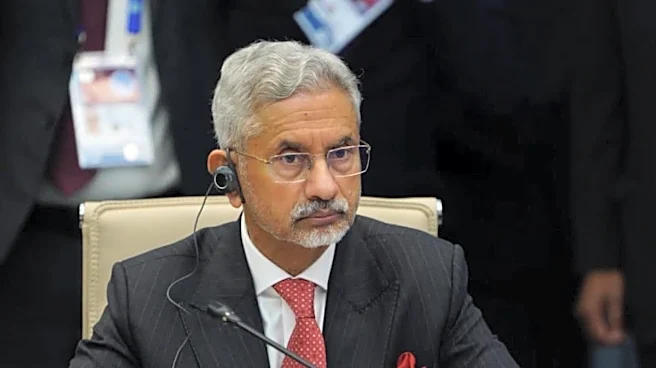
External Affairs Minister Dr S Jaishankar on Sunday shared that he received a call from Iranian Foreign Minister Abbas Araghchi to discuss the ongoing conflict in West Asia. In a series of posts on X, Jaishankar said that he also spoke with Qatari Prime Minister, Sheikh Mohammed bin Abdulrahman bin Jassim Al Thani and Foreign Minister of the United Arab Emirates, Sheikh Abdullah bin Zayed Al Nahyan regarding the tensions in Middle East.
This is the sixth time EAM Jaishankar, Iran foreign minister Araghchi have spoken since the onset of war in Iran. Before today’s call, EAM spoke to Araghchi on March 21.
EAM tagged Iran’s FM on X and shared the development. “Received a call from Foreign Minister @araghchi of Iran. Discussed the present situation,”
his post reads.
Received a call from Foreign Minister @araghchi of Iran. Discussed the present situation.
— Dr. S. Jaishankar (@DrSJaishankar) April 5, 2026
“Had a telecon on the ongoing conflict with PM & FM @MBA_AlThani_ of Qatar this evening,” another post by EAM stated.
“Discussed the evolving situation in West Asia with DPM & FM @ABZayed of UAE.”
The telephonic conversation comes after US President caused quite a stir through his warning to Iran over opening of Strait Of Hormuz.
The Strait of Hormuz, a narrow but vital shipping lane between the Persian Gulf and the Gulf of Oman, handles roughly 20 per cent of the world’s oil and Liquefied Natural Gas (LNG) supplies. Following Iran’s move to restrict traffic, global oil and gas prices have surged, reflecting fears of prolonged disruption in one of the world’s most critical energy corridors.
West Asia remains a major source of India’s energy procurement, making stability in the region and uninterrupted access through the Strait of Hormuz crucial for the country’s energy security. The situation has fueled growing international concern, with several leading powers calling for the full reopening of the waterway to ensure the smooth flow of commercial shipping.
Amid the heightened tensions, Iran has allowed ships belonging to its friendly countries, including India, to continue transiting through the Strait. This selective access underscores Tehran’s attempt to balance its strategic posturing with the need to maintain ties with key partners, even as the broader standoff over the waterway continues.

/images/ppid_a911dc6a-image-177542043321115967.webp)


/images/ppid_a911dc6a-image-177536842543726024.webp)

/images/ppid_a911dc6a-image-177531122953844085.webp)
/images/ppid_a911dc6a-image-177523062468193791.webp)