
/images/ppid_a911dc6a-image-177079002610010543.webp)
/images/ppid_a911dc6a-image-177079002842398954.webp)
/images/ppid_59c68470-image-177079002661354065.webp)
South Korea is still processing the political upheaval that followed its December 2024 martial law standoff, an unprecedented moment that saw ousted President Yoon Suk Yeol attempt a last-ditch power grab and triggered a wave of impeachments. The episode exposed simmering polarisation but also revealed the strength of citizen mobilisation and the resilience of the country’s democratic institutions.
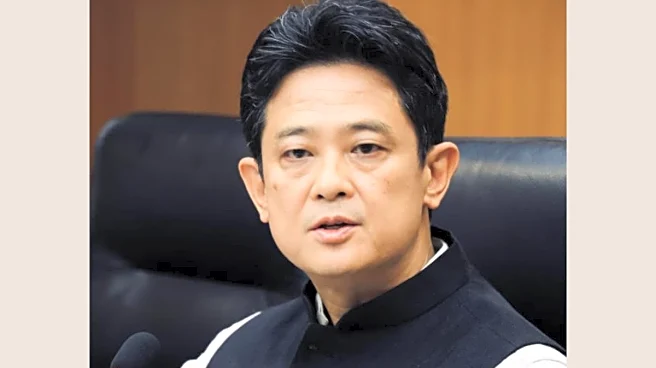
During an exclusive conversation with CNN-News18, South Korean Deputy Ambassador Sang-Woo Lim unpacked how bipartisan consensus on ties with India remains rock solid in Seoul despite the turbulence. He spoke about the next big openings in trade, technology, and security, the ripple effects of US President Donald Trump’s tariff regime on Asian supply
chains, and Seoul’s swift condemnation of the Delhi terror attack.
He also reflected on his time in India, including his unusual stint as a weekend museum guide, and the moments he will carry home.
Lim further broke from the usual diplomatic reticence to weigh in on sensitive domestic issues, reflecting on the state of South Korea’s democracy, the “citizen-led salvation” that rolled back martial law, and how he plans to shape Seoul’s global messaging once he takes over as Deputy Minister for Public Diplomacy.
Here are edited excerpts from the interview:
Q: It’s been a year since Seoul’s December 2024 martial law crisis, triggered by ousted President Yoon Suk Yeol, which resulted in a wave of impeachments. Since that upheaval exposed sharp political polarisation, do you foresee any challenges to continuity in South Korea–India foreign policy under the new Lee Jae Myung administration?
Sang-Woo Lim: There is a strong bipartisan consensus in Korea on the need to deepen our relationship with India. The new Lee Jae Myung administration has already shown a clear commitment to strengthening this partnership. Within two weeks of taking office, President Lee met Prime Minister Narendra Modi on June 17, on the sidelines of the G7 summit, in Canada. Shortly after, a presidential envoy visited India and met the Prime Minister again. This was followed by a visit from our new Foreign Minister, Cho Hyun, who previously served as Ambassador to India. And just last month, President Lee and Prime Minister Modi held another meeting during the G20 summit in South Africa.
Q: As someone who will soon return to Seoul to become Deputy Minister for Public Diplomacy, how do you plan to shape South Korea’s diplomatic messaging domestically and internationally, given recent turbulence?
Sang-Woo Lim: Korea has long served as a model for developing nations aiming to become advanced economies. By navigating recent political turbulence with stability, we have also demonstrated the strength and resilience of our democratic system. As I return to Seoul as Deputy Minister for Public Diplomacy, my priority will be to engage widely with partners across the world and reaffirm that Korea is fully back on the global stage. We are ready to share the lessons we’ve learned not only in economic development but also in building durable democratic institutions. We also stand prepared to contribute to addressing regional and global challenges, working closely with friends like India. At the heart of my public diplomacy efforts will be people-focused engagement, because citizens are the foundation of any lasting relationship between nations.
Q: While Seoul looks to widen its global partnerships, what concrete areas — trade, technology, culture, security — do you see as most ripe for expansion in India–South Korea ties under the current global environment?
Sang-Woo Lim: Economic cooperation has been the main engine of Korea–India relations. Our bilateral trade has more than doubled in the past decade, reaching $26 billion last year, and more than 670 Korean companies now operate in India. Major firms like Hyundai, LG, and Samsung have become household names. Given the current geopolitical and geoeconomic shifts, this is the right moment for our two countries to usher in the next wave of Korean investment in strategic sectors such as shipbuilding, semiconductors, and the defence industry.
I’m encouraged by the momentum already building in these areas. Leading Korean shipbuilders like HD Hyundai and Samsung Heavy Industries are deepening cooperation with Indian partners and exploring new projects in key states, including Tamil Nadu.
In semiconductors, Korean companies are beginning to invest more actively in India — notably, APACT is establishing a high-tech semiconductor assembly and testing facility in Andhra Pradesh, strengthening India’s growing semiconductor ecosystem.
In defence, Korea and India have concluded an agreement this year to produce the second batch of K9-Vajra self-propelled howitzers in India, marking another step forward in our strategic industrial partnership.
Q: How do you assess the impact of President Trump’s new tariff regime on Asian supply chains, and do you see any potential spillover effects — positive or negative — on Korea’s economic engagement with India?
Sang-Woo Lim: President Trump’s new tariff regime has had far-reaching effects on trading nations across the world. In its wake, we are seeing renewed interest in deeper economic cooperation among like-minded partners. In that sense, the current environment also offers Korea and India an opportunity to elevate our economic partnership. One option is to expedite the ongoing discussions on upgrading the Korea–India CEPA. At the same time, tariffs on Chinese goods are likely to push more Korean companies to relocate operations to India in order to strengthen supply-chain resilience. Most importantly, given the complementary strengths of our two economies, Korea and India can expand cooperation in emerging technologies to adapt to the rapidly changing global trade landscape.
Q: South Korea publicly condemned the Delhi blast terror attack. How do you think Seoul’s solidarity influences bilateral trust and future security cooperation between the two countries going forward?
Sang-Woo Lim: Korea condemns all acts of terrorism in the strongest terms. This has long been our consistent position, and we stand firmly in solidarity with India. Our shared stance has strengthened trust between our two countries and is already shaping deeper cooperation in security areas, including the increasingly important field of cyber security.
Q: How would you assess the state of South Korea’s democratic institutions today?
Sang-Woo Lim: Korea remains a vibrant democracy, grounded in strong and resilient institutions. Those very institutions were central to navigating last year’s martial law crisis. They fulfilled their constitutional duties with clarity and discipline, ultimately safeguarding our democratic system. The events of last year showed that our democratic order is firmly embedded in society and that our institutions are fully capable of withstanding challenges, even when they originate at the highest levels of government.
Q: Many describe the overturning of martial law as a “citizen-led salvation” of democracy. Does the current government view it as a turning point or simply a pause in deeper structural tensions?
Sang-Woo Lim: Democracy in Korea was neither imported nor something that emerged automatically after independence. It was built through the sacrifices of hundreds of ordinary citizens and the sustained courage of hundreds of thousands who took to the streets for decades to challenge authoritarian rule. That long struggle is why our democracy is regarded as almost sacrosanct in the Korean consciousness. So when news of an unjustified martial law broke, thousands of citizens immediately mobilised and rushed to the National Assembly to ensure that the vote to annul it could proceed safely.
The current government, just like the public, has full confidence in the power of citizens to uphold our democracy. At the same time, the crisis has sparked a broader conversation about potential constitutional reforms, particularly how to reduce the concentration of power in the presidency so that we can prevent similar political emergencies in the future.
Q: Speaking of your time in India, you’ve taken an unusually cultural route: volunteering as a tour guide at the National Museum on weekends. How much of that came from personal interest, and how much from a broader cultural-diplomacy approach to strengthening India-South Korea ties?
Sang-Woo Lim: I attended a guided tour at the National Museum earlier this year and found the exploration of India’s history and culture genuinely captivating. That experience inspired me to train as a guide myself, both to deepen my own understanding and to volunteer for Indian visitors as well as for the Korean community in New Delhi. The National Museum was very kind in accommodating my rather unusual request. After completing rigorous training and spending additional time studying Indian history and literature at home, I began volunteering as a guide from August this year. It has been one of the most meaningful forms of cultural engagement I’ve experienced during my time in India.
Q: Through your museum tours, you draw parallels between Korean and Indian mythology — for example, linking Korean “Dokkaebi” with Indian “Kirtimukha.” How are they similar, and do you think such shared cultural narratives can influence bilateral relations beyond soft power symbolism?
Sang-Woo Lim: In my tours, I try to highlight the deep historical and cultural connections between Korea and India. At the start of the National Museum tour, there’s a lintel featuring the “Kirtimukha”, a fierce protective face believed to ward off evil. You can see the “Kirtimukha” at the entrance of temples and even in many homes. Korea has a remarkably similar motif called the “Dokkaebi”, which appears on traditional roof tiles as a guardian figure meant to protect the household from misfortune.
These shared cultural symbols remind us that Korea and India are much closer than we often assume, and that our connections run deeper than we realise. They provide a strong foundation on which we can continue building our relationship in the years ahead.
Q: Finally, as you wrap up your term, what are the most memorable moments of your stay in India — and any regrets?
Sang-Woo Lim: There are so many memorable moments I will carry back with me to Korea, but if I had to choose just one, it would be the friendships I’ve been fortunate to build here. India welcomed me not only as a diplomat but as a friend, and that is something I will always cherish. In the end, it is the people who matter most, and I feel truly blessed to have spent my time in India surrounded by such wonderful friends.
One regret is that my volunteer work as a tour guide at the National Museum had to end sooner than I hoped. Guiding tours there became a very personal and meaningful journey for me. I sincerely hope that one day I’ll return to New Delhi, perhaps even to lead another tour through the galleries that I’ve come to love so deeply.

/images/ppid_59c68470-image-177079254546880916.webp)

/images/ppid_59c68470-image-177079253454926240.webp)



/images/ppid_59c68470-image-177079012148080585.webp)
/images/ppid_59c68470-image-177079009037957749.webp)
/images/ppid_59c68470-image-177079006320740736.webp)
/images/ppid_a911dc6a-image-177079006379879775.webp)
