
Power dressing has long meant ownership, custom tailoring and hefty price tags. This is usually associated with clothes that signal authority because they cost a small fortune. But that old equation is now
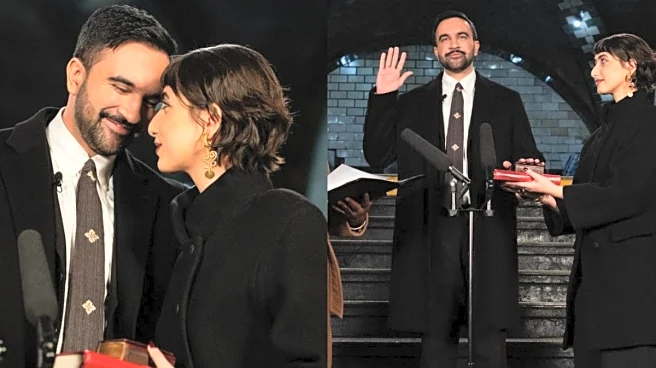
being disrupted, and Rama Duwaji, New York’s Gen Z First Lady, is at the centre of it. On January 1, 2026, as Zohran Mamdani was sworn in as the city’s first South Asian and Muslim mayor, fashion watchers weren’t counting labels. They were reading credits. And one phrase stood out – “On loan.”
Power Dressing, Without Ownership
For the midnight swearing-in ceremony held inside an old subway station, Duwaji skipped the predictable route. She wore a vintage wool Balenciaga coat rented from the Albright Fashion Library, paired with borrowed shorts from The Frankie Shop and vintage earrings. The look was restrained, deliberate and unmistakably political.
Scrutiny followed. Online chatter questioned her Miista Shelley boots, priced at $630. That conversation cooled once it became clear those were borrowed, too. The message had already landed.
Her stylist, Gabriella Karefa-Johnson, later explained the thinking on her Substack. “Thrifting is something Rama does often; so, renting second-life fashion felt like the most authentic way to approach a moment of this magnitude,” she wrote in her newsletter.
View this post on Instagram
Dodging The Fashion Backlash Playbook
Duwaji’s approach didn’t happen in a vacuum. Public women, especially in politics, know the pattern. Alexandria Ocasio-Cortez was criticised for wearing a designer outfit on a magazine cover. Michelle Obama was constantly judged for mixing high and low brands. Melania Trump still has her wardrobe dissected years later.
By being transparent about borrowing, Duwaji cut off that line of attack early.
Using Fashion To Amplify Voices
Both the mayor and the First Lady used clothing to signal values. Mamdani wore a gold-embroidered tie custom-made from Assam’s eri silk by Kartik Research. For the public ceremony, Duwaji chose a brown coat by Renaissance Renaissance, founded by Lebanese designer Cynthia Merhej.
View this post on Instagram
Fashion As Signal, Not Decoration
In late December, Duwaji had appeared on a digital cover of New York Magazine, shot by Szilveszter Makó. The images were stylised and playful, far from the soft-focus portraits typically expected of political spouses. “I love fashion, and I love being creative and putting things together and styling things,” she said, making her intentions clear.
Transparency Before Criticism
The fashion credits for the shoot prominently noted that the clothes were “on loan.” While standard in magazines, the emphasis felt intentional, especially as prices were left out. It helped head off criticism over luxury pieces, including a Jacquemus jacket, before it could gain traction.
A Deliberate Stylist Switch
Duwaji also changed stylists for the inauguration, moving from Bailey Moon to Gabriella Karefa-Johnson. Known for her outspoken views on fashion and politics, Karefa-Johnson brings both industry access and critique. A Mamdani spokesperson said her appeal lies in “moral clarity” and a belief that clothing carries values, history and culture.
/images/ppid_59c68470-image-177087024475928062.webp)




/images/ppid_a911dc6a-image-177070603750921141.webp)

/images/ppid_a911dc6a-image-17708075279507195.webp)
/images/ppid_a911dc6a-image-177070882633398788.webp)
/images/ppid_a911dc6a-image-17706885616409661.webp)
/images/ppid_59c68470-image-177072754680482508.webp)
/images/ppid_59c68470-image-177078253208686535.webp)