
/images/ppid_59c68470-image-178819269510228957.webp)
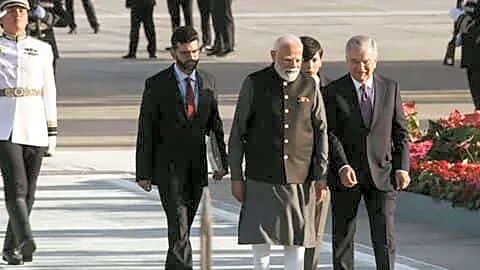
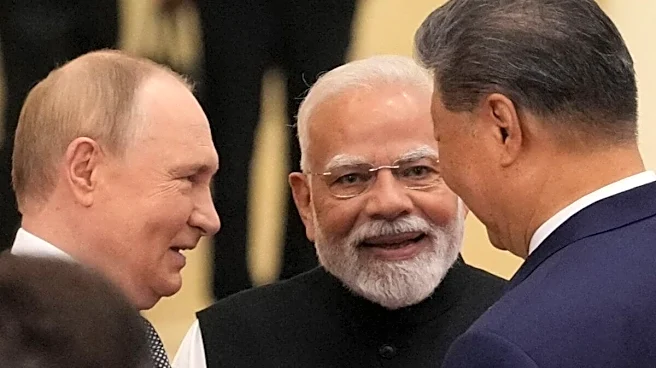
Prime Minister Narendra Modi touched down in Bishkek, Kyrgyzstan on Tuesday, joining Chinese Premier Xi Jinping and Russian President Vladimir Putin at the Shanghai Cooperation Organisation (SCO), bringing to the spotlight a 100-year-old conversation, i.e. The Mackinder-Spykman Tension – an argument between the west, and the rest.
The argument, or rather the tension, still decides a lot of geopolitics in 2026. The war between Iran and the US-Israel coalition has kept both the Strait of Hormuz and the Red Sea’s Bab el-Mandeb Strait under threat for months, disrupting the same sea lanes that Spykman placed at the centre of his Rimland. At the same time, China’s push to lock in overland routes through Central Asia, India’s push for Chabahar, and Russia’s
war in Ukraine, all test Mackinder’s claim that command of the interior can outlast command of the coast.
The reason the theory is worth revisiting today rather than being filed away as a historical footnote is because it gives one a frame for today’s events as they occur. It also explains why India must hedge its bets between two camps rather than choosing one. A century after Mackinder first put his case to the Royal Geographical Society, the question he posed is yet to be settled.
In essence, those who command the ‘Heartland’, i.e. the Eurasian plate consisting of West Asia, the Central Asian Republics, The Indian Subcontinent, China, and Russia – will be the commanders of the world.
The question, dear reader, is whether it is the middle of Eurasia that decides who runs the planet, or is it those on the edges?
Who Are Mackinder & Spykman, And What Did They Say?
In 1904, the British geographer Halford Mackinder told the Royal Geographical Society that whoever controlled the “Heartland”, i.e. the vast interior stretching from the Volga to the Yangtze, would eventually command the “World-Island” of Europe, Asia and Africa, and through it, the world.
About 40 years later, in 1944, the American strategist Nicholas Spykman disagreed. What mattered, he argued, was not the interior but the “Rimland” – the crowded, resource-rich coastal arch running from Europe through the Middle East, South Asia and East Asia. Control that ring, he wrote, and the interior becomes irrelevant.
Washington chose to build its Cold War containment strategy using Spykman’s map rather than Mackinder’s, with NATO in the west, and CENTO and SEATO through the middle and the east.
Mackinder’s Heartland Theory Proved
Bishkek proved Mackinder’s argument, with real ports and pipelines in the SCO’s portfolio instead of parchment maps. China has spent its recent years binding Central Asia more tightly to Beijing. At a summit in Xi’an last year, Xi Jinping declared 2025 and 2026 the “Years of High-Quality Development” for Chinese-Central Asia cooperation, where the six governments have already agreed that China will host a third such summit in 2027.
The SCO itself, spanning China, Russia, India, Pakistan, Iran and the Central Asian republics, now accounts for roughly 36% of global trade and 42% of the world’s population, according to the geopolitical outlet Russia’s Pivot to Asia. On paper, this is the Heartland, organised.
The trouble, however, is that the Heartland has never had a coastline, and that is where the theory is mildly impeded. India has spent a decade trying to fix that for itself, signing a 10-year contract in May 2024 to run the Shahid Beheshti terminal at Iran’s Chabahar port, meant to open a route to Afghanistan and Central Asia that completely bypasses Pakistan, but not all has gone as per the plan.
The Union Budget of 2026, presented in February, allocated nothing for Chabahar for the first time in nearly a decade, and by August, there was a slight panic after a US sanctions waiver protecting the port lapsed in April, and India wanted to hand over the project to an Iranian-owned firm. While there may be those who call this tactical recalibration, simply put, it’s the Rimland leverage, exercised through the sanctions power of Washington, stopping a Heartland gambit in its tracks.
Iran is Not a Bridge; It is the Argument
Since 28 February 2026, when the American and Israeli strikes killed Iran’s supreme leader and opened a war that has yet to subside, the fighting has concentrated on the Strait of Hormuz, the channel through which roughly a quarter of the world’s seaborne oil and a fifth of its liquefied natural gas normally passes.
On 1 September, hours before the summit’s main session in Bishkek, the US energy secretary said that a record 17 million barrels of oil had crossed the strait the previous day, even as the IRGC continued their threats. The American Central Command denied Iranian claims that a tanker had struck mines there that same week, saying, “No ships have hit mines in the Strait of Hormuz,” hours before two tankers were hit anyway by unclaimed projectiles.
India’s answer to the old binary is not to choose any one side of the map. India, since independence, has stuck by the cord of Non-Alignment, and it’s the same now.
New Delhi sits inside the SCO, which is also the closest thing the Heartland camp has to a members’ club, whilst also anchoring the Quad alongside the United States, Japan and Australia, the clearest Rimland structure since NATO.
At the Quad’s foreign ministers’ meeting in New Delhi in May, the four governments reaffirmed a “free and open Indo-Pacific” and launched a joint maritime surveillance initiative focused on the Indian Ocean, even as External Affairs Minister Dr. S. Jaishankar was, in parallel, working to stabilise ties with Beijing after the eastern Ladakh troop standoff dating back to 2020.
Simply put, it’s a dual ‘dual’ policy, or multi-track diplomacy, as others call it.
China is doing the same trick from the other direction. When Beijing hosted the Pakistani Prime Minister Shehbaz Sharif on 25 May, the two governments announced a “new broad consensus” on upgrading the China-Pakistan Economic Corridor (CPEC), including the Karakoram Highway and the Khunjerab Pass that would link Karachi’s Gwadar port back to China’s Xinjiang region.
Officially, while this is just a corridor, Spykman might have called it a Heartland power buying its way onto the Rimland, i.e. a warm-water door that never has to pass through the Strait of Malacca.
/images/ppid_59c68470-image-178840002528683464.webp)


/images/ppid_59c68470-image-17883151707981114.webp)



/images/ppid_59c68470-image-178828003003598200.webp)