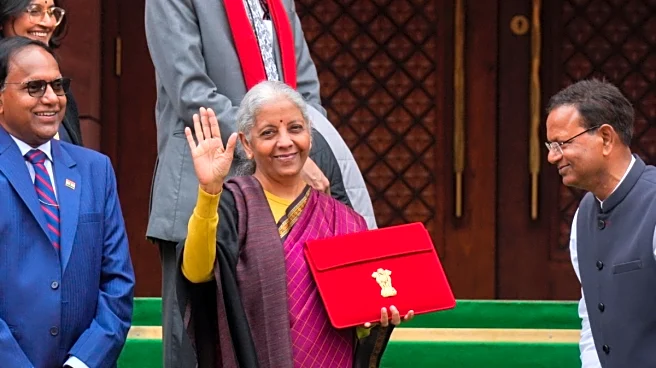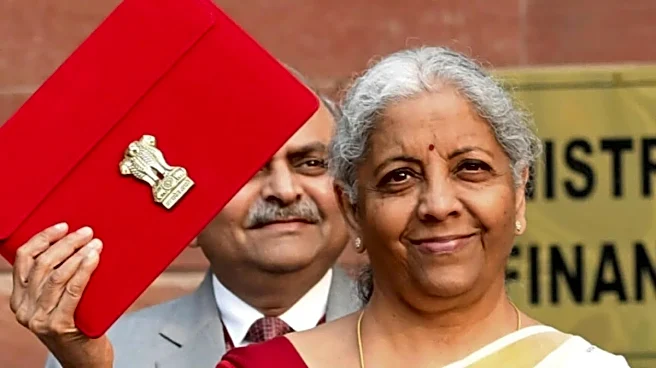



India’s Union Budget 2026-27, presented by Finance Minister Nirmala Sitharaman on Sunday, is not merely a fiscal document. It reads like a strategic blueprint shaped by a world in flux.
From critical minerals and nuclear energy to semiconductors, maritime logistics, defence modernisation and the digital infrastructure powering artificial intelligence, this year’s Budget is anchored in geopolitical realities that have redrawn supply chains and sharpened global competition.
At the heart of the exercise lies the government’s argument that atma nirbharta (self-reliance) is no longer a developmental slogan but the centrepiece of India’s long-term security and growth trajectory. The measures unveiled across six crucial sectors reveal a Budget designed
to de-risk India from global chokepoints while positioning the country as a credible alternative to existing power centres.
Rare Earth Corridors Signal India’s Intent To Break A Strategic Dependency
The rare earth announcement represents one of the most consequential shifts in India’s economic and geopolitical thinking. FM Sitharaman proposed dedicated rare earth corridors across Tamil Nadu, Kerala, Andhra Pradesh and Odisha, an intervention that acknowledges how central these minerals are to future technologies and strategic autonomy.
Rare earth elements underpin electric mobility, renewable energy, semiconductors, precision-guided defence systems and satellite infrastructure. Yet the global supply chain is skewed, with China continuing to dominate processing and refining. India holds substantial monazite-rich beach sand deposits, particularly along the southern coastline, but has long remained import-dependent due to limited refining capacity and heavily centralised regulatory structures.
The proposed corridors are intended to correct this imbalance by clustering mining, processing, refining and downstream manufacturing in states with established deposits and industrial ecosystems. By moving domestic industry up the value chain, from shipping out raw minerals to manufacturing high-value components, the government is signalling its ambition to shift India from being a peripheral player to a strategic producer.
The timing is deliberate. As global supply chains undergo “friend-shoring” and countries reduce dependency on single-country sources, India aims to present itself both as a secure partner and as a nation reclaiming control over critical minerals essential to 21st-century technologies.
Nuclear Duty Exemptions Align With A Larger Policy Reset
In another move with long-term geopolitical implications, the Budget proposes extending basic customs duty exemptions on imports required for nuclear power projects until 2035. The exemption now applies across all nuclear plants, irrespective of capacity, lowering the cost of equipment and specialised machinery that India continues to source from abroad.
The announcement comes alongside a parallel policy shift: the government’s ongoing attempt to create a regulatory framework that would allow private companies to participate in nuclear power development for the first time. The Atomic Energy Act of 1962 had placed civil nuclear operations firmly under state control, but the proposed Atomic Energy Bill, 2025—referred to as the SHANTI Bill—seeks to allow private participation under safety and liability safeguards.
Lower input costs, coupled with the potential opening of the sector, create a significantly different landscape for domestic heavy-engineering firms such as L&T, MEIL and BHEL. The long-term duty relief also offers predictability to global reactor manufacturers and SMR developers who require clarity before committing capital.
As India aims to expand nuclear capacity from its current 8,780 MW to 22 GW by 2032 and 100 GW by 2047, the cost and financing structure becomes critical.
Semiconductor Mission 2.0 Positions India In The Global Tech Race
FM Sitharaman used the Budget to unveil the India Semiconductor Mission (ISM) 2.0 with an expanded outlay of Rs 40,000 crore. The new phase focuses on producing equipment and materials, developing full-stack Indian IP, and strengthening supply chains, critical steps for a country seeking to embed itself more meaningfully into the semiconductor value chain.
The announcement builds on ISM 1.0 and on the success of the Electronics Components Manufacturing Scheme launched in April 2025. With investment commitments already double the original targets, the government’s decision to scale up funding reflects both market appetite and a recognition that chip manufacturing is no longer an industrial policy issue but a strategic requirement.
The government is linking talent creation directly to its semiconductor and AI strategy. MeitY’s plan to expand AI training to 500 universities, along with semiconductor-linked chip-design programmes already active in 315 institutions, aims to create a nationwide deep-tech workforce. Union Minister Ashwini Vaishnaw highlighted that industry-led curriculum design is underway, mirroring global practices where semiconductor readiness is treated as a national priority.
Container Manufacturing And Maritime Infrastructure Get A Strategic Push
The Budget proposed a Rs 10,000 crore scheme over five years to create a globally competitive container manufacturing ecosystem.
FM Sitharaman paired this with a broader logistics and waterways strategy. A scheme to enhance construction and infrastructure equipment manufacturing will support high-value, technologically advanced domestic production. The announcement of a new Dedicated Freight Corridor from Dankuni to Surat complements the effort to streamline East-West cargo movement.
Simultaneously, the government plans to operationalise 20 new National Waterways over the next five years, starting with NW-5 in Odisha, linking key mineral belts and industrial centres to major ports. Ship-repair ecosystems in Varanasi and Patna, skill centres along inland waterways, and a Coastal Cargo Promotion Scheme to double the share of inland and coastal shipping by 2047 all point to a logistics regime designed for strategic resilience.
The proposal to indigenise seaplane manufacturing, supported by a Seaplane VGF Scheme, is aimed at improving last-mile connectivity and boosting tourism in remote or hard-to-reach areas.
Defence Spending Rises As India Expands Its Modernisation Plans
India’s defence outlay for 2026–27 has been increased to Rs 7.8 lakh crore, marking a 15 per cent rise over the previous year (Rs 6,81,210 crore). A significant portion of this push comes from higher capital expenditure, with the allocation for modernisation growing by 21.84 per cent to Rs 2.19 lakh crore.
The Ministry of Defence has several major procurements in the pipeline, including contracts for Rafale fighter jets, submarines and unmanned aerial vehicles, and the higher capital outlay reflects the scale of upcoming projects.
Defence Services revenue expenditure has also risen, while the allocation for defence pensions now stands at Rs 1.71 lakh crore. By contrast, the defence (civil) budget has seen a marginal reduction of 0.45 per cent from last year, even as the overall defence allocation continues to grow.
The Budget further proposes exempting basic customs duty on raw materials used to manufacture aircraft parts intended for maintenance, repair or overhaul in the defence sector.
Other tariff-related announcements were also made, including a reduction in duty on all dutiable goods imported for personal use—from 20 per cent to 10 per cent—in response to US tariffs. The government additionally increased the limit for duty-free imports of specified inputs used in seafood processing for export, raising it from one per cent to three per cent of the previous year’s export turnover.
The Finance Minister also proposed a basic customs duty exemption on capital goods used for manufacturing lithium-ion cells and critical minerals, expanding the range of inputs eligible for import relief.
A Tax Holiday Till 2047
FM Sitharaman announced a tax holiday until 2047 for foreign firms providing cloud services globally through data centres located in India. The condition: such firms must serve Indian customers through an Indian reseller entity.
This long-term incentive could significantly deepen the presence of companies like Google, Amazon and Microsoft. It also aligns with India’s ambition to anchor global compute capacity within its borders. Google has already committed $15 billion to build an AI-focused data centre in Visakhapatnam, beginning with a massive one-gigawatt capacity.
By pulling cloud infrastructure closer to domestic users, the government hopes to ensure that India’s own demand for AI-driven services can be met without relying excessively on offshore compute power. The safe harbour for non-resident firms using bonded warehouses for electronic components, with profits capped at 2 per cent of invoice value, further sweetens the incentives for global firms to treat India as an operations node rather than merely a market.






/images/ppid_59c68470-image-176994756091679136.webp)

/images/ppid_59c68470-image-176994753075255179.webp)
/images/ppid_59c68470-image-17699475334664564.webp)
/images/ppid_59c68470-image-176994753180668063.webp)