


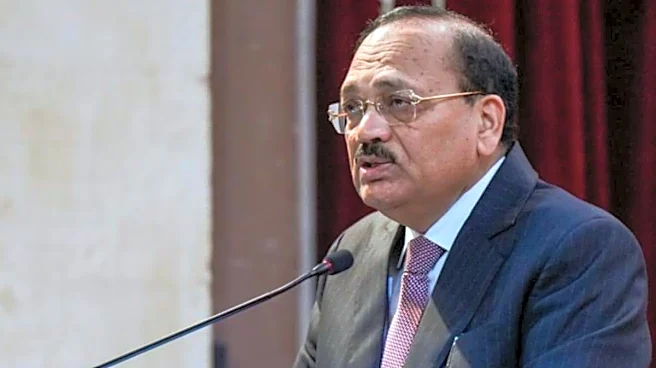

Hyderabad, Apr 14 (PTI) Former CJI B R Gavai on Tuesday said that sustainable development must be seen as a constitutional vision that ensures that development does not deepen existing hierarchies, but instead works to dismantle them.
If development results in the displacement of marginalized communities, if it intensifies existing inequalities, or if it places disproportionate environmental burdens on those who are already vulnerable, then can it be said to be sustainable, he asked.
“When we think of sustainable development, we must ask more fundamental questions–development for whom, and at what cost,” he said, delivering a lecture on “Sustainable Development and Substantive Equality: A Constitutional Dialogue” at the NALSAR University of Law
here.
“Our approach to development, therefore, must be forward-looking in a deeper sense. It is not enough to ensure that future generations have access to resources. We must also ensure that they inherit a more equal social order. Development must correct, and not carry forward, historical disadvantage,” the former Chief Justice of India said.
This requires rethinking the very design of policies and institutions.
Climate adaptation, disaster response, urban planning, access to clean energy–each of these must be informed by a commitment to substantive equality, he said.
The question cannot simply be whether a policy is efficient or economically viable. It must also be whether it reduces vulnerability and whether it reaches those most at risk, he said.
A one-size-fits-all approach often ends up reinforcing existing hierarchies because it ignores the unequal starting points of different communities, he said.
Substantive equality demands that workers should not been seen as peripheral to the city, but as central to it, he said.
It calls upon citizens to recognize that access to clean surroundings, green spaces, sanitation, and housing is not a privilege tied to income, but a matter of dignity, Justice Gavai added.
Substantive equality requires us to move beyond identical treatment and to recognize that those who have been historically disadvantaged require different, and often stronger, measures to ensure inclusion, he stressed.
“When we talk about substantive equality, one central consideration is that we must look closely at the disadvantages that marginalized communities face, and then think of concrete measures to remove and address those disadvantages,” he said.
He said a model of development that leaves large sections of society behind is not sustainable at all. “It is, as Ambedkar warned us, a continuation of the very contradictions that place our democracy in peril,” he added.
Justice Gavai, who has been made Dr B R Ambedkar Chair Professor on Constitutional Law and Social Inclusion by NALSAR, said it is a privilege of the highest order to hold a Chair Professorship in the name of Ambedkar. PTI VVK SJR VVK SA




/images/ppid_a911dc6a-image-17761870250296848.webp)



/images/ppid_a911dc6a-image-177612962951920468.webp)