

The year was 1893. Swami Vivekananda, a great Bengali, had given a famous lecture in the World Parliament of Religions at Chicago in the United States of America.
Many revolutionary groups like The Jugantar and The Anushilan Samiti were formed. Newspapers like The Yuganthar, Vande Mataram (started in 1889), and Amrit Bazar Patrika of 1891 had sown the ideas of revolution in the youth, which the British tried to muzzle through the Press Acts of 1908 and 1910 like they did with the Rowlatt Act.
The spread of the ideas of revolution was curbed by the Dramatic Performance Act in 1876. Bankim Chandra Chattopadhyaya’s Anand Math (‘Vande Mataram’) was very inspirational. In 1905, Bengal was partitioned by Lord Curzon. Rabindranath Tagore wrote patriotic
songs. Meanwhile, there was the impact of World War I and the Rowlatt Act of 1917.
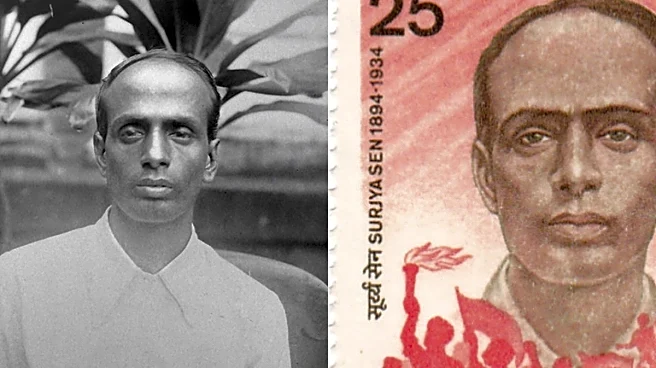
Surjyo Sen, also widely known as Surya Sen or Surjya Sen, was born on the March 22 in 1894 at Noapara in Chattogram (‘Chittagong’ as called by the British) in Bharat, which was ruled by the British imperialists at that time. After India-Pakistan partition and Independence, Chittagong became part of East Pakistan (Post 1971, now Bangladesh). His father was Ramniranjan Sen, a School Teacher. His father died young and he was raised by his kind uncle. Surjyo da had many siblings. He completed his primary education at Dayamayi Primary School in Noapara. Surjyo Sen was enrolled in Harsh Chandra Dutt’s National High School in Chattogram’s Nandankanan. In 1913, Surya Sen passed his Matriculation Exam in 1st division.
Later, he went to study at Chittagong College, where he first pursued his Intermediary and which he completed successfully. However, due to a certain misfortune, he could not complete his BA degree at Chittagong College. He continued his BA at Krishnath College in Behrampore (now a town in Murshidabad in free India’s West Bengal). He came back to Chittagong and became a Maths teacher at a high school in Nandankanan, Chittagong. He was an excellent Teacher. He became famous as ‘Masterda’. ‘Master’ means ‘Teacher’. ‘Da’ is a term of respect for elders or seniors in Bengali language.
He married Pushpa Kuntla but did not involve in family life. His mind was set on obtaining freedom for India from the British.
Surya Sen was a good organiser and strategist. He was both soft-spoken and sincere. He had both charm and charisma. Surya Sen, like Bhagat Singh, was influenced by the revolutionaries in Europe and Russia. He soon created an army of young students.
Surjya da learnt about India’s freedom struggle from a teacher in Krishnath College. Initially, Surjyo was greatly attracted by Gandhi’s Ahimsa philosophy or the policy of non-violence. He became close to Deshbandu Chittaranjan Das. He was a part of Gandhiji’s Non-Violent Non-Cooperation movement but was later disillusioned by Gandhiji’s policies when Gandhi ji called off the Non-Cooperation Movement in 1922 because of a lone incident at Chauri-Chaura, a place in present-day Bihar. The same kind of disillusionment happened with freedom fighter, Bhagat Singh, too.
Bhagat Singh, Surjyo Sen, and some other revolutionaries fighting for independence from India began to obsess with violence as a means of revolution in order to secure independence for India after they had witnessed the failure of the ‘Ahimsa’ or Non-Violence weapon brandished by Gandhiji to obtain independence from the extremely cunning and cruel British imperialists. Surjyo Sen was disappointed with the Indian National Congress’s acceptance of Dominion Status for India as a Goal. Meanwhile, the Jallianwala Bagh massacre happened on the April 13th of 1919. The cruelty of the British disturbed Surjyo Sen and Bhagat Singh. It was then that they thought of taking up arms against the British. The British had meanwhile passed the draconian Rowlatt Act of 1919, according to which anybody could be arrested and could even be jailed without trial.
Masterda was a contemporary of Bhagat Singh – both influenced by the World Wars, Russian Revolution, Lenin, ideas of Karl Marx and Engels.
There were many who influenced Surya Sen. Jatindranath Das was around twenty-three years old when he died for Bharat Mata. Persons like Jatin Da, Deshbandu Chittaranjan Das, RB Bose were all already doing much for Bharat Mata. We must remember how on March 23, 1931, three freedom fighters – Bhagat Singh, Shivaram Rajguru, and Sukhdev Thapar were all executed by the British.
Surjyo Sen was especially influenced by the actions of the Irish Republican Army. The Irish Republican Army was established in 1919 to halt British rule in Ireland. The Irish Republican Army demanded the withdrawal of the British from Ireland. Later, the Irish Republican Army split into two factions – Officials and Provisionals. The Officials sought independence through peace while Provisionals believed in violence as a means of obtaining independence. The Provisionals felt that peaceful means were unable to secure independence for Ireland. The violence of the Provisionals of The Irish Republican Army resulted in 1800 deaths, including those of 600 civilians. There was an equally brutal retaliation by the British army, which continued for 30 years. The Irish Republican Army exploded bombs and shot/injured many. They targeted public places like pubs.
Inspired by the violent means of the Irish Republican Army to obtain independence for Ireland, Surjyo Sen joined the Anushilan Samiti, a revolutionary group of India, as a means to obtain freedom for Bharat. And later he started the IRA, aka The Indian Republican Army. He was greatly inspired by the exploits of a Teacher in Ireland, who was responsible for The Easter Uprising against the British. So, Surjyo da, too, thought that it was possible to rise like that against the British in Bharat.
Surya Sen became the General of the Chittagong branch of the IRA. All this happened in 1929. In 1929, a conference of the Chittagong Congress was held under the leadership of S.C. Bose. Surjyo Sen was made District Secretary of the Congress.
Surya Sen, Ambika Chakraborthy, Nirmal Sen, Ganesh Ghosh – all decided to form an independent government free from British rule in Chittagong.
A meeting was later arranged and the following were proposed such as:
1. A sudden takeover of the armoury.
2. Disrupting railway network.
3. Disrupting telephone network.
4. Snapping telegram lines.
5. Mass killing of Europeans.
6. Forming Interim government of revolution.
So, let’s find out as to why the Chittagong armoury raid became so famous in history. The Chittagong or Chattogram revolution happened on the April 18, 1930. Masterda, along with five friends and a small army of young boys, raided the Chittagong armoury, cut off the railway lines and other communication lines. Most of the Indian Republican Army were boys as young as twelve. They were part of Surya Sen’s army. Most were students. They took over Chittagong for a day from the British. Surjyo Sen’s IRA (Indian Republican Army) brought down the mighty British empire for a day in Chattogram. He hoisted the Indian Flag and declared an India Republic on the 18th of April of 1930.
Surjyo Sen was a man far ahead of his times with a mighty vision in his head – that of extricating Bharat from British rule. In fact, with respect to the Chittagong armoury Raid, Surjyo da was trying to replicate the Easter Day uprising that had happened in Dublin in Ireland and which had triggered the path to freedom for Ireland. Surya Sen hoped for a similar success in Bharat.
Eventually, he was right in this assertion because Bharat did acquire freedom from the British within the next few years using the combined approach of both violence and peace, multiple uprisings all over Bharat.
Let us first understand as to who were the main comrades of Masterda. Surjyo Sen’s close comrades were Ambika Chakravarthy, Ananta Lal Singh, Ganesh Ghosh, Lokenath Pal, Nirmal Sen, Kalpana Datta, and Pritilata Waddedar.
Ambika Chakraborthy was the one who maintained the network of contacts. He was also in charge of getting funds and collecting information about the police.
Ananta Singh was a renowned physical instructor, who trained young boys in shooting and fighting.
Ganesh Ghosh was the military strategist of Masterda’s group.
Lokenath Bal was the youngest of Sen’s comrades. He was tall, fair, and handsome and could easily pass off as a British citizen or officer or soldier. He was often used by the revolutionaries.
Nirmal Sen smuggled in the arms and ammunition.
Kalpana Datta was part of Surjyo Sen’s group. She was a chemistry student, who used chemical supplies from the college and taught herself how to make bombs and explosives. She was allowed to participate after the partly successful Chittagong Armoury raid. She was the first woman in the freedom movement of Chattogram and a pioneer woman.
Pritilata Waddedar was a messenger in Masterda’s group. She acted as a messenger of information between those freedom fighters in Jail/those hiding to help stay in touch with the outside world. Pritilata wanted to become a martyr and she became so after she consumed cyanide after a successful attack on a British Club, wherein many Britishers were killed.
Surjyo Sen’s recruitment of women in the Bharatiya freedom struggle was a trendsetter for the amalgamation of women in the freedom movement.
An amount of Rs 18,000 (which was a huge sum, given that it was 1930) was required for the Chattogram Armoury Raid. Small amounts were collected and contributed.
Surjyo da’s plan with respect to the Chittagong Armoury raid was thus – He was calling for the capturing of 2 British Armouries in Chittagong and distributing weapons to other revolutionaries. The plan included dismantling the telephone and telegraph systems and also to break down the railway line between the city and the rest of Bengal. Surjyo Da fixed the 18th of April of 1930 as the day to capture the Armouries. They managed to capture the Armouries. Unfortunately, they were not able to obtain the necessary machine guns and the ammunition.
18th April, 1930: The Chattogram Armoury Raid
Masterda was a master planner, organiser, and strategist. He was a well-read person. He planned to carry out simultaneous attacks in 5 places in Chattogram or Chittagong. Imagine, if there had been similar attacks carried out in different places at different times, all over Bharat. However, there are always few visionaries and brave people like Surya Sen.
The plan was to raid the Police and Army armoury of Chittagong, take the Machine Guns along with the cartridges. The plan was to sabotage the railway line (transport) and telegraph (communication) lines, attack the European Club and either kill or take the European officers as hostages.
There were different groups to attack different places in Chattogram.
The Police Armoury was located on a small hillock. Around 6 revolutionaries led by Ganesh Ghosh took over the armoury and raised slogans of Vande Mataram. Ganesh Ghosh and Anant Singh attacked the guard. The others who were involved were Dev Prasad Gupta, Himantu Sen, Haripad Mahajan, and Saroj Guha.
There was another group of 10 members headed by Lokenath Bal, who captured the Auxiliary Military Armoury. The others involved in this attack were Rajat Sen, Manoranjan Sen, Jiban Goshal, Phani Nandi, Subodh Chowdhury, and thirty others.
The Nangalkot railway line attack was carried out by Lokenath, Kalpana, and Lal Mohan. A goods train passed by in Chittagong. Lal Mohan Sen, Subodh Mitra, Sukumar Bhoumik, and Haren Dutt reached the railway station, 60 miles from Chittagong. They uprooted the rail track and cut the telegraph lines. The passing goods train derailed. The other group consisted of Upendra Kumar Banerjee, Vijay Shankar, Sarkar, and Sushil Dey.
The British Cantonment attack was carried out by Pritilata. The attack on the European Club was carried out by Surya Sen.
Another group caused the destruction of the Telegraph Office. Dwijan Dastidar, Kalpana Chakraborthy, Maninder Guha, Biren De, and Niranjan. Ambika Da, aka Ambika Chakraborthy, was to lead this group. The revolutionaries used chloroform to make the Telegraph operators unconscious. The revolutionaries broke the Telegraph apparatus with hammer and axe and Ambika da had a revolver.
On the April 18, 1930, however – post capturing the Chittagong armoury, the revolutionaries burnt the British Union Jack Flag and hoisted the Temporary Indian Flag. Slogans of Inquilab Zindabad and Vande Mataram were shouted.
The Plan would have worked out quite well but for the Fault Lines.
Unfortunately, even Surjyo Sen did not anticipate that no cartridges would be in the Police/Army armoury. In addition, there were few or almost no machine guns. Also, they had mistaken ‘Good Friday’ as a Festival and not a day of mourning for Christians.
Since it was Good Friday, there was almost no European at the European Club. Thus, Surya Sen and other revolutionaries of The Indian Republican Army had foolishly believed that the cartridges would be kept along with rifles and machine guns. In addition, they thought that Good Friday was a Festival Day.
There were definite fault-lines in the spying/intelligence collection on behalf of the rebels and so the Chittagong Armoury Raid was not a complete success in spite of the best and sincere efforts by the small army of men and children led by Surya Sen.
After the part-success and part failure of the mission to capture the armouries, the young lads led by Surya Sen had to go to the Jalalabad hills in Chittagong to fight because they knew that they would be at an advantage on the hills.
Surjyo Sen lost many comrades in the ensuing battle in the Jalalabad hills with the British. Surjyo Sen and few others escaped into the neighbouring villages. Surjyo Sen could not be caught by the British for the next four years. Eventually, he was betrayed by Netra Sen, his relative in whose home he was staying. Surjyo was thus arrested in 1933. Netra Sen was later killed by a revolutionary loyal to Surya Sen.
Finally, Surjyo Sen was arrested and taken to Midnapore Jail. Then, he was taken to Ratnagiri.
Surjyo was hanged on the 12th of January of 1934. He was brutally tortured before he was hanged. Tarakeshwar Dutt was hanged with Sen and their bodies were thrown into the sea. Surjyo da had to endure extreme torture at the hands of the British. His teeth were broken with a hammer. His nails were pulled out. His eyes were gouged out.
Surya Sen was a man ahead of his times. His decision to allow children, women, and teenagers into the freedom struggle showed his visionary capacity. His liberal attitude in allowing all those who wanted to be a part of the freedom struggle was an unprecedented virtue and boon. He knew that the British imperialists would not suspect that children and women would take part in revolution. In addition, Masterda was probably well aware of the nature of youth to be led easily by a vision than elders. Masterda provided them with leadership and vision. It is easier to make children believe in dare-devil dreams that adults would dismiss using their ‘logic’. Thirdly, the children also have more enthusiasm than adults in wanting to achieve their dreams. The mighty British Empire would have fallen much earlier had there been more Masterdas, who believed in revolts and uprisings.
If a small but important town like Chittagong could have achieved so much by the efforts of one person, then imagine if there were uprisings everywhere – then the British would have left long ago! The sad thing was that the British army and all their workforce mainly consisted of Indians. The British would not have been able to rule India had our own people not betrayed them. It was the greed and the foolishness of the Bharatiya people, which had kept them in slavery for so long.
Thus, the Chittagong Armoury Raid was the biggest achievement in the freedom struggle of Chittagong before independence. ‘Masterda’ Surjyo Sen wanted the Chittagong uprising to be an example for all future uprisings against the British in the different provinces of Bharat.
Surjyo ‘Da’ or Master ‘da’ or Surya Sen or Surjya Sen seems to have been a great inspiration to Netaji SC Bose. Netaji Subas Chandra Bose has been honoured with a memorial by Prime Minister of India, Shri. Narendra Modi ji at New Delhi. It is now equally important to honour the Legend behind the Legend. It is quite clear that Netaji was inspired by his fellow Bengalis, who protested against the British. His important inspirations must have been Bankim Chandra Chattopadhyaya, Surjyo Sen, Rabindranath Tagore, Jatin da, Chittaranjan Das, and Rash Behari Bose among others.
Surya Sen seems to have been a great inspiration to Shri. Subas Chandra Bose.
One must remember that it was Surjyo Sen, who was amongst the first persons to involve women directly in revolution against the British. These included persons like Kalpana Dutta and Pritilata Waddedar amongst others. This is also what Subhas babu did – he created a Women’s Regiment known as ‘Rani Lakshmi Bai Regiment’ in his ‘Indian National Army’. It also appears that Subhas Babu had taken a cue from the Chittagong Armoury raid, which included children amongst members in the army of soldiers against the British. The INA, too, had children working as soldiers. Thus, the presence of both children and women in Netaji’s army reminds one of some striking resemblances with Surya Sen’s ‘Indian Republican Army’.
Kalpana Dutta and Pritilata Waddedar stood as epitomes of women’s freedom and rights. The fight for freedom begins with the young people. Only the youth of a country can truly transform the future of a nation. The thirst for freedom begins at a young age for great souls like Shri. Surya Sen and Shri. Keshav Baliram Hedgewar. We must sacrifice our youth for Bharat Mata like Vanchinathan and Surya Sen. This is in sharp contrast to those who decide to do good unto their nation only in their old age.
Masterda knew that the acts of revolution and violence would not be able to secure independence from the British. He wanted to trigger similar protests across Bharat. He wanted his revolutionary group’s acts of defiance to create ripple effects and multiplier effects. His life activities conveyed the great message that life is all about trying and fighting even if one might not succeed immediately. His Chittagong army’s courage, perseverance, strategy and planning, spirit of sacrifice, patriotism, and hard work are just unbelievable and greatly inspiring to one and all.
The task of honouring Netaji SC Bose will remain incomplete till we complete building a resplendent Memorial for ‘Masterda’ Surya Sen in Bharat. Just like Bhagat Singh belongs to both Bharat and Pakistan, may the spirit of Surya Sen guide the relationship between Bharat and Bangladesh. Masterda is the pride of Bengal. Masterda is the pride of Bharat. Jai Hind and Vande Mataram!
Dr. S Padmapriya, Ph.D, Author, Educator and Thinker, from Chennai. Views expressed in the above piece are personal and solely that of the author. They do not necessarily reflect News18’s views.
/images/ppid_a911dc6a-image-177100572282276854.webp)



/images/ppid_59c68470-image-177100504592948655.webp)