
/images/ppid_59c68470-image-177927252988054009.webp)
/images/ppid_59c68470-image-177927255926740595.webp)

A new investigative report has revived some of the most explosive allegations surrounding the 2022 removal of former Pakistan Prime Minister Imran Khan, including claims involving the United States, Pakistan’s military establishment, Russia, China and nuclear diplomacy.
The report revisits the controversial “cypher” episode that Khan has repeatedly cited as evidence of foreign-backed regime change. While Washington and Pakistan’s military have consistently denied orchestrating his ouster, the latest reporting brings renewed attention to several claims that continue to fuel political controversy in Pakistan.
Here are the biggest revelations and allegations detailed in the report:
‘All Will Be Forgiven in Washington’
At the centre of the controversy is the alleged diplomatic cable sent
after a March 2022 meeting between then US Assistant Secretary of State Donald Lu and Pakistan’s ambassador in Washington.
According to the leaked cypher cited in the report, Lu allegedly suggested that relations between the US and Pakistan would improve if Khan was removed through a parliamentary no-confidence vote. The most explosive line attributed to the conversation was: “All will be forgiven in Washington.” The cable allegedly also warned of consequences if Khan survived politically.
The phrase became central to Khan’s argument that powerful international actors wanted him removed from office. The US government has repeatedly denied any involvement in regime change.
Khan’s Moscow Visit Became A Flashpoint
The report says one of the key triggers for Washington’s anger was Khan’s visit to Moscow on February 24, 2022, the exact day Russia launched its invasion of Ukraine.
Photos of Khan meeting Vladimir Putin during one of the biggest geopolitical crises in decades reportedly deeply frustrated US officials. Khan later claimed the timing of the trip had already been fixed and that Pakistan should maintain an independent foreign policy. But the report suggests the visit significantly worsened his standing in Washington.
The cypher allegedly reflected concerns that Khan was drifting away from the US strategic orbit at a sensitive moment in global politics.
The ‘Nuclear State’ Anxiety
The report claims that even after Imran Khan’s ouster in April 2022, Pakistan’s nuclear and missile programme remained a major concern for Washington. On the very day Khan lost power, Pakistan test-fired the Shaheen-III ballistic missile, capable of travelling nearly 3,000 km. While officially aimed at maintaining deterrence against India, the report argues the test also demonstrated Pakistan’s ability to strike Israel, something that reportedly heightened American anxieties over Islamabad’s strategic capabilities.
According to the account, then army chief General Qamar Javed Bajwa tried to repair ties with the Biden administration after Khan’s removal. During meetings in Washington in October 2022 with senior US officials, including Defence Secretary Lloyd Austin and National Security Adviser Jake Sullivan, Bajwa allegedly assured the Americans that Pakistan would cap the range of its missiles so they would not be able to reach Israel. The report further claims Bajwa also signalled Pakistan’s willingness to scale back its military posture, restrain its nuclear programme and reduce dependence on China in order to regain American trust.
The most explosive allegation concerns Pakistan’s nuclear command structure. The report says Bajwa later attempted to allow American inspectors access to sensitive nuclear sites, but was blocked by the head of the Strategic Plans Division (SPD), which oversees Pakistan’s nuclear arsenal and does not directly report to the army chief. It links this internal friction to President Joe Biden’s October 2022 remark calling Pakistan “one of the most dangerous nations in the world” due to “nuclear weapons without any cohesion.” The report finally claims that current army chief General Asim Munir later consolidated unprecedented personal control over Pakistan’s nuclear command through constitutional and bureaucratic changes, effectively placing the country’s nuclear weapons structure under a single authority for the first time.
Asim Munir’s Rise And Washington’s Reset
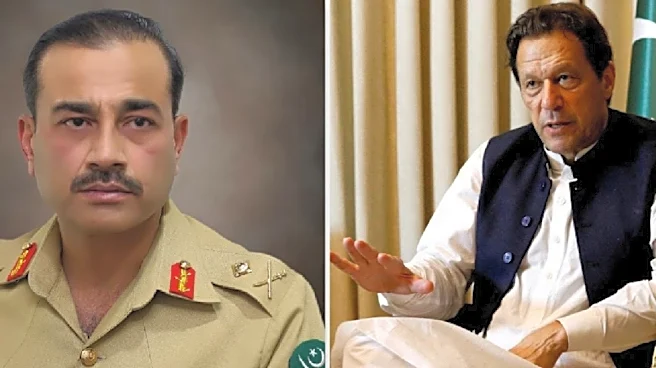
The report also focuses heavily on Asim Munir—Trump’s “favourite Field Marshal—and the dramatic transformation in US-Pakistan relations after Khan’s removal.
According to the report, Pakistan’s military establishment regained influence in Washington after Khan’s ouster, particularly under Munir’s leadership.
The report claims Pakistan repositioned itself from being viewed as a difficult partner to becoming a strategic intermediary for the US in regional diplomacy, especially during the recent Iran crisis. It also references earlier reporting claiming US President Donald Trump privately discussed Khan’s situation with Munir and suggested the issue needed to be “resolved”.
The Dropsite report says: “Khan later alleged that Munir traveled to London after his firing and met with Nawaz Sharif—the former Pakistani Prime Minister who, by late 2019, was living in self-imposed exile in London after being permitted to leave Pakistan for medical treatment in the middle of a corruption sentence. According to Khan, that meeting marked the beginning of what he would later, from prison, call “the London Plan,” an alleged understanding between Munir, Sharif, and members of Pakistan’s senior judiciary under which Munir would be elevated to army chief in exchange for the political and judicial dismantling of Khan’s government and his party.”
China Concerns Behind The Scenes
Another major thread in the report involves growing US concern over Pakistan’s deepening ties with China during Khan’s tenure.
The report claims Washington viewed Khan as increasingly comfortable with closer engagement with both China and Russia at a time when geopolitical competition with Beijing was intensifying.
Pakistan’s strategic partnership with China, especially through the China-Pakistan Economic Corridor (CPEC), had already made Islamabad central to Beijing’s regional ambitions. The report suggests US officials feared Pakistan could drift further into the China-Russia camp under Khan.
“In an August 2025 interview, Munir told a journalist, ‘We will not sacrifice one friend for the other’, referring to Pakistan’s relationship with Washington and Beijing. However, in an effort to realign itself, Pakistani military leadership has ended up doing just that.”
The Military-Civilian Power Equation
The report revives long-standing allegations that Pakistan’s military leadership and civilian governments were no longer aligned by early 2022.
According to the report, tensions between Khan and sections of the military establishment had intensified over appointments, foreign policy and political control.
The cypher controversy, it claims, became politically explosive because it appeared to overlap with domestic power struggles already underway inside Pakistan. Khan has repeatedly accused the military establishment of facilitating his removal. Pakistan’s military, however, denies interfering in politics.
Why The Cypher Still Matters
The cypher controversy continues to dominate Pakistan’s political narrative because it sits at the intersection of several sensitive issues: foreign influence, military power, relations with the US, ties with China and Russia, and Pakistan’s political sovereignty.
For Khan’s supporters, the cypher remains proof that his government was targeted for pursuing an “independent foreign policy”. For critics, it reflects diplomatic pressure being interpreted politically during a domestic power struggle.
Either way, the controversy refuses to disappear from Pakistan’s political landscape.



/images/ppid_59c68470-image-177927256568146357.webp)

/images/ppid_59c68470-image-177927263896388441.webp)
/images/ppid_59c68470-image-17792725331942661.webp)
/images/ppid_59c68470-image-177927252531148701.webp)
/images/ppid_59c68470-image-177927269687470076.webp)
/images/ppid_59c68470-image-177927259257384859.webp)
/images/ppid_59c68470-image-177927266931143460.webp)
/images/ppid_59c68470-image-177927252741519562.webp)