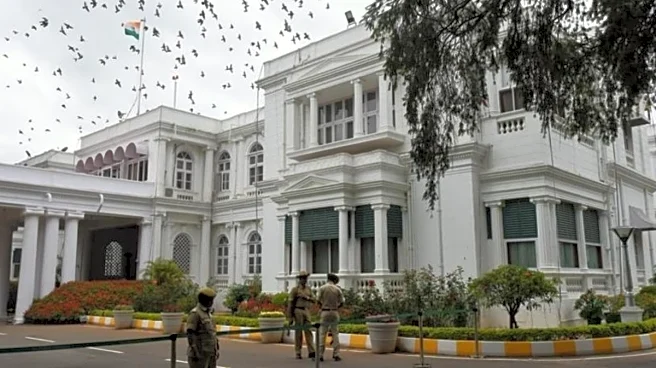




During British rule, the official residences of Governors were known as Governor’s Houses.
After Independence, India’s first Governor-General C Rajagopalachari is believed to have renamed them Raj Bhavan. However, no formal documentation, government notification, or Gazette record confirming this change has been found. Over time, the term Raj Bhavan simply became the accepted usage across states.
The Union Ministry of Home Affairs (MHA) recommended replacing the name Raj Bhavan with Lok Bhavan, stating that the old title carries colonial associations. The new name, the Ministry says, should reflect openness and a more public-centred ethos.
On 25 November 2025, the Home Ministry wrote to all State Governors and Lieutenant Governors of Union Territories
asking them to adopt the new title. Governors have been implementing the directive through state notifications.
States That Have Already Adopted the Name Lok Bhavan
According reports, eight states have already carried out the renaming:
- West Bengal (Kolkata and Darjeeling Raj Bhavans)
- Tamil Nadu
- Kerala
- Assam
- Uttarakhand (Dehradun and Nainital)
- Odisha
- Gujarat
- Tripura
In Ladakh, the Lieutenant Governor’s residence has been renamed Lok Niwas. More states and Union Territories are currently processing the change.
Who Has the Authority to Change the Name?
The power to rename Raj Bhavans does not rest with state governments or state legislatures.
The Governor acts on the directive of the Union Government. The Home Ministry is the decision-making authority, as Raj Bhavans are considered central government property, not state assets. Because this is an administrative change and not a constitutional amendment, Parliament’s approval is not required.
Is There Any Constitutional Basis for These Names?
The Constitution only recognises the Governor’s official residence as a functional space and does not confer it with a formal title such as Raj Bhavan. This means the recent decision to rename these residences does not alter the role or authority of the Governor in any way. The functions, constitutional responsibilities and manner in which the office is referred to in English remain exactly the same. The change applies only to the name of the building, not the position it houses.
Do States Need Legislative Approval?
Renaming a Raj Bhavan does not involve state legislation. It is executed through administrative notifications issued by the Governor under the guidance of the Home Ministry.
What Happens If a State Does Not Implement the Directive?
If a Governor chooses not to issue the renaming notification, the Union Home Ministry can step in to seek an explanation, press for compliance, or even recommend administrative action. Since Governors are appointed by the President on the advice of the central government, they are expected to follow such directives in the normal course of administration. Until now, no Governor has opposed or declined the instruction, which is why the rollout across states has remained smooth.
Why This Isn’t Treated Like Renaming a State
Changing the name of a state or Union Territory requires constitutional procedures, including approval from Parliament.
Renaming Raj Bhavans is considered a minor administrative change and therefore follows a simpler process.
What Will Change On Ground?
The new name Lok Bhavan will now feature across all official spaces, including signboards and plaques, government stationery, websites, communication material, visiting cards, and even emblems or insignia wherever relevant. The government expects the cost of this transition to be minimal, absorbed within routine administrative spending. Many Raj Bhavans, including Karnataka’s, already operate as heritage and public-facing venues, which means the updated name will simply fold into their existing civic identity.
The Karnataka Raj Bhavan in Bengaluru, for instance, is a well-known landmark admired for its colonial-era architecture, expansive gardens, guided tours offered on select days, and the public events held within its grounds. Similarly, Raj Bhavans in Kolkata, Chennai, Mumbai, and other state capitals draw tourists, historians, and architecture enthusiasts, making the renaming a change of nomenclature rather than function.





/images/ppid_a911dc6a-image-177089857481720650.webp)

/images/ppid_a911dc6a-image-177089866690032944.webp)
/images/ppid_a911dc6a-image-177089871495294861.webp)
/images/ppid_a911dc6a-image-177089853476914935.webp)
/images/ppid_a911dc6a-image-177089863165870219.webp)