


/images/ppid_a911dc6a-image-177503917632997956.webp)
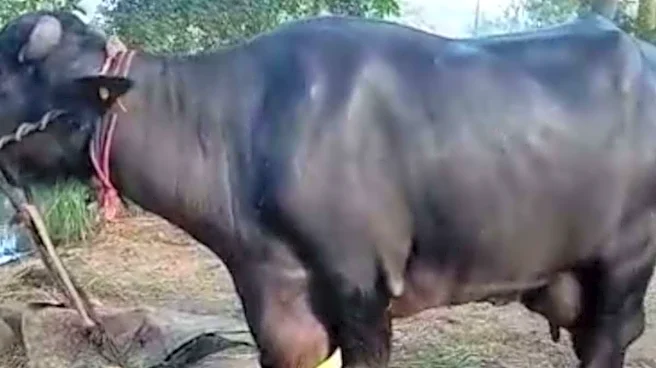
In what is being described by critics as a humiliating admission of fiscal collapse, the Punjab government in Pakistan has announced a new revenue measure that targets the province’s most basic agricultural output: animal waste. According to exclusive details obtained by CNN-News18, the Maryam Nawaz-led administration is set to impose a “Gobar Tax” (Dung Tax) of PKR 30 per day on every buffalo across the province.
While the government frames the move as a green energy initiative under the “Suthra Punjab” (Clean Punjab) Biogas Programme, the measure has sparked a firestorm of ridicule and rage, with opposition leaders and farmers alike viewing it as a sign of total financial desperation.
The plan, which is currently being finalised by provincial
authorities, aims to turn animal waste into a structured revenue stream. The Punjab government has begun compiling exhaustive lists of 168 cattle colonies across the province that will be brought under the tax net. In cities like Lahore, cattle owners will be required to pay the daily fee of PKR 30 per animal, ostensibly to fund waste management, cleanliness, and the transition to biogas production.
Under the “Suthra Punjab” mandate, the government intends to collect this dung to power state-led biogas plants. However, the logistical burden of “measuring” the output of millions of buffaloes has raised eyebrows. Government sources suggest the fee will be a flat daily levy per head of cattle, turning the simple act of livestock rearing into a taxable liability for the first time in the region’s history.
The official narrative from the Chief Minister’s office paints this as a visionary leap towards a circular economy. By centralising dung collection, the government hopes to generate renewable energy while cleaning up the often-clogged drainage systems of urban cattle colonies.
However, sources close to the political opposition in Pakistan tell a different story. “This is not governance; it is a humiliating admission that Pakistan’s largest province has run out of real revenue sources,” a senior opposition figure remarked. Critics argue that after years of economic mismanagement and mounting debt, the government has reached a point where it is measuring buffalo droppings to scrape together a few extra rupees. The “green” label is seen by many as a thin veil for a desperate “wealth grab” from a sector that is already reeling under the weight of inflation and high feed costs.
For the poor cattle farmers and dairy owners of Punjab, the tax is a “double whammy”. The agricultural sector is currently battling record-high fodder prices, expensive electricity for tubewells, and a general spike in the cost of living. Adding a PKR 30 daily tax per buffalo—which could amount to nearly PKR 11,000 annually per animal—threatens to push many small-scale farmers out of business.
“On one hand, corrupt politicians and bureaucrats continue enjoying luxury vehicles, foreign trips, and massive salaries,” noted an industry analyst. “On the other hand, the farmer, who is already struggling to keep his animals fed, is now being told he must pay the government for his buffalo’s waste. It proves the system is fundamentally broken.”

/images/ppid_a911dc6a-image-177515002533838714.webp)