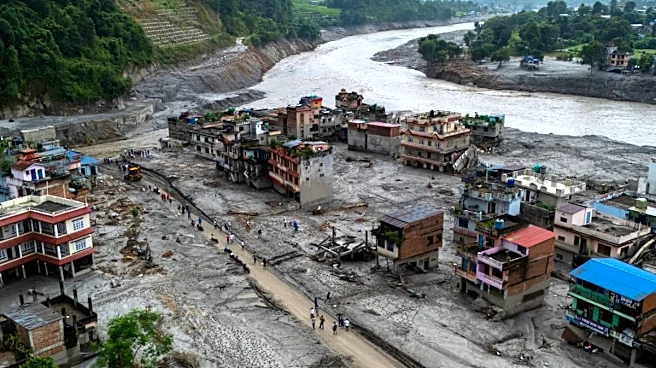



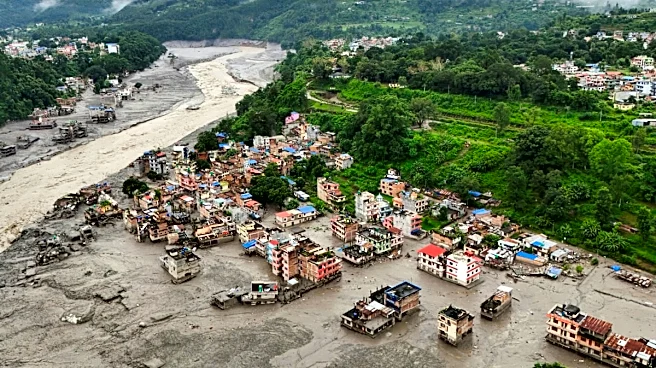
Nepal has shifted its diplomatic pitch from seeking humanitarian assistance to demanding “climate compensation” for the devastating flash floods that have killed more than 1,000 so far and left nearly 4,000 missing, arguing that the Himalayan nation is bearing the consequences of a climate crisis it contributed little to creating, according to The Kathmandu Post.
The devastating floods were triggered by a collapse or avalanche of ice and rock near the Nepal-Tibet border on August 26.
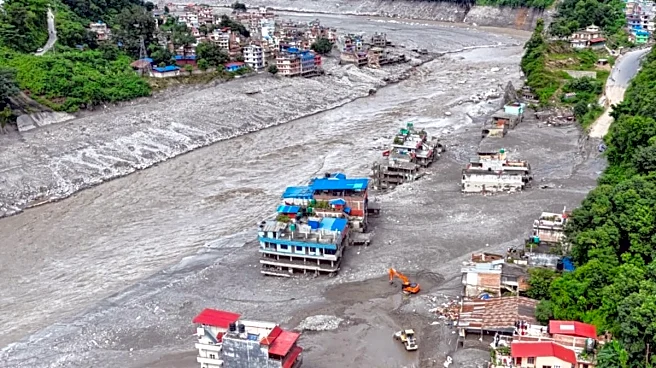
The resulting floodwaters surged into the Bhotekoshi River and swept through settlements downstream, destroying homes, vehicles, roads and bridges and damaging hydropower facilities.
Nepal Demands ‘Climate Compensation’
In an interview with The Kathmandu Post, Nepal Foreign Minister Shisir Khanal linked
the disaster directly to the wider climate crisis, arguing that Nepal’s contribution to global greenhouse gas emissions is negligible compared with that of major industrial economies.
“Nepal’s greenhouse gas emissions are virtually negligible. Yet, we are paying the ultimate price for a global crisis we did not create. The rapid melting of glaciers and these catastrophic mountain tsunamis are direct consequences of global climate change,” the minister said.
Also Read: Inside Nepal’s Mud-Choked Hydropower Tunnels: How Rescuers Are Racing Against Time To Find Survivors
He said Kathmandu was therefore changing the way it approached international assistance, moving from a humanitarian-aid framework towards a demand for compensation based on climate responsibility.
“We are shifting our diplomatic framework from “aid” to “justice and compensation. This is not a matter of charity; it is a matter of legal and moral liability,” he said, while speaking to The Kathmandu Post.
Nepal Calls India, China, US ‘Top Industrial Emitters’
The foreign minister said China is the biggest industrial emitter in the world, followed by the United States and India and added that these countries have a responsibility to compensate countries like Nepal.
“The major industrial emitters – such as China, which is the world’s top emitter, the United States at number two, and India at number three – have a historical responsibility to compensate vulnerable nations like Nepal,” Minister Khanal said to The Kathmandu Post.
He said Nepal had already begun the formal process of seeking such compensation from international partners.
“To this end, the Ministry of Finance has officially dispatched a formal climate compensation claim letter to our international partners. We will be raising this issue with absolute firmness and clarity at every upcoming international forum. This is a matter of civilisational survival. If our Himalayan glaciers disappear, the water security of over two billion people in South Asia – dependent on rivers like the Ganges and the Trishuli – will be permanently compromised. We are advocating not just for Nepal, but for the survival of South Asian civilisation,” the minister added.
‘Not Flood But Himalayan Tsunami’
Minister Khanal described the disaster as an unprecedented event, saying its scale and intensity went far beyond a conventional flood.
“This was not a standard flood. With wave heights reaching 20 to 30 meters and speeds clocked at 180 kilometres per hour, this was a disaster of tornado-like velocity – what many are rightly calling a “Himalayan Tsunami”. It is a scale of disaster that is entirely outside the living memory of Nepal,” he said, while speaking to The Kathmandu Post.
Also Read: Not A Glacial Lake Outburst? Scientists Probe New Theory To Determine What Triggered Nepal Floods
Khanal said the destruction had been widespread, affecting municipalities and infrastructure across several districts.
Nepal Seeks $5 Billion Aid From UN
Meanwhile, Nepal has estimated the cost of recovering from the disaster at around $5 billion and has also sought urgent financial assistance from a United Nations special fund for climate-disaster recovery, according to a report published by The New York Times.
Maheshwar Dhakal, climate change chief in Nepal’s Ministry of Agriculture, Forest and Environment, said human-caused climate change had contributed to the conditions behind the disaster.
He framed the catastrophe as an example of the disproportionate burden faced by vulnerable countries despite their relatively small contribution to global emissions.
“Those who have contributed the least are suffering the most,” Dhakal said, according to a letter sent by the Nepalese government to the board of the climate-disaster recovery fund.
Nepal Floods
Nepal’s death toll from the disaster rose to 987 on Monday, with authorities continuing to recover bodies.
The floods also affected areas on the Chinese side of the border, where 16 people were reported killed and nearly 550 remain missing in Tibet, according to Chinese media reports. Hence, the total death toll from Wednesday’s disaster now stands at 1,003.
Around 4,000 people remain missing, while more than 10,000 people have been rescued so far.
Search teams are working amid intermittent rain, swollen rivers and damaged roads and bridges, while authorities are attempting to trace 639 workers and employees at various hydropower project sites. Many are believed to be trapped inside tunnels.
A controlled blast was carried out at one of the sites to clear access to a blocked tunnel. Technical teams from India and China are assisting Nepalese authorities with rescue operations, while Kathmandu has sought additional international support, including specialised equipment and technical expertise for tunnel rescue and forensic operations.
India has also stepped up its rescue and relief operations in coordination with Nepalese authorities. The Ministry of External Affairs said on Monday that 158 Indian nationals had been rescued following the floods. The MEA had earlier said that more than 275 Indians and 128 people of Indian origin remained missing or non-contactable in Nepal.

/images/ppid_59c68470-image-178814275479620282.webp)



/images/ppid_59c68470-image-178824502862576678.webp)

/images/ppid_59c68470-image-17880650372493571.webp)