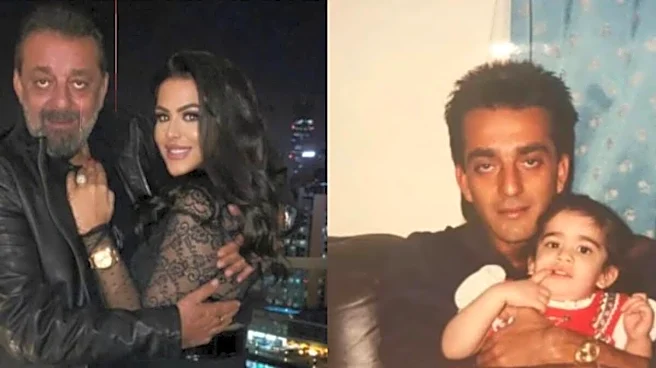



For many people, the phrase “star kid” instantly brings to mind privilege, access and a life cushioned from hardship. But Sanjay Dutt’s daughter Trishala Dutt has said that her childhood was far more complicated than that public perception. Raised in New York by her maternal grandparents after losing her mother Richa Sharma at a young age, Trishala recently spoke about growing up with bullying, racism, grief and the loneliness of not having a safe emotional space.
In a conversation with the YouTube channel Inside Thoughts Out Loud, Trishala reflected on how difficult her early years were, especially as an Indian child in the US. She said that the bullying began when she was barely five or six years old. Trishala Dutt Opens Up About Childhood
Bullying
Speaking about the taunts she faced as a child, Trishala said, “I faced a lot of hardship and a lot of taunting from children around me because I was a child at the time, and I did not have a safe space.”
The bullying, she shared, did not end there. In middle school, her weight became another reason for children around her to target her. Later, when she entered high school, the situation became even more intense as people began discovering that she was Sanjay Dutt’s daughter.
Trishala said she had “no one to lean on” during those years and often wished she had “someone to talk to” when she was younger.
Losing Her Mother At 8
Trishala is Sanjay Dutt’s daughter from his first marriage to actress Richa Sharma. Sanjay and Richa married in New York in 1987 and welcomed Trishala the following year. Soon after, Richa was diagnosed with brain cancer.
Recalling her mother’s illness, Trishala said, “My mother passed away in 1996 when I was 8 years old, and she passed away from a brain tumour. She was diagnosed in 1989. When they found out, it was already grade 4. That type of brain cancer is one of the deadliest and most aggressive human cancers.”
Richa underwent treatment at Memorial Sloan Kettering Cancer Center, the same hospital where Sanjay Dutt’s mother Nargis Dutt had also been treated for cancer. While Trishala was still very young, her family was already dealing with uncertainty, illness and emotional strain.
Sanjay Dutt Was Dividing His Time Between India And The US
Trishala also spoke about how her father was trying to balance his film career in India with Richa’s treatment in the US. She said, “Dad was splitting his time between India and the US. He was back and forth because he was working, and it was hard to stay here for her entire treatment while also being an actor back home.”
At the time, Sanjay’s own life was marked by major personal and legal challenges. After struggling with substance abuse in the 1970s and 1980s, he had gone to rehab and rebuilt his life. Later, in 1993, he was accused in connection with the Mumbai bomb blasts case, which led to years of legal turmoil and jail time.
For Trishala, this meant growing up with grief on one side and distance on the other.
‘I Didn’t Look The Part Of Sanjay Dutt’s Daughter’
As her mother battled cancer, Trishala said food became a source of comfort for her. “When I was younger and my mother was going through cancer, I developed a weight problem because I turned to food for comfort,” she shared.
But the weight gain made her an easy target for judgement. Trishala said people expected a celebrity’s daughter to look a certain way, and she felt she did not fit that image.
She said, “People think that if you are a celebrity’s daughter, you have to look a certain way and I just didn’t look the part of Sanjay Dutt’s daughter.”
Her visits to India were not easy either. Trishala recalled being photographed by the paparazzi as a child, which would often lead to cruel comments being written about her.
“When I was a child, so many things were written about me, people would leave mean comments,” she said. She added, “Nobody has thicker skin than me because I have seen it all at a very tender age.”
Why Trishala Chose Therapy As A Profession
Trishala, who now works as a mental health professional in New York, said that people often assume she had everything handed to her because of her family background. However, she clarified that privilege did not mean the absence of pain.
She said, “I have been through many storms, a lot of dark clouds. Was I born with a silver spoon in my mouth? Yes and no. I didn’t have everything handed to me as everybody thinks. I had to work a lot to get to where I am today. I have internal struggles just like everybody else. I am not perfect and I became a therapist to let people know that it’s okay to struggle. You don’t always have to have it together and you are not alone in this journey.”

/images/ppid_a911dc6a-image-177933008463387125.webp)