
Wage pendency in the Mahatma Gandhi National Rural Employment Guarantee Act (MGNREGA) stands at Rs 1,340 crore, of which nearly Rs 1,095 crore—or Rs 8 in every Rs 10—is concentrated in just four states.
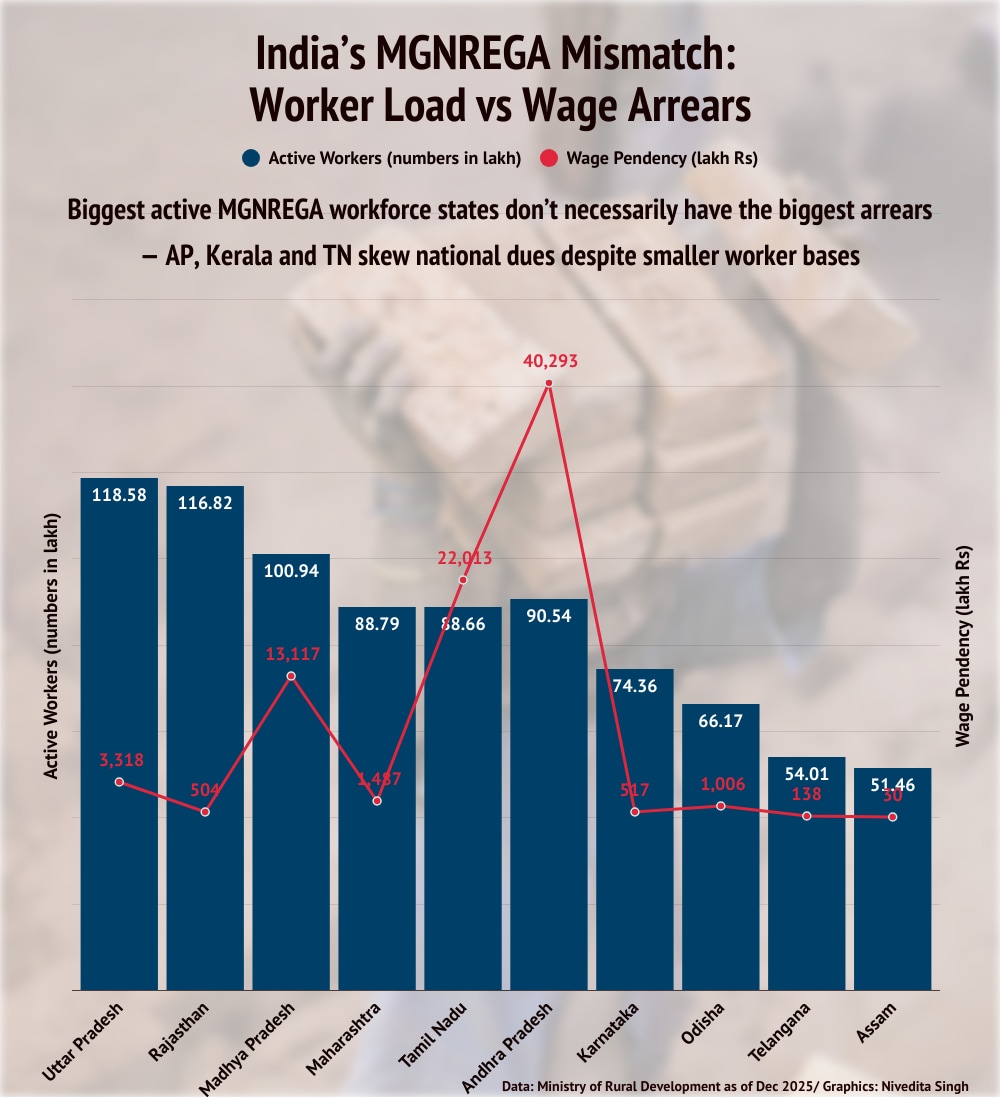
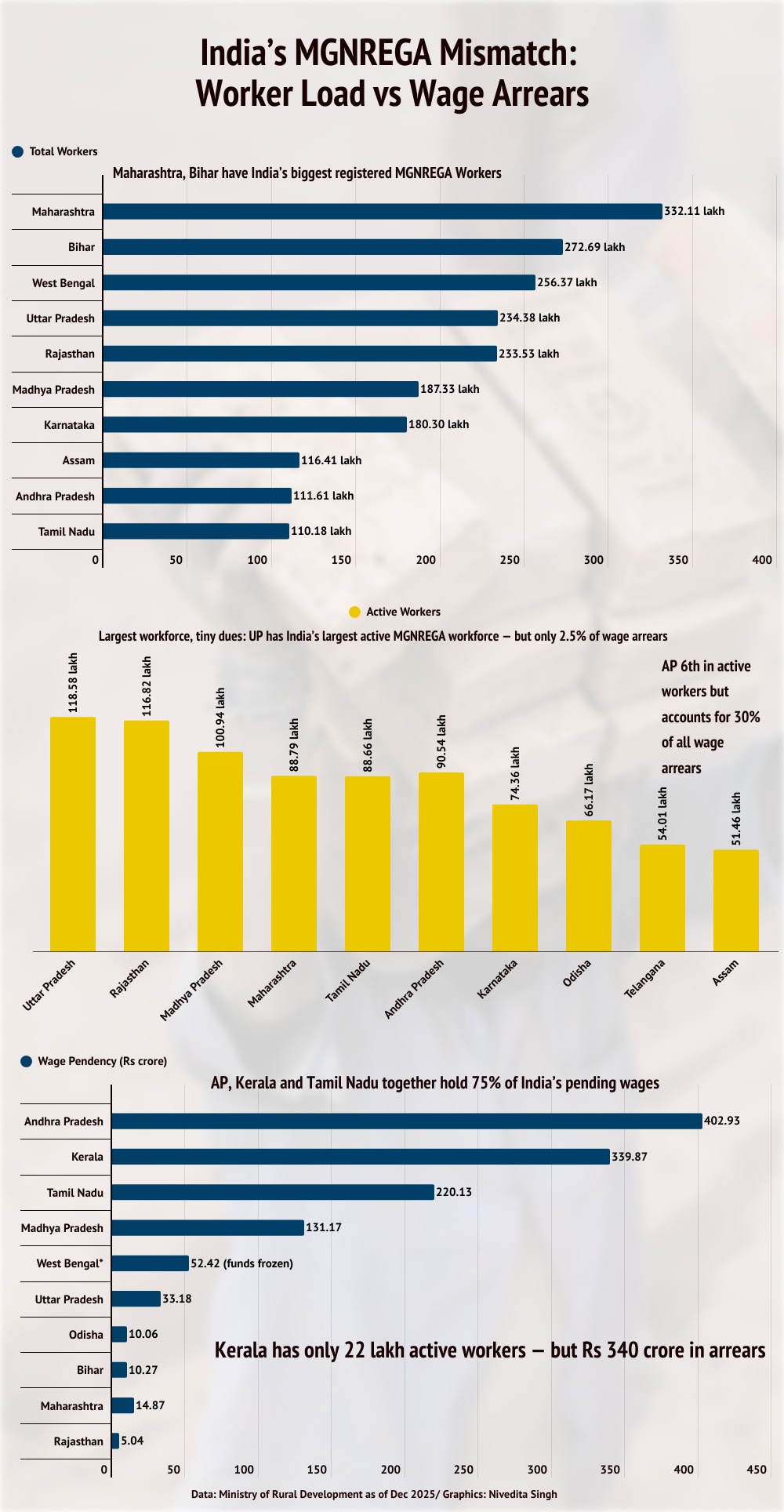
Data from the Ministry of Rural Development shows that as of December 5, the wage pendency in Andhra Pradesh was the highest at Rs 402.93 crore, followed by Rs 339.87 crore in Kerala. Tamil Nadu follows with Rs 220.13 crore, while Madhya Pradesh is next at Rs 131 crore.
Interestingly, these states are not with the highest active MGNREGA workers.
Wage pendency and the active workforce analysis reveals sharp imbalances where states with smaller worker bases are driving the majority of delays.
As per NREGASoft, the total number of workers under MGNREGA are 27.64 crore, of which 12.16 crore were active as on December 1.
Andhra Pradesh has a total of 1.1 crore workers and about 90.54 lakh were active at the sixth position but the state holds 30 per cent of the total pending wages. Kerala has 58.03 lakh total workers and 22.63 lakh were active. The state’s pending wages amount to 25 per cent of India’s wage arrears — the second-highest after Andhra Pradesh.
Collectively, these four states account for about 25 per cent of India’s active MGNREGA workers, but nearly 82 per cent of all pending wages.
Uttar Pradesh: Highest Active Workforce But Low On Pending Wages
Uttar Pradesh, with a total of 2.34 crore registered workers, has the country’s largest active MGNREGA workforce at 1.2 crore. But it accounts for only 2.5 per cent of total pending wages—Rs 33.18 crore out of Rs 1,340 crore.
Rajasthan has 2.33 crore registered workers and an active MGNREGA workforce of 1.17 crore, the second-largest in the country. Yet, it accounts for an exceptionally small share of pending wages—just Rs 5.04 crore, 0.38 per cent of the national pendency.
Madhya Pradesh has 1.87 crore registered workers and more than 1 crore active workers, making it the third-largest active MGNREGA workforce in India. However, as stated earlier, Madhya Pradesh contributes a disproportionately high share of pending wages—about 10 per cent of the national total.
Maharashtra has the largest pool of registered MGNREGA workers in the country — 3.32 crore — though its active workforce stands at fourth highest at 88.79 lakh. The wage pendency of the state is only Rs 14.87 crore, amounting to 1.1 per cent of India’s total pending wages.
Tamil Nadu has 1.10 crore registered workers and stands fifth in terms of active workers at 88.66 lakh. But stands third with 16.4 per cent of total pending wages nationwide.
MGNREGA is a demand-driven wage employment scheme and fund release is a continuous process, as per official records. Under the scheme, the wage payments are directly credited by the Union government to the account of beneficiaries through Direct Benefit Transfer protocol.
Sanctions for wage payments are issued daily by the ministry through the Public Finance Management System (PFMS) based on fund transfer orders received from the states after due procedures.
For FY 2024-25, a budget allocation of Rs 86,000 crore was made, which was the highest-ever allocation for the scheme at the Budget Estimate (BE) stage since inception. In the FY 2025-26, the government has retained this allocation at Rs 86,000 crore, ensuring continued support for rural employment.
Also, all the pending wage liabilities up to FY 2024-25, except West Bengal, have already been cleared. Release of funds to the Bengal has been stopped since March 2022 as per provision of Section 27 of the Act due to non-compliance with directives of the Union government.
The data till July-end shows that in 2025-26, Rs 47,567 crore has been released under the scheme out of which Rs 39,595 crore is for payment of wages.
By November-end, Rs 68,393.67 crore had been released to states/UTs, which includes Rs 57,853.62 crore for wage component and an amount of Rs 10,540.05 crore for material and admin.
As the Centre retains its highest-ever allocation for the scheme, the challenge is no longer money alone but ensuring that the pipeline between muster roll and bank account is swift and uniform. Without that, arrears will continue to cluster—at least in a handful of states—distorting a programme designed to guarantee work and dignity.
/images/ppid_59c68470-image-177099503123072195.webp)