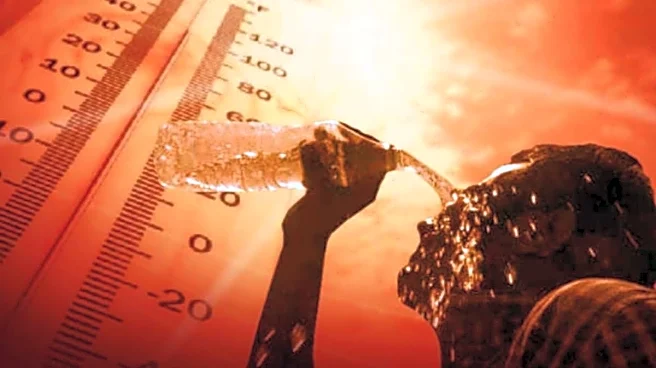


As a punishing heatwave tightens its grip across the Indian subcontinent, traditional thermometers are failing to capture the true scale of the danger. Mercury levels regularly breach 44°C in the northern plains, forcing the India Meteorological Department (IMD) to issue rolling heatwave alerts. However, climate scientists and public health officials are urgently tracking a much more lethal, invisible metric: wet-bulb temperature.
Unlike standard air temperature, wet-bulb temperature measures the compounding impact of heat and ambient humidity. It represents the lowest temperature to which an object can be cooled through the evaporation of water. For the human body, this calculation is a matter of pure survival, dictating whether our primary
internal cooling mechanism—sweating—can actually function. With a burgeoning El Niño event threatening to drive global temperatures even higher, experts warn that several densely populated Indian metropolitan areas are creeping perilously close to the absolute physical limits of human tolerance.
The Thermodynamics of Sweating: Why Humidity Kills
The biological reality of heat stress is straightforward. When the human body overheats, it pumps blood to the skin and releases sweat. As that moisture evaporates into the surrounding air, it removes latent heat, cooling the body down. However, this system relies entirely on atmospheric capacity. In highly humid environments, the air is already saturated with moisture, preventing sweat from evaporating.
Consequently, a dry 45°C day in the desert expanses of Rajasthan can actually be safer than a muggy 38°C afternoon in Kolkata or Mumbai. In coastal or river-basin cities, the sweat simply sits on the skin. The body continues to heat up internally, causing the core temperature to spike. If left unchecked, this triggers a rapid cascade of medical emergencies: severe dehydration, heat exhaustion, rapid-onset heatstroke, and eventual multi-organ failure.
Redefining the Survival Ceiling: The 31°C Danger Zone
For decades, the global scientific consensus held that the absolute threshold of human survivability was a sustained wet-bulb temperature of 35°C. At this level, even a perfectly healthy person resting in the shade with unlimited drinking water would succumb to the heat within six hours because the body can no longer shed heat to its environment.
However, groundbreaking physiological research, including data from the Penn State HEAT Project, has shattered that assumption. Recent real-world testing reveals that the true danger zone for vulnerable populations begins much earlier, at a wet-bulb temperature of just 31°C to 32°C. Prolonged outdoor exposure at these lower thresholds is already pushing the human metabolic system into critical distress.
Recognising this structural gap, the IMD has recently overhauled its weather reporting system, introducing percentile-based thresholds for the first time. This reform ensures that coastal regions experiencing oppressive, moisture-heavy heatwaves receive formal emergency alerts, even if absolute temperatures do not hit standard heatwave criteria.
India’s Cities on the Frontline
The intersection of geography, urban architecture, and socioeconomic vulnerability makes India uniquely exposed to wet-bulb disasters. The threat is concentrated across three distinct fault lines.
First, major coastal and eastern employment hubs—including Mumbai, Chennai, Kolkata, and Bhubaneswar—frequently experience the lethal pairing of high seasonal temperatures and maritime humidity. Second, the rampant expansion of concrete and glass infrastructure has created intense “Urban Heat Islands”. These dense metropolitan areas trap solar radiation all day, resulting in warm nights that prevent the body from recovering.
Finally, millions of Indian citizens—including construction labourers, farmers, delivery riders, and street vendors—rely entirely on outdoor manual work. With limited access to air conditioning and cooling zones, these workers face the brunt of the wet-bulb threshold daily, making the invisible rise of humid heat the country’s most pressing public health challenge.








/images/ppid_a911dc6a-image-17791592287636658.webp)
