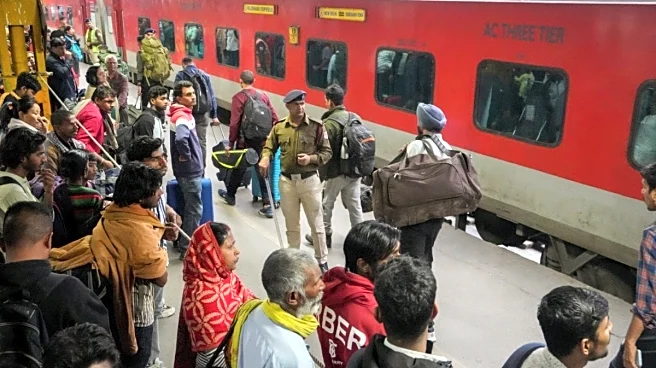

Indian Railways transported nearly 90 per cent of passengers and over 86 per cent of goods back in 1949. IR was the lifeline of the country and a profitable venture. Still, the then railway minister Gopalaswami
Ayyangar thought it necessary to say so in his budget speech of 1949–50: “There is still a considerable gap between the actual demand for transport and the capacity of railways to meet it in full in proper time. The problem of bridging the gap is one of adequacy of power, rolling stock and line capacity…. I will endeavour to bridge the gap sooner rather than later.”
Unsurprisingly then, Gopalaswami Ayyangar decided to end his 1949–1950 budget speech with the following tribute: “Before I close, I should like to pay a tribute of appreciation to the Chief Commissioner of Railways and his colleagues on the Railway Board, to the officers and staff serving under it, to the Heads of the nine Railway Administrations and the officers and staff serving under them, and particularly to the large body numbering over 8 lakhs of Railwaymen for the hard work they have been and are doing, as well as for the service they have been rendering to the public under conditions of a certain amount of disorganisation and confusion, for which they certainly could not be saddled with responsibility. The House will, no doubt, agree with me in paying this tribute.”
Where Have Those Days Gone?
Fast forward to 2025: Indian Railways today is a pale shadow of the golden era of the 1950s and 1960s, having lost its predominant position as the nation’s lifeline. Here is the story in brief:
One, Passenger Transport: These numbers have yet to recover to pre-Covid-19 levels. Suffice it to say that railways today carry around 10 per cent of total passenger throughput, while substantially expanded bus services (including long-distance routes), including the premier Volvo and Mercedes AC buses, carry 87 per cent, and air traffic accounts for 3 per cent.
With more airports being added under the Regional Connectivity Scheme (RCS) – UDAN (Ude Desh Ka Aam Nagrik), despite the Vande Bharat revolution, railways as a passenger carrier will sooner rather than later be relegated to third place, with air traffic overtaking it.
Two, Goods Services: There is no reliable data comparing total railway freight traffic with the total freight traffic available in the country. Nonetheless, I say with a reasonable degree of certainty that its share has come down to around 25 per cent, and is falling fast.
A bigger worry is that railways have been reduced to a carrier of a narrow set of commodities: coal, iron ore, foodgrain, fertilisers, cement, and a fast-eroding basket of POL. All other items are marginal.
The railways’ freight basket has not changed much in the last decade in terms of traffic volume or revenue share. In 2015–16, coal accounted for 45 per cent of total freight revenue. In 2024–25 and 2025–26, coal’s share is estimated to rise to 50 per cent.
Worse, with the Government of India committed to “Net Zero” by 2070, railway coal traffic will dwindle rapidly. If railways do not get their act together and become a logistics force to reckon with — an aggregator of high-value smalls — there is a high chance that they will be relegated to a footnote in India’s transportation business.
The Disruptive Dilemma — To Increase Or Not To Increase
Since Independence, Bharat has had more than fifty railway ministers — 43 Cabinet ministers and a few Ministers of State (Independent Charge). Traditionally, increases or decreases in passenger and freight fares were announced in the annual railway budget speech by the Railway Minister of the day. And the toughest dilemma most ministers faced was whether to increase passenger fares.
After scrutinising passenger-fare increases since Independence, I find the decision was so tough and disruptive that only a few ministers mustered the courage to raise fares. There was complete political unwillingness to “increase passenger fares” even when there was “willingness to pay”. The railway ministers who dared to raise fares are few.
Worse, the political resistance to passenger-fare hikes has been so great that at least one erudite, well-meaning and capable Railway Minister — Prof Dinesh Trivedi — lost his job for attempting a modest fare increase in the form of a safety surcharge to raise Rs 6,000 crore. Unfortunately, this author — as the exclusive unofficial assistant to Dr E. Sreedharan, sole adviser to the High-Powered Committee on Railway Safety, headed by noted scientist Dr Anil Kakodkar — was the principal author of the safety-surcharge formula in the Kakodkar Committee Report, due to which Prof Trivedi lost his job.
Below is the story of how difficult various railway ministers found the task of increasing railway fares:
One, Prime Minister Nehru Era
The first three Railway Ministers — Dr John Mathai, Gopalaswami Ayyangar and Lal Bahadur Shastri — did not muster the courage to increase passenger fares.
Ten years after Independence, Babu Jagjivan Ram (Railway Minister from December 1956 to April 1962) in the 1957–58 Budget announced a 10–15 per cent hike in third-class passenger fares (the majority segment) to generate Rs 10 crores in extra revenue, citing wage rises and steel costs, without alternatives such as cuts elsewhere.
The 1958–59 and 1959–60 speeches defended these adjustments, noting stabilised earnings at Rs 110–120 crores post-hike while adding surcharges on long-distance travel, though avoiding broad increases in second-class fares.
Two, Indira Gandhi Era
S. K. Patil: The second fare increase had to wait another decade when S. K. Patil (Railway Minister from June 1964 to March 1967), in his 1965–66 Railway Budget speech, announced a 10 per cent across-the-board hike in third-class passenger fares — the dominant segment — to raise Rs 15–20 crores, citing wage bills up by Rs 25 crores and fuel costs, while sparing season tickets and short-distance travel.
In the 1966–67 speech, amid economic crisis, he defended the adjustment with further selective rises (e.g., 5–7 per cent on second-class) and introduced dynamic-pricing pilots, boosting passenger revenue from Rs 150 crores to Rs 175 crores despite volume dips.
Gulzarilal Nanda (Railway Minister from 18 February 1970 to 17 March 1971): In his 1970–71 Budget speech, Nanda announced a 10–15 per cent hike in third-class ordinary and season-ticket fares — the bulk of passenger traffic — to generate Rs 20 crores in additional revenue, citing wage increases (Rs 30 crores extra) and fuel-price surges without viable alternatives. He spared suburban and short-distance commuters but introduced surcharges on long-haul second-class travel, projecting passenger earnings to rise from Rs 190 crores to Rs 215 crores.
Kengal Hanumanthaiah (Railway Minister from 18 March 1971 to 22 July 1972): In his 1971–72 and 1972–73 Budget speeches, Hanumanthaiah announced a 7–12 per cent hike in third-class and season-ticket fares to raise Rs 25 crores, citing staff wage revisions (up Rs 40 crores) and material-price surges while protecting suburban services. Passenger-revenue projections rose from Rs 215 crores to Rs 245 crores, with selective second-class adjustments amid 2.8 billion passengers.
Lalit Narayan Mishra (Railway Minister from 5 February 1973 until his assassination on 3 January 1975): In his 1973–74 and 1974–75 Budget speeches, Mishra announced a 15–20 per cent hike in third-class passenger fares (covering 90 per cent of traffic) and season tickets, aiming to generate Rs 40–50 crores extra, while introducing dynamic surcharges on peak routes. This followed prior adjustments but was the steepest yet, citing costs increase up by Rs 100 crores. Passenger revenue jumped from Rs 260 crores to Rs 320 crores despite volume stability at 3.2 billion.
Kamalapati Tripathi (Railway Minister from 4 January 1975 to 24 March 1977, and briefly again in 1980): In the 1975–76 speech, Tripathi announced a 10–20 per cent rise in third-class and suburban fares (generating Rs 30–40 crores extra), citing expenses up by Rs 150 crores while exempting certain concessional categories amid controlled-inflation rhetoric. The 1976–77 presentation reinforced these with peak-season surcharges on long-distance travel, boosting passenger revenue from Rs 320 crores to Rs 380 crores despite stable volumes around 3.4 billion.
One can see from above that after the sole passenger-fare increase by Jagjivan Ram under the Nehru era, five Railway Ministers under Indira Gandhi dared to increase passenger fares to keep pace with increases in staff and fuel costs.
Three, Morarji Desai Fare Reduction Era
Madhu Dandavate (Railway Minister from 24 March 1977 to 14 January 1979): Instead of increasing passenger fares, his 1977–78 and 1978–79 speeches highlighted subsidies for third-class fares (reducing fares from Emergency-era levels). He criticised predecessors’ steep increases, focusing on “people-friendly” policies amid post-Emergency populism.
Four, Rajiv Gandhi Era
B. A. Ghani Khan Choudhury (Railway Minister from 2 September 1982 to 31 December 1984): In his 1983–84 and 1984–85 Budget speeches, Choudhury announced a 5–10 per cent hike in third-class ordinary and season-ticket fares (the primary revenue source), targeting Rs 15–20 crores in additional income amid wage escalations and fuel costs, while introducing concessional schemes for students and sparing short-haul suburban travel. Passenger earnings rose from Rs 450 crores to Rs 520 crores, supporting projects such as the initiation of the Kolkata Metro despite 4.2 billion passengers.
Bansi Lal (Railway Minister from 1 January 1985 to 25 October 1989): In his 1985–86 Budget speech, he announced a 6–12 per cent hike in third-class and season-ticket fares, generating Rs 25–30 crores extra while sparing suburban commuters, citing expenses up by Rs 200 crores. Subsequent speeches (1986–87, 1987–88) included further 5–10 per cent adjustments with dynamic pricing on premium trains, boosting passenger revenue from Rs 520 crores to over Rs 800 crores by 1989, amid 4.5 billion passengers.
Five, V. P. Singh Rollback Era
George Fernandes (Railway Minister from December 1989 to November 1990): In his 1990–91 Budget speech, Fernandes reduced third-class and season-ticket fares (a 5–10 per cent rollback from Bansi Lal/Scindia levels) to benefit the masses, generating populist support while projecting revenue stability via freight emphasis and efficiencies amid 4.8 billion passengers. He criticised Congress-era increases, prioritising Antyodaya schemes for the poor over hikes.
Six, P. V. Narasimha Rao Era
C. K. Jaffer Sharief: (Railway Minister from 21 June 1991 to 24 September 1995). In his 1992–93 and 1993–94 Budget speeches, Sharief announced modest 5–8 per cent hikes in third-class and season-ticket fares (targeting Rs 30–40 crores in extra revenue), citing wage bills up by Rs 250 crores and gauge-conversion costs, while introducing concessions for seniors and sparing suburban routes. Passenger earnings grew from Rs 950 crores to Rs 1,200 crores by 1995, funding 6,000 km of broad-gauge conversions despite 5.2 billion passengers.
Seven, H. D. Deve Gowda and I. K. Gujral Era
Ram Vilas Paswan: (Railway Minister from June 1996 to March 1998) under the United Front government led by H. D. Deve Gowda and I. K. Gujral — No fare increase.
Eight, Atal Bihari Vajpayee Era
Nitish Kumar: (Railway Minister from 19 March 1998 to 5 August 1999, and again from 20 March 2001 to 22 May 2004) — No fare increase.
Ram Naik: (Minister of State for Railways with Independent Charge from 13 March 1998 to 13 October 1999) — No fare increase.
Nine, Manmohan Singh (UPA) Era
Mamata Banerjee: (Railway Minister twice: from 13 October 1999 to 16 March 2001 under NDA, and from 25 May 2009 to 19 May 2011 under UPA-II) — No fare increase.
Lalu Prasad: (Railway Minister from May 2004 to May 2009 in UPA-I) — No fare increase.
Dinesh Trivedi — Losing the Job Due to Attempted Fare Increase: (Railway Minister from July 2011 to March 2012 under UPA-II), succeeding Mamata Banerjee. In the March 2012 Budget, Trivedi proposed a 10–30 per cent rise across classes (e.g., 20 paisa per km for second-class, higher for AC tiers) to generate Rs 6,600 crores extra for safety and infrastructure, citing accumulated losses and the need for modernisation such as new lines and signalling.
This broke the no-fare-hike tradition of 15 years. The hike led to immediate backlash; Mamata Banerjee demanded his removal, forcing Trivedi’s resignation days later, with Mukul Roy reversing parts of it.
Mukul Roy — Rollback King: (Railway Minister from 20 March 2012 to 22 September 2012 under UPA-II). He rolled back Trivedi’s hikes under pressure from Mamata Banerjee and the Trinamool Congress.
Pawan Kumar Bansal: (Railway Minister from 28 October 2012 to 10 May 2013 under UPA-II). After more than 15 years, in his 2012–13 interim Budget, Bansal approved a 10–21 per cent rise across classes (e.g., 20 paisa per km for second-class, higher for AC), generating Rs 6,600 crores extra for safety, modernisation and debt reduction, noting that fares had remained unchanged since 2002 despite inflation. He defended this in Parliament as essential for profitability amid accumulated losses.
Mallikarjun Kharge: (Railway Minister from 17 June 2013 to 26 May 2014 under UPA-II) — he presented one Railway Budget but introduced no fare increase.
Ten, Narendra Modi Era
D. V. Sadananda Gowda: (Railway Minister from May 2014 to November 2014 under Modi NDA-I).
In the 2014–15 Railway Budget, Gowda announced a 4.9–58 per cent hike across classes (e.g., Rs 2 per km for second-class sleeper, higher for AC tiers such as 58 per cent on 3AC), generating Rs 6,800 crores extra over five years, citing no increases since 2013 despite inflation and the need for modernisation such as new lines and signalling. He balanced this with concessions for seniors (50 per cent off) and dynamic-pricing pilots.
Suresh Prabhu: (Railway Minister from November 2014 to September 2017 under Narendra Modi’s NDA-I) — No fare increase.
Piyush Goyal: (Railway Minister from September 2017 to May 2021 under Narendra Modi’s NDA-I and NDA-II) — there was a modest passenger-fare increase on 1 January 2020, citing the financial burden arising from implementation of the Seventh Pay Commission.
Ashwini Vaishnaw: (Railway Minister since July 2021 to date) — Neither here nor there
For the first four years of Ashwini Vaishnaw’s tenure as Railway Minister, there was no increase in passenger fares. But in 2025, railway passenger fares were increased twice, in July and December. These adjustments, calculated on a per-kilometre basis for certain long-distance train classes while exempting suburban and most short-distance travel, are marginal in nature — I call them too little, too late.
The fare adjustments are as follows:
From 1 July 2025 onwards: A fare revision was introduced, marking the first hike in several years.
- Non-AC Mail/Express trains: Increase of 1 paisa per kilometre.
- AC classes: Increase of 2 paise per kilometre.
- Second-class travel: No increase for journeys up to 500 km, with a minor increase beyond that.
- Suburban and monthly season tickets: Fares remained unchanged.
From 26 December 2025 onwards: A second fare rationalisation was announced in the same financial year.
- Ordinary class (beyond 215 km): Increase of 1 paisa per kilometre.
- Mail/Express (non-AC and AC classes): Increase of 2 paise per kilometre.
- Suburban services and monthly season tickets: Fares remained unchanged.
The Untold Story
In 78 years since Independence, few railway ministers have shown the courage to increase passenger fares to offset ever-increasing operating costs. The first to do so was Babu Jagjivan Ram, a no-nonsense railway minister known for his clarity of thought and administrative acumen. The last one to substantively increase passenger fares was S. D. Sadananda Gowda, the first railway minister under Prime Minister Narendra Modi. Gowda also had the courage to call the Railway Board “unwieldy” in his Budget speech.
Whenever passenger fares were increased, passengers accepted them without demur and continued to patronise the railways. In the past thirty years (after the fare increases by C. K. Jaffer Sharief in 1992–93 and 1993–94), no railway minister has bothered to increase fares even to neutralise rising costs (Pawan Kumar Bansal’s last budget in the Manmohan Singh government and Sadananda Gowda’s first budget in the Narendra Modi government were exceptions).
The result is worsening railway passenger services, severe shortcomings in provisioning for passenger amenities, ballooning losses on account of running passenger services, and discerning passengers deserting railways in droves for the comfort and superior service of long-distance AC Volvo and Mercedes buses, and the speed of air travel, fast relegating railway passenger services to the footnote of the transportation market.
The time to act was yesterday; today is already late, and tomorrow will bring a sudden, painful decline to IR as a carrier of passenger services. The phrase “IR as the lifeline of the nation” now belongs to yesteryears — a distant past.
The author is a multidisciplinary thought leader with Action Bias, India-based international impact consultant, and keen watcher of changing national and international scenarios. He works as president, advisory services of consulting company BARSYL. Views expressed in the above piece are personal and solely those of the author. They do not necessarily reflect News18’s views.

/images/ppid_59c68470-image-177104254494215325.webp)

/images/ppid_a911dc6a-image-177104210287325129.webp)

/images/ppid_a911dc6a-image-177104202793221357.webp)
/images/ppid_a911dc6a-image-177104206710214315.webp)
/images/ppid_a911dc6a-image-177104202907093694.webp)
/images/ppid_59c68470-image-177104014803952296.webp)
/images/ppid_59c68470-image-177104006389961167.webp)
/images/ppid_a911dc6a-image-177103853218557950.webp)