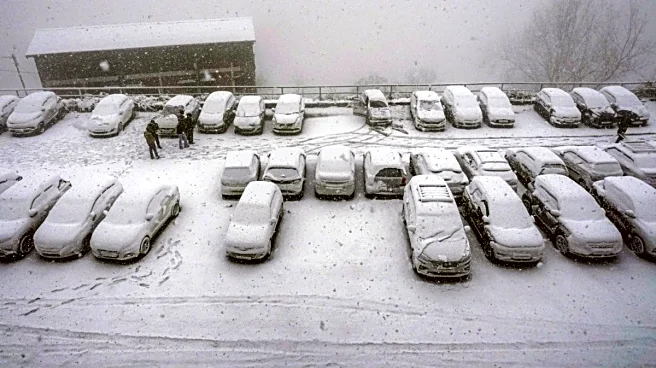




A fresh Western Disturbance is set to affect the Western Himalayan region from January 31 to February 2, raising the likelihood of heavy rainfall and snowfall on February 1, the India Meteorological Department (IMD) said in a press release issued on Tuesday
The weather agency also forecast light to moderate rainfall over the plains of northwest India and adjoining central India during the same period. In addition, dense fog conditions are expected during morning and night hours in northwest India, parts of central India and east India till February 2.
According to the IMD, dense to very dense fog with visibility dropping below 50 metres was recorded in isolated pockets of Punjab, Haryana and West Uttar Pradesh over the past 24 hours. Fog conditions
were also observed in parts of Rajasthan, Madhya Pradesh, Bihar and Odisha.
The department said cold day to severe cold day conditions prevailed in parts of Himachal Pradesh, while hailstorms were reported in isolated areas across Himachal Pradesh, Uttarakhand, Punjab, Haryana, Uttar Pradesh, Madhya Pradesh, Maharashtra and Delhi.
Thunderstorms accompanied by squally winds, with speeds ranging from 30 kmph to as high as 95 kmph, were recorded across several states, including Jammu and Kashmir, Himachal Pradesh, Uttarakhand, Uttar Pradesh, Madhya Pradesh, Maharashtra and the coastal regions of Konkan. The lowest minimum temperature over the plains was recorded at Amritsar (3.7°C).
The IMD warned that under the influence of the upcoming Western Disturbance, scattered to fairly widespread rainfall and snowfall with thunderstorms and gusty winds are likely over the Western Himalayan region and adjoining northwest plains on February 1, with isolated heavy rainfall or snowfall over Jammu and Kashmir and Himachal Pradesh.
The department has also issued fishermen advisories, cautioning against venturing into parts of the Arabian Sea and the Bay of Bengal between January 28 and February 2 due to rough sea conditions.
Dense fog and cold wave conditions could impact road, rail and air traffic, the IMD said, advising people to limit travel, stay indoors during severe weather, and take precautions against cold-related health issues.
The IMD has urged state authorities and the public to remain alert and follow district-wise weather warnings as conditions evolve over the coming days
/images/ppid_a911dc6a-image-177077322976413782.webp)

/images/ppid_59c68470-image-177077258165510745.webp)

/images/ppid_59c68470-image-177077272281824806.webp)
/images/ppid_59c68470-image-177077276056749159.webp)
/images/ppid_59c68470-image-177077261155977594.webp)
/images/ppid_59c68470-image-177077268877789072.webp)
/images/ppid_59c68470-image-17707726531682045.webp)
/images/ppid_59c68470-image-177077254224536754.webp)
/images/ppid_a911dc6a-image-177077043838376354.webp)