

/images/ppid_59c68470-image-177859503710395327.webp)
/images/ppid_a911dc6a-image-177867206857339185.webp)
When India adopted the 73rd Constitutional Amendment in 1992, it set in motion the world’s largest experiment in democratic decentralisation. Three decades on, as we mark National Panchayati Raj Day on April 24, we have around 2.6 lakh Panchayats, over 32 lakh elected representatives, and a remarkable body of institutional learning. We also have honest reasons for unease. Gram Sabhas too often fall short of quorum. Women elected as Sarpanch find their agency circumscribed by “Sarpanch-pati” practices. Gram Panchayat Development Plans remain, in too many villages, pro-forma documents. Substantive participation by Scheduled Castes, Scheduled Tribes and women is unevenly kept. The next decade will be defined less by the architecture of devolution
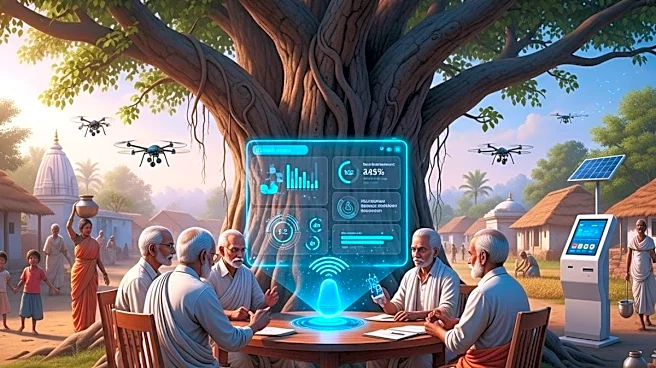
than by whether we close the gap between institutional form and democratic substance. Artificial intelligence, deployed with care, offers one of the most promising levers we now have. SabhaSaar offers a glimpse of what this can look like. Launched by the Ministry of Panchayati Raj on August 14, 2025, this AI-powered voice-to-text tool automatically transcribes and summarises Gram Sabha proceedings, generates minutes, logs attendance, records resolutions and tracks action points. By late January 2026, more than 1.1 lakh Gram Panchayats had adopted it. It now operates in 23 Indian languages, including Bodo, Santhali, Maithili, Dogri, Kashmiri and Sindhi, so linguistic diversity no longer stands between communities and their institutional memory. But SabhaSaar is only an opening move, not an endgame. The deeper question is how AI can be woven into the grain of Panchayat life so that planning is sharper, deliberation more inclusive, and accountability harder to evade. Consider first the chronic weakness in village planning. The Gram Panchayat Development Plan is meant to be a participatory, evidence-based blueprint, but is often copied forward from the previous year, populated with generic works and poorly aligned with real need. The Panchayat Secretary, stretched across several villages and dozens of portals, rarely has the time or data fluency to do better. An AI-assisted GPDP companion, integrated with eGramSwaraj, could change this. Such a tool would ingest village-level indicators from the Census, NFHS-5, Mission Antyodaya and asset geo-tags, combine these with SabhaSaar transcripts, and produce a diagnostic dashboard in the local language showing where the village stands on water, sanitation, nutrition, learning and livelihoods. It would suggest a priority-ranked menu of works and convergence opportunities with line-department schemes, with indicative cost estimates drawn from the state Schedule of Rates. The Sarpanch and the Gram Sabha retain full authority – while AI merely ensures that every decision is taken with the village’s own data visible on the table. Even a conservative 10-15% improvement in allocative efficiency, applied to GPDP-routed funds of roughly ₹40,000-50,000 crore annually, implies ₹4,000-7,500 crore redirected each year toward works that match village deficits. A second and arguably more transformative frontier is the information asymmetry that silences marginalised voices. A widow eligible for the National Social Assistance Programme, a MGNREGA worker owed wages, a Dalit household awaiting a PMAY instalment, a tribal student due a scholarship, each must navigate a thicket of portals, officials and paperwork. A voice-first AI entitlement assistant, reachable through an ordinary phone call or WhatsApp voice note in the caller’s own dialect, could rebalance this. Built on large language models fine-tuned on scheme guidelines and connected through APIs to the MGNREGA MIS, PFMS and DBT databases, such an assistant could tell a caller in Bhojpuri or Santhali whether her job card is active, how many days of wages are outstanding, why her pension is delayed, and how to file a grievance. Sitting outside the Panchayat hierarchy yet complementing it, the assistant does not replace the Gram Sachivalaya – it creates a parallel channel of verification that makes gatekeeping costlier. Over time the entitlement gap narrows, not because officials are coerced, but because citizens arrive better informed. A third opportunity builds directly on SabhaSaar. Once Gram Sabha audio is routinely captured and transcribed, the same data can illuminate the quality of deliberation itself. AI analysis of speaker turns and topic coverage, with appropriate anonymisation and consent, can produce a simple deliberation quality index for every Panchayat, for instance, how many women spoke, how many members raised issues, what proportion of time was devoted to each item, and whether resolutions respond to the questions citizens raised. A visible index creates the same reputational pressure Swachh Bharat rankings did for sanitation, at near-zero marginal cost. Fourth, AI-augmented social audit holds real promise for accountability. Computer vision applied to geo-tagged photographs and freely available satellite imagery can flag MGNREGA assets that exist only on paper. Language models can cross-check muster rolls against household rosters to surface ghost workers. A voice-based whistleblower channel, routed to Social Audit Units rather than to the implementing Panchayat, can protect those who report irregularities. The Gram Sabha that meets to ratify a social audit would, for the first time, arrive armed with visual and statistical evidence rather than rumour, and would be in a position to question rather than merely ratify. These possibilities come with real obligations. Connectivity in many Panchayats remains uneven. Digital literacy among elected representatives, especially first-time women and marginalised members, must be systematically built. Data on citizens’ entitlements must be held to exacting privacy standards. Algorithms must be auditable in the languages in which they operate. Above all, AI must augment, never substitute for, the constitutional space of the Gram Sabha. By getting this right, the next decade of Panchayati Raj will not merely digitise existing practice, but will equip the institution to become what the Constitution always envisaged – a site of substantive, informed and inclusive self-government. Profs. Vivek Pandey and Ranjan Ghosh are rural development experts and teach at the Indian Institute of Management, Ahmedabad. Views expressed are personal and solely those of the authors. They do not necessarily reflect News18’s views.
/images/ppid_59c68470-image-177884258300262709.webp)



/images/ppid_a911dc6a-image-177883422555542248.webp)

/images/ppid_a911dc6a-image-177878495952864180.webp)
/images/ppid_59c68470-image-177885256778177956.webp)

/images/ppid_a911dc6a-image-177858454562922923.webp)