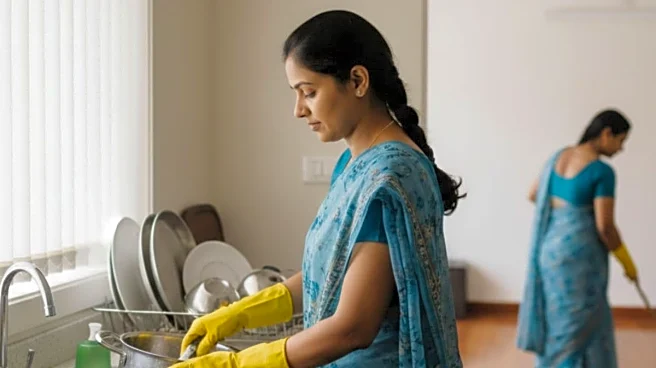

In many Bengaluru homes, the biggest monthly shock is no longer rent or groceries. It is the domestic help bill. What was once an informal, negotiable arrangement has turned into a structured, demand driven
market with surprisingly firm price points. Across the city, households are finding that domestic help salaries have climbed sharply, with some rates now rivalling EMIs.
Paying Rs 2000 for a single daily chore, Rs 7000 for full time cleaning, and Rs 12000 to Rs 15000 for cooking is becoming increasingly common. This shift is not limited to posh neighbourhoods or gated communities. It is spreading across apartments, independent houses, and even older localities that traditionally paid far less.
The New Price Reality Inside Homes
The numbers themselves tell a powerful story. A maid who comes once a day just to wash utensils or sweep and mop is now asking for around Rs 2000 per month for that single task. In many apartment complexes, demand for full time cleaning across all rooms has pushed rates to around Rs 7000 monthly.
Cooking, however, has become the premium service. Households report paying Rs 12000 to Rs 15000 a month for cooks who prepare two meals a day. The price varies based on dietary preferences, complexity of cooking, and number of people in the household. Specialised diets, weekend cooking, or hosting guests often invite additional charges.
What is striking is that these rates are increasingly non-negotiable. Many domestic workers are upfront. This is the rate, take it or wait.
What Is Driving This Sudden Shift
At the core of this change is a clear mismatch between demand and supply. Bengaluru has grown faster than its support systems. Thousands of new households are formed every year, driven by tech jobs, start-ups, and migration from other cities. Almost all of them look for domestic help.
On the supply side, the numbers are far smaller. Fewer workers are entering domestic work. Many have shifted to delivery jobs, construction, retail, or factory work that offers fixed hours, weekly offs, and sometimes social security benefits.
Domestic work, by comparison, often involves multiple homes, early mornings, physical strain, and little job stability. As a result, domestic workers now have leverage. And they are using it.
From Informal Labour to Market Power
Another major change is information sharing. Domestic workers today talk to each other. Apartment WhatsApp groups of workers, word of mouth across neighbourhoods, and shared experiences have led to rate standardisation.
In many localities, workers now collectively decide what the minimum acceptable pay should be. If a household refuses, the worker simply moves on, confident that another home will agree.
This informal rate fixing has quietly transformed domestic help into a seller’s market.
Time Is Money Now
Recently, domestic workers have also begun charging by task rather than by time. Earlier, a single worker might handle multiple chores for a bundled fee. Now, each task is clearly defined and priced.
Utensils are one rate. Floor cleaning another. Bathrooms cost extra. Cooking is separate altogether. Ironing, dusting, or walking a pet may invite additional payments.
This task-based approach reduces ambiguity for workers and increases costs for households. Families that earlier relied on one multipurpose maid are now either paying more or juggling multiple workers.
The Household Budget Crunch
For middle class families, the impact is significant. A typical household with utensils, cleaning, and cooking help could easily spend Rs 15000 to Rs 20000 a month on domestic help alone.
This is forcing many to rethink routines. Some have shifted back to dishwashers, robotic vacuum cleaners, or simplified cooking routines. Others choose to live without daily help, at least temporarily.
However, these adjustments come at a personal cost. Dual income households with long work hours find it difficult to manage without support. The maid economy is not a luxury for them. It is essential infrastructure.
Why This Trend Is Unlikely to Reverse Soon
There is little reason to believe domestic help salaries will stabilise quickly. Migration continues. Apartment living expands. Meanwhile, alternative employment avenues for workers continue to grow, especially with platform-based gig work.
Without institutional protection, domestic work remains physically demanding and socially undervalued. Higher pay, therefore, becomes the compensatory mechanism.
Experts point out that as long as demand continues to exceed supply, wages will remain firm.
A Quiet Reset of Urban Living
What Bengaluru is witnessing is not just a rise in salaries, but a recalibration of how domestic labour is valued. The comfort and convenience that households enjoy now come with a clear price tag.
In many ways, the maid economy in Bengaluru is catching up with the city’s real cost of living. The adjustment is painful for families, but long overdue for workers.
As one resident put it simply, domestic help is no longer cheap labour. It is professional support. And Bengaluru households are learning that this shift is not temporary.
/images/ppid_a911dc6a-image-177095464341460939.webp)

/images/ppid_a911dc6a-image-177095459124798392.webp)
/images/ppid_a911dc6a-image-177095456236021374.webp)
/images/ppid_a911dc6a-image-177095464047646858.webp)
/images/ppid_a911dc6a-image-177095453061774080.webp)
/images/ppid_a911dc6a-image-177095452776148437.webp)


/images/ppid_a911dc6a-image-177095363447023809.webp)
/images/ppid_59c68470-image-177095256656558605.webp)

/images/ppid_59c68470-image-177095259574929498.webp)