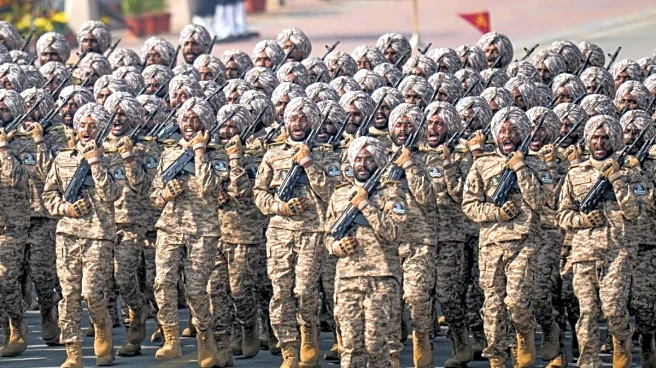

The Indian Army’s regimental system is one of the most enduring military traditions in the world, a structure built not merely on organisation, but on history, geography, identity and collective regimental memory.
Over centuries, the subcontinent’s forces evolved from princely-state units and Presidency Armies to the British Indian Army, followed by the restructuring that accompanied Independence and Partition.
Today, India has 27 infantry regiments, each with its own lineage, traditions, recruitment base, motto, war cry and battle honours. Some regiments trace their origins to the early eighteenth century; others were raised during the Second World War or formed in response to modern border-security needs. Together, they form the backbone of one of the world’s largest armies.
The 27 Infantry Regiments Of The Indian Army
Parachute Regiment
Raised in 1945 and headquartered in Bengaluru, the Parachute Regiment is India’s elite airborne and special forces arm. Its battalions have participated in the 1947–48 Kashmir conflict, the Korean War (via 60 Para Field Ambulance), the 1965 and 1971 Indo-Pak Wars, Operation Pawan in Sri Lanka, Operation Cactus in the Maldives, counter-insurgency operations and the Kargil War.
Motto: Shatrujeet | War Cry: “Balidan Param Dharma”
Punjab Regiment
With origins dating between 1757 and 1805, the Punjab Regiment is one of India’s oldest. Its regimental centre is located at Ramgarh, Jharkhand. Punjab battalions fought in the Carnatic campaigns, the Burma theatre, both World Wars and all post-Independence conflicts.
Its defence of Longewala in 1971, where 23 Punjab held ground against a Pakistani brigade, remains an iconic battle.
Motto: Sthal Wa Jal | War Cry: “Jo bole So Nihal, Sat Sri Akal”
Madras Regiment
Raised in 1758 and based in Wellington, Tamil Nadu, the Madras Regiment is India’s senior-most infantry regiment. Post-Independence, its battalions fought in J&K (1947–48), the 1962 Sino-Indian War, the 1965 and 1971 Indo-Pak conflicts, and sent seven battalions to Sri Lanka during Operation Pawan. It also absorbed Travancore, Cochin and Mysore State Forces after 1947.
Motto: Swadharme Nidhanam Shreyaha | War Cry: “Veera Madrasi, adi kollu”
The Grenadiers
Raised in 1778 with its centre at Jabalpur, Madhya Pradesh, the Grenadiers maintain the longest unbroken lineage in the Indian Army. Historically, grenadiers were chosen as the strongest soldiers for high-risk tasks, a tradition that shaped the regiment’s culture.
It has produced three Param Vir Chakra awardees, including the young Subedar Major Yogendra Singh Yadav for his gallantry in Kargil.
Motto: Naam Namak Nishaan | War Cry: “Sarvada Shaktishali”
Maratha Light Infantry
Tracing its history to the Bombay Sepoys of 1768, the Maratha Light Infantry is headquartered in Belgaum, Karnataka. Traditionally recruiting from Maharashtra’s Maratha heartland, the regiment earned 21 battle honours in World War I, the highest for any Indian regiment at the time. It remains one of India’s most decorated units.
Motto: Duty, Honour, Courage | War Cry: “Bol Shri Chhatrapati Shivaji Maharaj ki jai”
Rajputana Rifles
Formed in 1921 at Delhi Cantonment by amalgamating six older units, the Rajputana Rifles is the Army’s oldest rifle regiment. It has served in Korea, the Congo under the UN, and in every Indo-Pak conflict. The regiment has earned six Victoria Crosses, among many Indian honours.
Motto: Veer Bhogya Vasundhara | War Cry: “Raja Ramachandra ki jai”
Rajput Regiment
Raised in 1778 and based in Fatehgarh, Uttar Pradesh, the Rajput Regiment has fought in both World Wars and played key roles in post-Independence battles, including the capture of Tiger Hill in the Kargil War.
Motto: Sarvatra Vijay | War Cry: “Bol Bajrang Bali ki jai”
Jat Regiment
Raised in 1795 with its centre at Bareilly, Uttar Pradesh, the Jat Regiment is one of India’s most battle-tested formations. It earned 19 battle honours before 1947 and has served with distinction in all major wars since, including extensive counter-insurgency deployments.
Motto: Sangathan Va Veerta | War Cry: “Jat Balwan, jai bhagwan”
Sikh Regiment
Raised in 1846 and based at Ramgarh Cantonment, the Sikh Regiment is the most decorated infantry regiment of the Indian Army. Its 1st Battalion, before mechanisation in 1979, was the Commonwealth’s most decorated infantry battalion.
Its soldiers famously defended Saragarhi in 1897, where 21 Sikhs fought to the last man.
Motto: Nischay Kar Apni Jeet Karon | War Cry: “Jo bole So Nihal, Sat Sri Akal”
Sikh Light Infantry
Raised in 1944 at Fatehgarh, Uttar Pradesh, the Sikh Light Infantry descends from the 23rd, 32nd and 34th Sikh Pioneers. Recruiting mainly from Mazhabi and Ramdasia Sikhs, the regiment has operated in Siachen, counter-terrorism zones and UN missions.
Motto: Deg Teg Fateh | War Cry: “Jo bole So Nihal, Sat Sri Akal”
Dogra Regiment
Originating from the Agra Levy of 1858 and based in Faizabad, Uttar Pradesh, the Dogra Regiment recruits from Himachal Pradesh, Jammu & Kashmir and Punjab. It distinguished itself in the fall of Suadih (1971) and the capture of Tiger Hill (1999).
Motto: Kartavyam Anvatma | War Cry: “Jawala Mata ki jai”
Garhwal Rifles
Raised in 1887 with its centre at Lansdowne, Uttarakhand, the regiment is known for its discipline and gallantry, including three Victoria Crosses. Its rigorous mountain training remains a hallmark.
Motto: Yudhaya Krit Nishchaya | War Cry: “Badri Vishal Lal ki jai”
Kumaon Regiment
Tracing its origins to 1813 and based at Ranikhet, Uttarakhand, the Kumaon Regiment produced India’s first Param Vir Chakra recipient, Major Somnath Sharma. It traditionally recruits Kumaoni and Yadav soldiers.
Motto: Parakramo Vijayate | War Cry: “Kalika Mata ki jai”
Assam Regiment
Raised in 1941 with its centre at Shillong, the Assam Regiment represents all Northeastern states. Known for its distinctive greeting “Tagra Raho”, it has served across diverse theatres, including UN deployments.
Motto: Assam Vikram | War Cry: “Rhino Charge”
Bihar Regiment
Formed in 1941 and based in Danapur, Bihar, the regiment fought in the Burma Campaign, the 1947–48, 1965, 1971 and Kargil wars. It recruits from across Bihar and Jharkhand and is affiliated with INS Vikramaditya.
Motto: Karam Hi Dharam | War Cry: “Jai Bajrang Bali”
Mahar Regiment
Raised in 1941 at Saugor, Madhya Pradesh, the Mahar Regiment originally recruited from the Mahar community but now has a mixed composition. It has participated in the 1965 War, CI operations and UN missions.
Motto: Yash Siddhi | War Cry: “Bolo Hindustan ki jai”
Jammu and Kashmir Rifles
With origins dating to 1821 in the J&K State Forces, the regiment joined the Indian Army after accession in 1947. Based in Jabalpur, it has distinguished itself in Kashmir operations, UN missions and the Kargil War, where Captain Vikram Batra (PVC) served.
Motto: Prashata Ranvirta | War Cry: “Durga Mata ki jai”
Jammu and Kashmir Light Infantry
Raised after 1947 and formalised later, JAK LI is headquartered at Awantipora, J&K. Composed largely of local volunteers, it has earned exceptional honours, including a COAS Unit Citation for 12 JAK LI in Kargil.
Motto: Balidanam Vir Lakshanam | War Cry: “Bharat Mata ki jai”
Naga Regiment
Raised in 1970 at Ranikhet, the Naga Regiment embodies Naga martial culture, represented by the dao, spear and mithun in its crest. It has served in the 1971 war, UN missions and Kargil.
Motto: Parakramo Vijayate | War Cry: “Jai Durga Naga”
Gorkha Regiments (1 GR, 3 GR, 4 GR, 5 GR, 8 GR, 9 GR, 11 GR)
India retains seven Gorkha regiments under the 1947 Tripartite Agreement. Though formally distinct, they share a common ethos, recruiting largely from Nepali Gorkhas and Indian Gorkha communities. Their legendary courage, kukri tradition and gallantry awards — pre- and post-Independence — make them among the Army’s most storied units.
War Cry: “Jai Mahakali, Ayo Gorkhali”
Brigade of The Guards
Raised in 1949 at Kamptee, Maharashtra, the Brigade of The Guards was conceived by Field Marshal K. M. Cariappa as the Indian Army’s first “all-India, all-class” infantry regiment, breaking away from traditional regional or caste-based recruitment.
Originally a line infantry regiment, it later transitioned into the mechanised infantry role, becoming one of the core elements of India’s mechanised forces alongside the Armoured Corps. The Guards earned distinction early in their history, securing the highest number of battle honours among regiments raised after Independence, serving in conflicts from 1965 and 1971 to counter-insurgency and UN missions.
Motto: Pehla Hamesha Pehla | War Cry “Garud ka hun bol pyare”
Ladakh Scouts
Raised in 1963 and made a full regiment in 2000, the Ladakh Scouts specialise in extreme high-altitude warfare from their base in Leh. They played crucial roles in Operation Meghdoot (Siachen) and Operation Vijay (Kargil), earning numerous gallantry awards.
War Cry: “Ki Ki So So Lhargyalo”
Mechanised Infantry Regiment
Raised in 1979 at Ahmednagar, the Mechanised Infantry Regiment was created to give the Army a highly mobile, armour-compatible infantry force, an idea championed by General K. Sundarji, who became its first Colonel of the Regiment.
It is one of the youngest yet most widely dispersed regiments in the Army. Its units have participated in Operation Pawan in Sri Lanka, Operation Rakshak in Punjab and J&K, and Operation Vijay in Kargil, and have also played prominent roles in UN peacekeeping missions in Somalia, Congo, Angola and Sierra Leone.
Motto: Valour and Faith | War Cry “Bolo Bharat Mata ki jai”
Arunachal Scouts
Raised in 2010 with its centre at Shillong, the Arunachal Scouts were created to strengthen border defence along the Tibet frontier. Formed initially from the Assam Regiment, they specialise in mountain and jungle warfare.
Dogra Scouts
Raised in 1964 with their base in Kinnaur, Himachal Pradesh, the Dogra Scouts secure the high-altitude Indo-China border, operating at elevations above 14,000 ft in some of the Army’s toughest terrain.
Sikkim Scouts
Raised in 2013 and operational since 2015, the Sikkim Scouts recruit exclusively from Sikkim’s mountain communities. Based at Lucknow, they specialise in defending the high Himalayas along the India–China frontier.
Conclusion
India’s regimental system is more than a military structure; it is a living archive of the country’s history, culture and martial traditions. These 27 infantry regiments embody the diversity and resilience of the Indian Army.



/images/ppid_a911dc6a-image-177089159606325981.webp)

/images/ppid_a911dc6a-image-177089152458421393.webp)
/images/ppid_a911dc6a-image-177089155801556978.webp)
/images/ppid_a911dc6a-image-177089152814626887.webp)