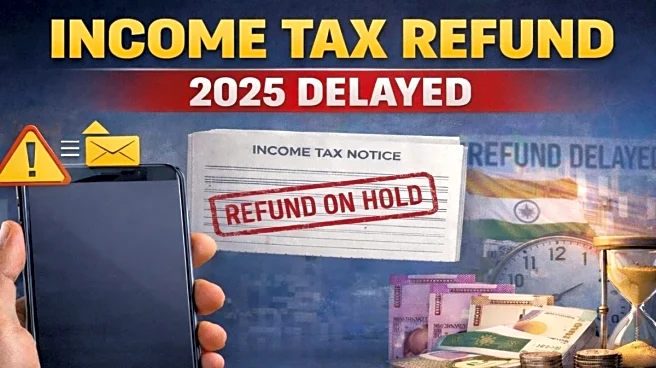

Income Tax Refund 2025: Three months after the conclusion of the extended due date for filing Income Tax Return (ITR) of FY2024-25 (Assessment year 2025-26) on September 16, a considerable number of taxpayers
are still awaiting their refunds. Typically, ITR refunds don’t take this much time and are debited to the taxpayer’s account in one or two weeks.
However, there’s nothing illegal about delaying the refund from the tax department side. Under Section 143(1) of the Income Tax Act, the department is legally permitted to process returns filed for FY 2024–25 up to December 31, 2026.
Multiple reasons are associated leading to delay in refunds for taxpayers:
High-Value Refund Flagged
The Central Board of Direct Taxes (CBDT) Chairman Ravi Agrawal told earlier that delays in refunds are occurring due to anomalies in certain claims of specific deductions in high-value ITRs.
In such situations, the Income Tax Department issues intimations, and taxpayers are required to respond to these communications in order for refunds to be processed.
Abhishek Soni, CEO and co-founder of Tax2win, notes that many salaried individuals have received such intimations. These cases largely involve employees who claimed deductions such as those under Sections 80C, 80D, or HRA in their ITRs but had not declared these to their employers at the time when tax was deducted at source (TDS).
NUDGE Campaign
Another factor contributing to slower refunds is the Central Board of Direct Taxes’ (CBDT) ‘Nudge’ campaign, launched in December 2025. Under this initiative, taxpayers whose returns show discrepancies are proactively informed via SMS and email. They are advised to either accept the variations identified by the Income Tax Department or rectify them by filing a revised or updated return. While the campaign is intended to promote voluntary compliance, refunds linked to such cases are being held back until the taxpayer responds.
Incorrect Information Of Bank Account
Sometimes, users put wrong information in bank details, leading to failure in sending refund amount.
Old Pending Tax
If a taxpayer has any old tax dues, the department releases the refund only after those dues are cleared. Also, if the ITR is not e-verified within 30 days of filing, the return does not get processed at all.
Mismatch In Form26AS, AIS Or TIS
If there is any major error in the return or the data does not match with Form 26AS, AIS or TIS, the refund is put on hold. In some cases, the ITR is marked as “defective,” and processing does not move forward until the issue is fixed. Sometimes, large refunds also face temporary financial delays.
Physical verification delays
If you opted to send your ITR-V physically to the Centralised Processing Centre (CPC) Bengaluru, late delivery can push back processing.
Step-By-Step Guide To Check Your ITR Refund
Method 1: Through the Income Tax Portal (incometax.gov.in)
- Go to www.incometax.gov.in
- Click on Login
- Enter your PAN, password and OTP
- After logging in, go to:
e-File > Income Tax Returns > View Filed Returns - Choose the relevant Assessment Year
- Check the status shown against your return
It will show terms like Processed, Refund Issued, Refund Failed, etc.
Method 2: Check refund status on TIN-NSDL (SBI Refund Banker)
- Visit https://tin.tin.nsdl.com/oltas/refund-status
- Enter your PAN
- Select the Assessment Year
- Enter the captcha
- The page will show your refund status, date of issue, mode of payment or reason for failure.
Method 3: Check through your bank account
- If your refund is credited, it will appear in your bank statement as: “ITR Refund – CPC Bangalore”.
- You will also receive an SMS from your bank or SBI.
Method 4: Check CPC email or SMS
The Income Tax Department sends an email and SMS when:
- Your return is processed
- Your refund is issued or failed
Do Taxpayers Get Interest On Delayed Refund?
As per Section 244A of the Income Tax Act, if a refund is delayed, the tax department will pay interest at the rate of 6 per cent per annum on the amount due. The interest is calculated from the date the refund becomes due until the date it is actually issued, provided the delay is not because of missing or incorrect information filed by the taxpayer. If the taxpayer has made an error or failed to respond to queries on time, the interest clock may not run for that period.


/images/ppid_a911dc6a-image-177105042575465447.webp)

/images/ppid_a911dc6a-image-177105033328862095.webp)
/images/ppid_a911dc6a-image-177105037137039801.webp)




/images/ppid_59c68470-image-177105003415990657.webp)

/images/ppid_59c68470-image-177105003432353455.webp)
/images/ppid_a911dc6a-image-177104902795770968.webp)