
/images/ppid_a911dc6a-image-177012233196627064.webp)
/images/ppid_a911dc6a-image-177012167607222415.webp)
/images/ppid_a911dc6a-image-177012153875699296.webp)
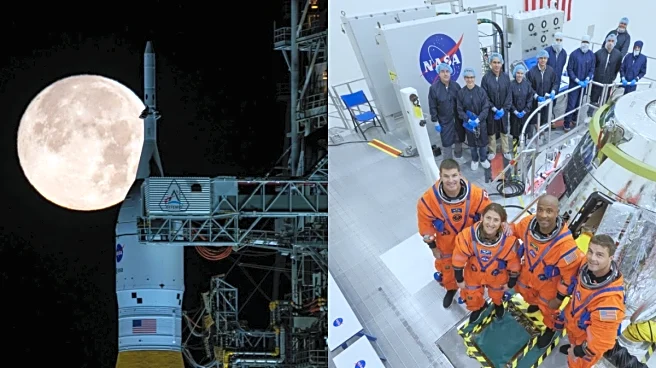
The US space agency National Aeronautics and Space Administration (NASA)’s much-awaited return to the Moon has been pushed back by a few weeks. After two days of intensive tests at the Kennedy Space Centre in Florida, the space agency announced on Tuesday that it is now targeting March “as the earliest possible launch opportunity” for its crewed test flight which had been expected to lift-off on February 8.
NASA Administrator Jared Isaacman, confirmed that the team is moving off the February launch window. “With more than three years between Space Launch Systems (SLS) launches, we fully anticipated encountering challenges. That is precisely why we conduct a wet dress rehearsal. These tests are designed to surface issues before flight, and set
up the launch day with the highest probability of success,” he added soon after the completion of the wet dress rehearsal on Tuesday.
The space agency said the engineers pushed through several challenges during the two-days and met many of the planned objectives. But to allow teams to review data, and conduct a second wet dress rehearsal, it will now target March as the earliest possible launch opportunity for the flight test.
HYDROGEN LEAK…WHAT REALLY HAPPENED?
A wet dress rehearsal is essentially a fueling test of the Space Launch system (SLS) rocket during which the team monitors all systems at the agency’s Kennedy Space Centre in Florida, identifies any issues and resolves them before attempting a launch.
During the tests which began on February 2 morning, teams spent several hours troubleshooting a liquid Hydrogen leak at a core stage interface during fueling, which required pauses to warm equipment and adjust the propellant flow. All core stage and interim cryogenic propulsion stage tanks were successfully filled, and teams counted down to about T-5 minutes before the launch automatically halted due to a spike in the liquid Hydrogen leak rate.
Additionally, they also detected some issues with the extended Orion closeout work, and occasional dropouts of audio communication channels. The biting cold weather also caused a late start to tanking operations, and affected some cameras which required attention.
“The team will fully review the data, troubleshoot each issue encountered during the two days, make the necessary repairs, and return to testing. As always, safety remains our top priority, for our astronauts, our workforce, our systems, and the public. We will only launch when we believe we are as ready to undertake this historic mission,” added Isaacman.
WHAT HAPPENS TO THE ASTRONAUTS IN QUARANTINE?
The four astronauts -NASA’s Reid Wiseman, Victor Glover, and Christina Koch, and CSA (Canadian Space Agency) astronaut Jeremy Hansen will now be released from quarantine, which they entered in Houston on January 21st. They will enter quarantine again about two weeks out from the next targeted launch opportunity.
The mission is indeed historic as it marks NASA’s return to the Moon after 54 years after the last Apollo landing. Four astronauts will fly aboard NASA’s Orion spacecraft and travel nearly 4,600 miles beyond the far side of the Moon. The spacecraft will not land on the Moon, and once the crew comes around the far side of the Moon, Orion will begin the return leg of their journey home.
The mission is designed to test the spacecraft’s systems in the deep space environment. The lessons learned throughout the mission will pave the way for humans to return to the lunar surface.








/images/ppid_59c68470-image-177012256007374908.webp)

/images/ppid_59c68470-image-177012252617289779.webp)
/images/ppid_59c68470-image-177012253357226261.webp)
/images/ppid_59c68470-image-17701225696484365.webp)