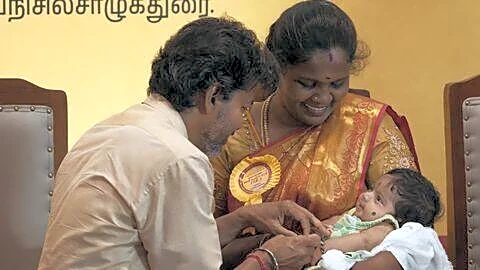




Tamil Nadu Chief Minister C Joseph Vijay will launch the state government’s ‘Thaai Maaman Thanga Mothiram Thittam’ (Maternal Uncle Gold Ring Scheme) in Madurai on Monday, September 28, offering a one-gram gold ring to eligible babies born in government hospitals and primary health centres.
The scheme, announced as part of the TVK government’s welfare agenda, is being rolled out with the stated aim of celebrating childbirth, encouraging deliveries in government hospitals and strengthening public confidence in state-run healthcare.
Vijay is scheduled to launch the programme at the Government Rajaji Hospital in Madurai, where he is expected to present rings to newborns and visit the maternity ward. The launch will also mark his first reported official
engagement in Madurai since taking charge as chief minister.
What Is The Thaai Maaman Gold Ring Scheme?
Under the scheme, every eligible baby born in a Tamil Nadu government hospital or primary health centre from June 22, 2026, onwards will receive a one-gram gold ring.
The government order for the scheme was issued on June 23. The June 22 cut-off coincides with Vijay’s birthday, although the government has presented the scheme primarily as a welfare initiative linked to maternal and child health and Tamil cultural tradition.
The rings will be 22-carat, 916-hallmark gold, with each ring carrying a unique serial number. They will be handed over in tamper-proof packaging, according to the state government.
Health Minister KG Arunraj had earlier said there would be no compromise on the quality of the gold. “It will be 916 hallmark gold, and the people need not worry about the quality,” he said while announcing the postponement of the original launch schedule.
Who Is Eligible?
The benefit is available to babies born in government hospitals and primary health centres in Tamil Nadu, provided the eligibility requirements are met. The mother must be a permanent resident of Tamil Nadu and must have registered under the Pregnancy and Infant Cohort Monitoring and Evaluation (PICME) system and obtained a Reproductive and Child Health (RCH) ID.
The scheme is therefore not simply a benefit available to any baby born anywhere in the state. The delivery must take place within the government healthcare system and the pregnancy must be covered by the state’s tracking and registration system.
The government has made the scheme retrospective to June 22, meaning families whose babies were born in government facilities between June 22 and September 28 will also be covered.
For this backlog, the government has arranged distribution through 107 hubs across Tamil Nadu. The rings will begin being distributed from September 28, with each hub expected to cater to about 100 babies a day.
For babies born after the scheme’s launch, the process is intended to be simpler. The ring will be handed over when the baby is discharged from the government hospital.
How To Apply
Eligible families do not have to apply separately for the gold ring. The benefit is linked to the mother’s registration under Tamil Nadu’s PICME (Pregnancy and Infant Cohort Monitoring and Evaluation) system and the RCH ID issued during pregnancy. Once an eligible baby is born in a government hospital or primary health centre, the hospital verifies the mother’s details and the baby’s birth before handing over the 1-gram, 22-carat ring.
For babies covered retrospectively from June 22, 2026, distribution is being organised through designated centres across the state. Families should therefore ensure that the pregnancy is properly registered under PICME and that the RCH ID and relevant hospital records are available for verification.
How Much Will The Scheme Cost?
The Tamil Nadu government has earmarked an annual outlay of Rs 755.83 crore for the programme. For the initial rollout, 1.28 lakh gold rings have already been procured. The larger procurement plan envisages roughly 4.41 lakh one-gram rings a year, corresponding broadly to the number of births taking place in government hospitals.
Work orders have been issued to jewellery companies including Joyalukkas and Kalyan Jewellers for supplying the rings. The procurement process itself had attracted attention after Joyalukkas emerged as the lowest bidder with an unusually low quote for associated charges. The government subsequently said it would ensure transparency in procurement and distribution.
The government has linked the new scheme to its broader maternal and child health initiatives, including financial assistance for pregnant women, free delivery and newborn-care services, emergency obstetric care, nutrition support and pregnancy tracking through PICME.
Why Is It Called ‘Thaai Maaman’?
The name draws from the Tamil tradition of ‘Thaaimaman Seer’, under which a maternal uncle gives gifts, including gold, to a newborn.
The government says the scheme is intended to bring this cultural tradition into a welfare programme while formally celebrating children born in government hospitals. The initiative was also included among the TVK’s pre-election promises.
In its official description of the scheme, the Tamil Nadu government has framed it as a way of “honouring motherhood” and “celebrating childbirth”, while also seeking to increase the number of deliveries in government hospitals and strengthen public trust in government medical institutions.