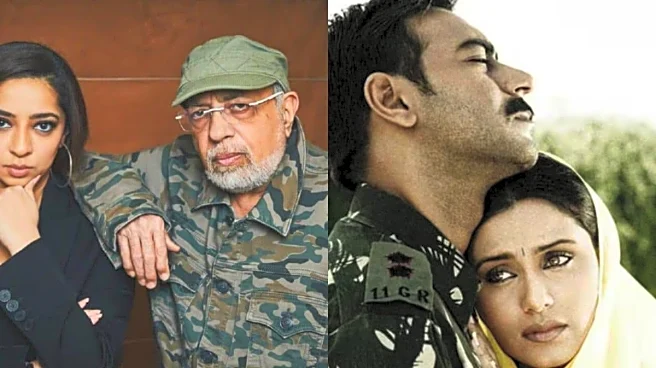




Putting a war film together is no mean feat. Border 2, having earned more than Rs 300 crore at the domestic box office, has emerged as the highest-earning Hindi film on cross-border conflict. With this, JP Dutta has added a new feather to his hat – after Border and LOC: Kargil. These two films may have earned big at the box office, but his daughter and Border 2 producer Nidhi Dutta exclusively tells News18 that making them, particularly LOC: Kargil, took a financial and physical toll on him.
She says, “He’s a very passionate filmmaker. He exhausted his personal savings to make sure that LOC was made. But along with the financial risk, his life was also at stake. He was shooting for the film in Ladakh. He has very high blood pressure. It was 240/130.
He had sworn the army doctor not to tell my mom, grandfather or the unit. Later on, when the film got completed, he told us that the doctor had told him, ‘Anything can happen to you. It’s a chance you’re taking with your life.’”
“My dad then told him that nothing can happen to him as the boys he’s making the film for won’t let him die. His intention and passion for telling stories is the legacy I want to carry forward,” Nidhi adds. That set also saw the tragic death of two crew members. “We had two light men who passed away during the making, because they were drinking. They weren’t allowed to drink. They were heart patients, which they hadn’t told us at that point. They had 90% blockages,” she tells us.
JP Dutta, in fact, also received pushback once LOC: Kargil was released, for making a four-hour-long film. “Our distributors told him that since it’s so long, they’re losing shows. He was suggested to trim down the film, but he refused. He didn’t want to chop its emotional quotient because he felt the families of the martyrs would go to theatres looking for their loved ones. He was okay with shows being lost. He didn’t care, monetarily. It wasn’t a commercial outing for him,” Nidhi says.
Nidhi further reveals that her father was initially ‘hesitant’ about directing the film. But it was a colonel’s words that made him change his stance. “LOC happened because the Kargil War had happened, unfortunately, and a colonel in the armed forces came to Mumbai to meet dad and told him that it’s a story that should be told. Dad told him, ‘I don’t know. It’s a big war. It just happened. It’s too soon.’ He didn’t want to do it immediately,” she recalls.
Nidhi continues, “He was a little hesitant. The colonel then made a statement that if 100 soldiers were killed, 99 were shot in the eye because that was the vantage point the Pakistanis had while our boys were going up the mountains. Dad then came and told my grandfather that if he doesn’t tell this story, he won’t be able to live with himself. That’s the reason he made LOC.”
/images/ppid_59c68470-image-177079012148080585.webp)

/images/ppid_59c68470-image-177079009037957749.webp)
/images/ppid_59c68470-image-177079006320740736.webp)
/images/ppid_a911dc6a-image-177079006379879775.webp)

/images/ppid_a911dc6a-image-177079003289086091.webp)


/images/ppid_a911dc6a-image-177079002610010543.webp)
/images/ppid_a911dc6a-image-177079002842398954.webp)
/images/ppid_59c68470-image-177079002661354065.webp)