
/images/ppid_a911dc6a-image-177100572282276854.webp)
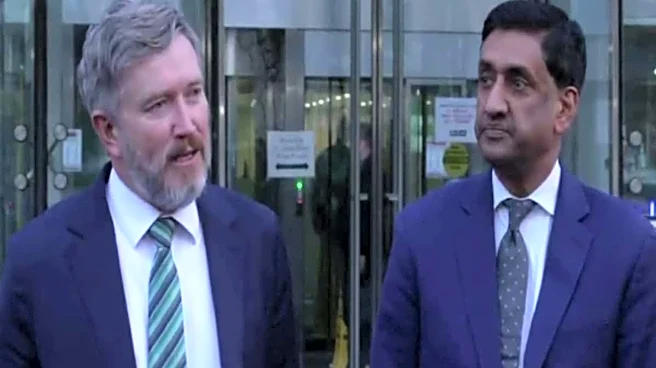
US House Representatives Thomas Massie and Ro Khanna on Monday said they identified at least six individuals “likely incriminated” after reviewing an unredacted tranche of Department of Justice files related to convicted sex offender Jeffrey Epstein.
Members of Congress were allowed for the first time on Monday to examine the unredacted versions of the DOJ files. Massie and Khanna were the lead sponsors of the bill that compelled the public release of the documents.
Six names identified
“We went in there for two hours. There’s millions of files, right? And in a couple of hours, we found six men whose names have been redacted, who are implicated in the way that the files are presented,” Massie told reporters outside the Justice Department office where lawmakers reviewed
the files.
The lawmakers did not reveal the names. They said one of the men is a high-ranking official in a foreign government, while another is a prominent individual. Later on X, Massie said the other name he recognised is of a “Sultan” and a “retired CEO,” who is listed as a co-conspirator.
Khanna said the review was not intended to create a “witch hunt” and noted that being named in the files does not automatically imply guilt. He added that powerful people beyond Epstein and Ghislaine Maxwell were involved in abusing underage girls or were present at locations where the abuse took place.
Call for DOJ review
Massie said he would not release any names and urged the Justice Department to correct its redactions.
“I think we need to give the DOJ a chance to go back through and correct their mistakes,” he said. “They need to themselves check their own homework.”
The law that mandated the release of the files allowed limited redactions, but lawmakers and victims have questioned the extent of material blacked out. Some have also raised concerns that names of victims were not consistently protected.
Questions over redactions
Massie referred to an FBI form listing conspirators in which the Justice Department had redacted the name and photo of one individual.
The lawmakers also discussed an email that drew attention, where a redacted person thanked Epstein for a “fun night” and wrote, “Your littlest girl was a little naughty.”
Massie said the email was sent by a woman and suggested that redaction decisions may have been made broadly.
“We can’t parse if the person who sent that was a victim or not,” he said.
Files received already redacted
Khanna said some documents reached the Justice Department already redacted by the FBI or from grand jury material, limiting what DOJ reviewers could see.
“The documents produced to Justice from the FBI, from the grand jury, was redacted when they got it,” Khanna said. He added that this was likely not the fault of career attorneys reviewing the material, but noted that the law required the FBI and original grand jury material to be provided unredacted.


/images/ppid_a911dc6a-image-177101752951095973.webp)



/images/ppid_a911dc6a-image-177101403147018469.webp)
/images/ppid_a911dc6a-image-177101053501199609.webp)
/images/ppid_59c68470-image-177101003680064644.webp)