
/images/ppid_59c68470-image-177077753316323586.webp)
/images/ppid_a911dc6a-image-177077683848562681.webp)
/images/ppid_a911dc6a-image-177077603394625504.webp)
Spanning from the Arabian Sea to the deserts bordering Iran and Afghanistan, Balochistan is a land abundant in minerals, history, and unresolved conflicts.
Despite being Pakistan’s largest province by territory, it remains the least developed and has been the epicentre of one of South Asia’s longest-standing liberation struggles.
The core of the conflict dates back to before Pakistan’s creation: the question of whether Balochistan’s fate in 1947 was a choice or an imposition. The roots of the modern struggle trace back to the princely State of Kalat.
Under the 1876 Treaty with British India, Kalat retained internal autonomy, setting it apart from directly administered colonial territories. As British rule neared its end in 1947, Kalat’s leadership
sought to restore its sovereignty.
A pivotal meeting in Delhi on August 4, 1947, brought together Lord Mountbatten, Jawaharlal Nehru, Muhammad Ali Jinnah, and the Khan of Kalat. It was agreed that Kalat will gain independence upon the British departure.
An agreement signed on August 11 between Kalat and the Muslim League recognised Kalat as a sovereign state, with an understanding that its independence would be respected. Kalat declared independence on August 15, raising its traditional flag and marking the Khan of Kalat as the ruler of a free state.
However, this independence was short-lived. British memoranda soon questioned Kalat’s capacity to function as a fully independent entity in international affairs. Political pressure from Pakistan’s new leadership mounted, pushing for Kalat’s integration into Pakistan.
According to Taj Mohammad Breseeg’s book Baloch Nationalism: Its Origin and Development Up To 1980, Jinnah sought accession while the Khan insisted on tribal consent before any binding decision.
In March 1948, Pakistani forces moved into Kalat and enforced its accession. For Baloch, this marked annexation, not a voluntary union, and has fuelled multiple uprisings since.
Since 1948, there have been five insurgencies, each driven by complaints of economic neglect, loss of autonomy, military repression, and the extraction of local resources without corresponding development. Despite Balochistan’s significant natural gas reserves, copper, gold, and strategic coastal access at Gwadar, many residents feel they see little benefit from these riches.
Tensions have recently intensified around the China-Pakistan Economic Corridor (CPEC), a CPC infrastructure initiative linking western China to the Arabian Sea. While Islamabad views CPEC as lucrative and transformative, Baloch activists see it as exploitation, displacement, demographic change, and militarisation. Security deployments to protect investments have only deepened local resentment.
Rebel groups like the Baloch Liberation Army (BLA) and the Baloch Republican Army (BRA) have grown in this environment. Their attacks have targeted security forces, infrastructure, and occasionally foreign interests linked to CPC projects.
Baloch activist and rebel groups, including BLA and BRA, alongside civil resistance, have tried to peacefully advocate their cause through diaspora mobilisations, human-rights advocacy, and appeals framed around political repression and missing persons. However, this push has seen limited global action.
Major rights bodies and UN-linked voices have repeatedly flagged concerns about human rights crackdowns and enforced disappearances. International human rights groups have documented patterns of disappearances attributed to state security institutions, with calls for Pakistan to end coercive measures against Baloch activists.
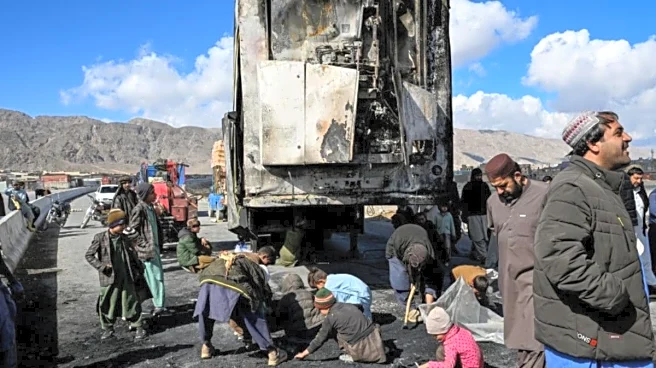
As non-violent mobilisation space narrows, some rebel factions argue that armed resistance is the only way to attract global attention. This struggle resurfaced in January with coordinated assaults across districts, including Quetta and Gwadar, targeting Pakistani Army forces. Pakistani security forces reported dozens of rebel deaths initially and later claimed at least 177 rebel deaths in subsequent operations.
Baloch women have also become more visible in this conflict. After the April 26, 2022, University of Karachi bombing by Shari Baloch, BLA messaging highlighted two Gen-Z, educated women — Hawa Baloch and Asifa Mengal — linked to subsequent attacks.
The rebel movement’s headline-grabbing operations have extended beyond provincial boundaries. The March 11, 2025, Jaffar Express hijacking gained international attention, projecting the Baloch cause outward while deepening public trauma.
Running parallel to these attacks is the image of families searching for the disappeared, allegations of extrajudicial killings, and the widening gulf between Islamabad’s security narrative and the community’s lived experience of pain and coercion.
Another shadow from the past involves Pakistan’s nuclear tests in the Chagai hills of Balochistan in May 1998. While celebrated nationally, many local Baloch argue that the aftermath left lasting geological and human scars: alleged radioactive contamination, barren lands, deformed terrain, and health issues among residents.
Diaspora Baloch communities mark March 27, associated with Kalat’s accession, as “Black Day” staging protests to draw international attention. Meanwhile, life in Balochistan continues under heavy security, economic uncertainty, and political distrust.
Beyond geopolitics and rebel statistics lies a human story: displaced fishermen in Gwadar, miners in dangerous conditions, students navigating checkpoints, and families caught between violence and crackdowns. For many residents, survival, dignity, and opportunity are paramount.
The Baloch struggle is complex and deeply emotional. It is about historical justice and control over their homeland. Seven decades after independence reshaped the subcontinent, the promises of 1947 in Balochistan are still argued, remembered, and resisted.
(The author is an international criminal lawyer and director of research at New Delhi-based think tank Centre for Integrated and Holistic Studies. Views expressed in the above piece are personal and solely those of the writer. They do not necessarily reflect News18’s views)
/images/ppid_a911dc6a-image-177078063816134902.webp)

/images/ppid_59c68470-image-177078010227674040.webp)

/images/ppid_59c68470-image-177078007003694796.webp)
/images/ppid_59c68470-image-177078013509370726.webp)
/images/ppid_59c68470-image-17707800326593461.webp)

/images/ppid_a911dc6a-image-177077884378925186.webp)
/images/ppid_59c68470-image-177077760046699504.webp)
/images/ppid_59c68470-image-177077752738996998.webp)
/images/ppid_59c68470-image-177077764100798849.webp)