
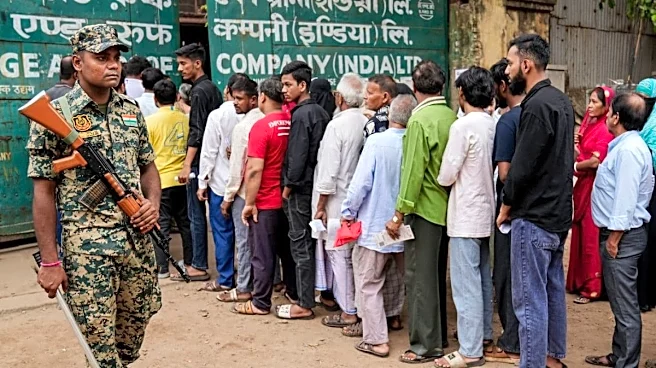
As the West Bengal Assembly election approaches its final stages, a familiar question has returned to the centre of political discussion: why does vote share matter more than seat count? While the number of seats determines who forms the government, analysts argue that vote share offers a deeper picture of a party’s real strength across the state.
This distinction is particularly important for the Trinamool Congress (TMC), which has consistently shown how electoral outcomes can differ sharply from overall voter support.
Follow West Bengal Assembly Election LIVE Updates
Seat count vs vote share
In any election, seat count is the final outcome. However, it does not always reflect how widely a party is supported or its vote share. A party can win many constituencies by narrow
margins and still have a lower total vote share. At the same time, another party may secure a large number of votes but fail to convert them into seats.
For TMC, this difference is crucial. A stable or rising vote share suggests that its base remains intact, even if it loses some seats. On the other hand, a drop in vote share may signal deeper political trouble, regardless of how many seats it wins.
What is first-past-the-post system?
India follows a first-past-the-post system, where the candidate with the highest number of votes in a constituency wins, even if the margin is very small. This system often creates gaps between vote share and seat count.
In West Bengal, this means that how votes are distributed matters as much as how many votes a party receives. TMC can win more seats if its votes are spread efficiently across constituencies. Meanwhile, an opponent may secure a high vote share but still end up with fewer seats if those votes are concentrated in a limited number of areas.
Lessons from 2021
The 2021 Assembly election remains the clearest example of this pattern. TMC secured around 48% of the vote but won about 213 seats. In comparison, the Bharatiya Janata Party (BJP) received about 38% of the vote but won only 77 seats.
This outcome showed how an efficient spread of votes can translate into a much larger legislative advantage. BJP’s rise in vote share was significant, but its votes were not distributed in a way that maximised seat gains.
For the 2026 election, the gap in vote share between TMC and BJP is being closely watched. Analysts see it as a key indicator of whether the contest is truly tightening across the state or becoming competitive only in certain regions.
Seat numbers alone may hide these trends. A party might lose or gain seats due to local factors, but vote share reveals broader shifts in voter preference.
Impact of opposition unity
Another factor that affects seat outcomes is the performance of opposition parties. If opposition votes are split, TMC can win more seats with a smaller share of the total vote. However, if rival parties manage to consolidate their support, even a slight decline in TMC’s vote share can lead to significant seat losses.
This is why analysts focus closely on vote share. It helps determine whether changes in seat count are due to genuine shifts in popularity or simply the result of how votes are divided.
Changing political trends
The shift in vote share over recent elections highlights evolving political dynamics in West Bengal. BJP’s vote share rose sharply from 10.17 per cent in 2016 to 37.97 per cent in 2021, marking its emergence as the main challenger to TMC.
During the same period, TMC’s vote share increased from about 44.9 per cent to around 47.9 per cent. While this rise was smaller, it was significant because the party already had a strong base and was able to convert its support into a large number of seats.
At the district level, the picture has been mixed. TMC’s vote share declined in some areas but increased in others, with notable gains in regions such as Murshidabad, Malda and Uttar Dinajpur.
Political strength
For TMC, vote share acts as a key measure of political health. A steady or rising share indicates resilience and continued public backing. In contrast, a sharp fall could point to growing dissatisfaction among voters.
In West Bengal’s competitive political environment, seat count shows who wins power, but vote share explains the strength behind that victory.

/images/ppid_a911dc6a-image-177766163054728448.webp)

/images/ppid_a911dc6a-image-177752127494180052.webp)
/images/ppid_a911dc6a-image-17774796406555981.webp)
/images/ppid_a911dc6a-image-17774614373916534.webp)
/images/ppid_a911dc6a-image-177745883500128594.webp)
/images/ppid_a911dc6a-image-1777466671525533.webp)