



Scientists welcomed the Union Budget’s long-awaited support for building and upgrading major astronomical research facilities, including large solar and optical infrared telescopes, along with planetarium-based public outreach, marking a major boost for Indian astronomy.
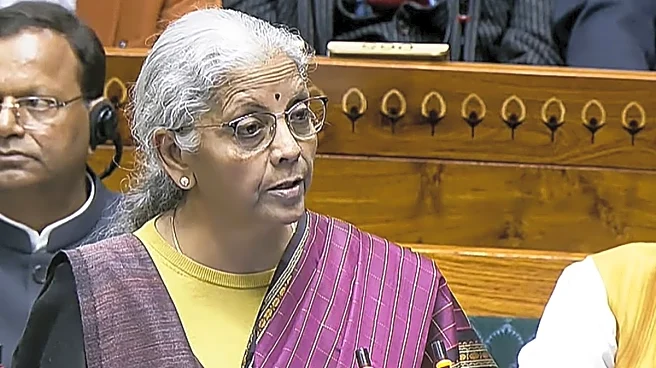
Finance Minister Nirmala Sitharaman announced the establishment and upgradation of the National Large Solar Telescope, the National Large Optical Infrared Telescope, and the Himalayan Chandra Telescope, as well as the COSMOS-2 planetarium, in her budget speech on Sunday to promote astrophysics and astronomy through immersive scientific and public outreach experiences.
“We are thrilled at the announcement and hail this push for building large next generation telescope facilities
and astronomy outreach centres in India,” stated the Indian Institute for Astrophysics (IIA), Bengaluru. Director IIA, Dr Annapurni Subramaniam called it a “game changer for astronomy research in India”.
The National Large Solar Telescope (NLST) is a ground-based 2-m class optical and near-infrared observational facility in India proposed near the Pangong Lake in Merak, Ladakh, at an altitude of around 4200 metres. The proposed National Large Optical Telescope, with cutting-edge instruments spanning near-UV to thermal infrared, is designed to enable key science goals, including high-resolution studies of solar system objects as well as exoplanet atmospheres.
Welcoming the decision, Professor Dibyendu Nandi from IISER Kolkata said these projects mark a crucial point for Indian astronomy. “These are very large-scale facilities. India has not had such major astronomical infrastructure before. This opens new doors for the scientific community, especially since access to global facilities is often limited and prioritised for their own scientific community. While it may take a decade to fully set them up, they will be extremely invaluable for the younger generation—sparking invaluable curiosity and imagination among young minds.”
Scientists said the inclusion of planetariums alongside telescopes is also crucial, noting that these projects have long featured in vision documents, and it is encouraging to see the budget formally endorse them. Astronomy outreach plays a vital role.
Indian astronomy got a major boost in 2015 with the launch of space observatory AstroSat, which opened the X-ray and UV skies to the community, followed by Chandrayaan missions providing a unique dataset related to the Moon. Aditya L1—India’s first solar observatory, launched in 2023—provided another boost to solar research in the country. India is also actively participating in international mega-projects like the Thirty Meter Telescope (TMT) International Observatory and the Laser Interferometer Gravitational-Wave Observatory (LIGO-India), strengthening its position as a key player in the global astronomy and astrophysics (A&A) community.
/images/ppid_a911dc6a-image-176993602650849254.webp)





/images/ppid_a911dc6a-image-176993252682897307.webp)
/images/ppid_59c68470-image-176994503085426505.webp)

/images/ppid_a911dc6a-image-176993953044641951.webp)
/images/ppid_59c68470-image-176992259573993206.webp)