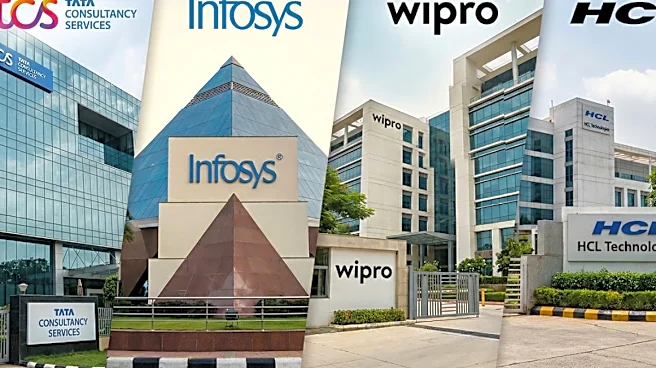



TCS, Infosys, HCL, Wipro Shares Fall Today: Shares of information technology (IT) companies, including Tata Consultancy Services (TCS), Infosys and Wipro, declined by more than 3.5 per cent in the early trade on Friday, April 24. The decline in stocks comes after Infosys on Thursday reported its weak Q4 earnings and bleak FY27 revenue guidance.
Infosys has announced muted revenue growth in Q4 FY26, with reported growth of 2 per cent quarter-on-quarter, while constant currency growth was slightly lower, as AI-driven spending caution amid macro uncertainty raised concerns over demand recovery in the sector.
For FY27, Infosys projected constant currency revenue growth of 1.5 per cent to 3.5 per cent, compared with its earlier guidance range of 3 per cent to 3.5 per cent, signalling
a more cautious demand environment in the near term.
“Poor guidance from IT majors indicates that large-cap IT stocks will continue to be weak despite the low valuations,” said V K Vijayakumar, chief investment strategist at Geojit Investments.
As of 10:05 am, Infosys fell nearly 4 per cent to Rs 1,191.10, emerging as one of the top laggards among large-cap IT counters. Tata Consultancy Services slipped 2.42 per cent to Rs 2,460.80, while HCL Technologies declined 2.49 per cent to Rs 1,222.40.
Tech Mahindra dropped 2.89 per cent to Rs 1,380.40 and Wipro was down 1.71 per cent at Rs 199.30. Mid-tier IT names were also under pressure, with Persistent Systems falling 2.16 per cent to Rs 4,955.70.
LTIMindtree was flat at Rs 4,504, while PB Fintech bucked the trend and traded 0.19 per cent higher at Rs 1,673.90.
The weakness in IT shares comes amid investor caution following Infosys’ quarterly earnings and management commentary, with the sector also sensitive to global demand outlook, discretionary spending trends, and movement in the US market where Indian IT firms derive a significant share of revenue.
What brokerages say on Infosys
Analysts largely described Infosys’ March quarter earnings as broadly in line to slightly below expectations, but said the main overhang remains the company’s FY27 revenue growth guidance of 1.5–3.5 per cent in constant currency terms. The outlook suggests that a sharp recovery in technology spending is yet to emerge, while management commentary on slower client decision-making and intense competition also dampened sentiment.
Jefferies said the quarter was mostly in line, but investors were disappointed by the muted FY27 guidance, lower headcount and softer net-new deal wins. While it raised earnings estimates slightly on forex tailwinds, the brokerage expects Infosys to post around 7 per cent EPS CAGR, adding that dividend yield may support the downside but limited growth visibility restricts upside.
HSBC noted that quarterly performance was a touch softer than anticipated, while the annual guidance was broadly in line given the recent weakness in sector expectations. It said the upper end of the guidance band would indicate stronger demand recovery, especially in the first half of FY27. HSBC also noted that the stock is trading near five-year lows despite healthy earnings growth in recent years.
Citi said the company delivered a weak fourth quarter, with both revenue and EBIT margin falling short of estimates. While the midpoint of the FY27 guidance was largely in line with expectations, the brokerage flagged delayed decision-making in March and higher competitive intensity as concerns. Citi has cut FY27 and FY28 earnings estimates marginally, but still expects Infosys to outperform peers in FY27.
Nomura said revenue for the quarter came in slightly below expectations, though margins were modestly better. It expects margins to remain around 21 per cent in FY27. The brokerage pointed to management confidence in a recovery in BFSI and EURS segments, helped by deal momentum and AI-led opportunities, and sees 3.4 per cent dollar revenue growth in FY27.
Morgan Stanley said Infosys missed estimates on key operating metrics in the March quarter and the FY27 outlook does not point to any meaningful acceleration in growth. It added that weak visibility could continue to pressure valuations, although the recent stock correction has narrowed the valuation gap with peers such as Wipro.