

/images/ppid_a911dc6a-image-177013911958388590.webp)
/images/ppid_a911dc6a-image-177013907631412003.webp)
/images/ppid_a911dc6a-image-177013903243466665.webp)
Marking a significant increase in allocation as compared to previous years, the education sector in the Union Budget 2026 has substantially positioned itself as a strategic national investment rather than just social expenditure.
In numbers and data, the allocation of Rs 1.39 lakh crore translates to a significant increase of more than 8 percent, which is higher than last year. This also reflects a major boost towards the National Education Policy (NEP) 2020 goal of spending 6 percent of the GDP on education.
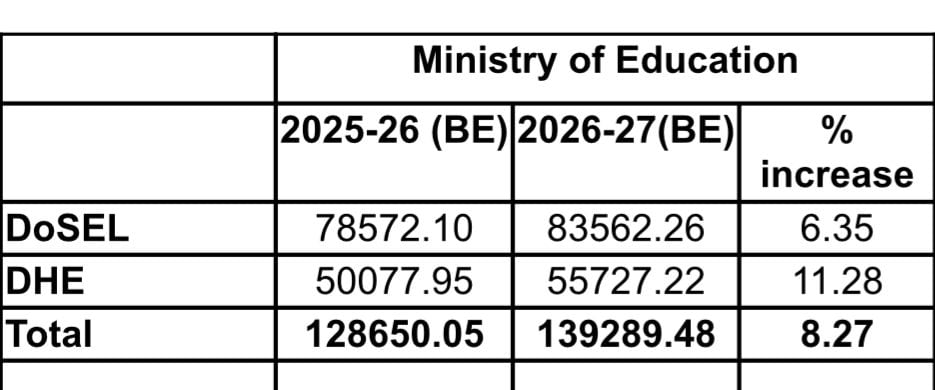
In higher education, the allocation has risen to Rs 55,727 crore – a significant jump from the previous year’s budget. Recording a steady upward curve, the 11.3 percent increase this year is double the growth rate of the previous fiscal year,
signalling a more aggressive investment phase earmarked for specific outcome-oriented initiatives.
Several first-of-its-kind initiatives have been introduced to bridge the gap between education and industry, including the setting up of university townships near major industrial and logistics corridors, establishing a National Institute of Design (NID) in the eastern region of India through a competitive “challenge route”. Another unique initiative includes a massive push for gender parity in STEM and higher education, with the setting up of one girls’ hostel in every district using viability gap funding (VGF).
The futuristic approach of the budget also highlighted preparing the workforce for a “phygital” (physical + digital) world with the rapid rise of artificial intelligence.
‘VISION PROPELLED BY YUVA SHAKTI’
Union Education Minister Dharmendra Pradhan lauded the Union Budget 2026, calling it driven by ‘yuva shakti’ giving boost to education and employment-creation while presenting a blueprint for the next phase of development.
Pradhan said the total allocation for the ministry of education has reached Rs 1,39,289.48 crore, marking 8.27 percent increase over Budget 2025. He said the budget is a solid blueprint for fully harnessing Bharat’s growth potential, fostering inclusive development of all sections and achieving the vision of ‘Viksit Bharat’.
#ViksitBharatBudget includes all. It gives boost to education and employment-creation and presents a blueprint for the next phase of development. https://t.co/9GZ38hSnVU
— Dharmendra Pradhan (@dpradhanbjp) February 1, 2026
He expressed his gratitude to Prime Minister Narendra Modi and Union Finance Minister Nirmala Sitharaman for delivering a futuristic, yuva shakti-driven, pro-people, employment-oriented and growth stimulating budget that includes everyone, stresses on people’s well-being and brings cheer to all, particularly poor and middle-class households. He said inspired by the three kartavyas of “accelerating and sustaining economic growth, fulfilling aspirations and building capacities of all and ensuring every family and community has access to resources, opportunities and amenities”, the budget will spur all-round growth across sectors, promote self-reliance in strategic and frontier areas.
This will facilitate ease-of-living, further invigorate our education, innovation and skilling landscape, strengthen MSMEs, boost tourism, augment healthcare, transform Tier-2 and Tier-3 cities into new growth centres. This will add momentum to the “Reform Express” for achieving the next phase of India’s growth and also ensuring that economic growth translates into tangible gains for more than 140 crore citizens.
The Union minister said among the three kartavyas outlined by Sitharaman, the second kartavya has announcements focused on strengthening the capacity of the yuva for realising the goal of ‘Atmanirbhar Bharat’. He highlighted in the higher education STEM institutions, prolonged hours of study and laboratory work pose some challenges for girl students.
He said the budget proposes to establish one girls’ hostel in every district through VGF/capital support. He added that the budget proposes setting up five university townships in the vicinity of major industrial and logistical corridors.
Pradhan further said these planned academic zones will host multiple universities, colleges, research institutions, skill centres and residential complexes. He said a high powered ‘education to employment and enterprise’ standing committee has been proposed to recommend measures that focus on the services sector, which is the core driver of ‘Viksit Bharat’. The committee will look into the impact of emerging technologies, including AI, on job and skill requirements, he said. It proposes specific measures for embedding AI in the education curriculum from school level onwards and upgrading state councils of educational research and training institutes for teacher training, he added.
He also lauded the setting up of India’s Animation, Visual Effects, Gaming and Comics (AVGC) content creator labs in 15,000 secondary schools and 500 colleges. This project aims to provide a platform to two million professionals by 2030 to the growing AVGC sector.
“The government’s plan to set up one girls’ hostel in every district of the country is going to revolutionise a framework to ensure safety and boost educational facilitation for girls and women across the remote areas of the country. Another milestone decision is the setting up of 5 university townships with states, which will be the integrated zones housing universities, research centres, and skill hubs to ensure students are ‘industry-ready’ upon graduation. Along with this, the Union Finance minister’s decision to set up AVGC Content Creator Labs in 15,000 secondary schools and 500 colleges will further prioritise upskilling for steering growth in the orange economy,” he said.
FOCUS ON EDUCATION-TO-EMPLOYMENT, WOMEN IN STEM: EXPERTS
Amid a market that witnesses a significant lack of job readiness, experts and industry leaders view this bill as the heart of recognising the transformative power of the orange economy.
“India’s growth rate has been impressive, and inflation has remained low. This budget comes against the backdrop of massive global uncertainty. However, there have been lingering concerns about the sources and quality of growth, and whether it is truly inclusive,” said Dr Partha Chatterjee, dean of academics and professor of economics at Shiv Nadar University.
Dr Sunil Rai, UPES vice-chancellor, said as the foundation for a sustained economic growth, the budget prioritises the critical link between education and employability.
“The focus on university townships near industrial hubs, the education-to-employment high-powered committee, and sector-specific skilling initiatives reflects a decisive shift towards outcome-oriented higher education. The strong emphasis on assessing the impact of AI on jobs, scaling investments and skilling across semiconductors and digital technologies, aligning curricula with industry needs, and initiatives supporting women’s participation in STEM all reflect a clear recognition that India’s demographic advantage must translate into real economic outcomes. By aligning institutions, industry and research, the Budget lays a strong foundation for preparing the workforce as India advances towards a Viksit Bharat,” he said.
Ashoka University vice-chancellor Somak Raychaudhury said the budget rightly places education, skills, science and healthcare at the centre of India’s growth strategy.
“The push for new universities, design institutes, and stronger STEM ecosystems signals a clear intent to democratise access and build a future-ready talent pipeline. Equally important is the Budget’s focus on strengthening India’s scientific and innovation backbone – from advanced research infrastructure such as astronomical telescope facilities on Indian soil to AI-enabled learning, creator labs, and targeted investments in biopharma and healthcare skilling. The proposed education-to-employment standing committee is a strong step towards tighter academia-industry alignment. Together, these measures significantly strengthen India’s human capital and innovation capacity, accelerating the journey towards a Viksit Bharat,” he said.
Dr P Venkat Rangan, vice-chancellor, Amrita Vishwa Vidyapeetham, hailed the budget as a thoughtful and forward-looking vision for India’s higher education system.
“It sees universities not just as teaching institutions but as vital engines for national capability, innovation, and inclusive growth. The focus on integrated university townships, stronger connections between industry and academia, and skills-related learning shows a clear understanding of how education needs to change to keep pace with a quickly evolving global economy. Overall, Budget 2026 reinforces the message that higher education is not a cost, but a strategic investment in India’s long-term economic resilience, innovation leadership, and sustainable development,” he said.
“Last year’s budget took an important first step by raising the LRS TCS threshold and exempting education remittances funded by loans, acknowledging the cash-flow challenges families face when planning overseas study. This year’s bold decision to cut the TCS rate on education remittances from 5% to 2% goes much further. It not only reduces upfront financial burden but also brings predictability and affordability to global education planning. The combined effect of these changes is real relief for families, broader access for students, and a more enabling environment for pursuing education abroad,” said Co-Founder, GradRight, Aman Singh.



/images/ppid_59c68470-image-177014254985920163.webp)

/images/ppid_59c68470-image-177014254305695630.webp)





/images/ppid_59c68470-image-177014002722588046.webp)