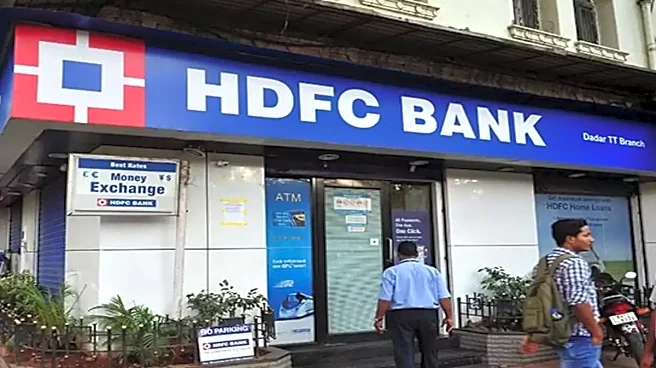




Shares of HDFC Bank fell more than 2 per cent on Wednesday after a report emerged about an internal vigilance probe linked to alleged irregular interest payments routed through marketing expenses. A decline in the share price of HDFC Bank often attracts far greater attention than a fall in many other companies. That is because the bank is not just another listed lender; it is deeply linked to India’s financial system, stock markets and consumption-driven growth story.
Market leader in private banking
HDFC Bank is India’s largest private sector bank and is officially classified by the Reserve Bank of India (RBI) as a Domestic Systemically Important Bank (D-SIB). It is among the country’s most closely tracked financial institutions. Over the years, it has built a reputation for
strong governance, steady loan growth and relatively stable asset quality.
Because of its scale and dominance in retail banking, investors often treat the bank as a benchmark for the overall health of the private banking sector. Any concern around governance or business practices, therefore, tends to draw immediate market attention.
Heavyweight in benchmark indices
The bank is one of the biggest constituents of benchmark indices such as Nifty 50 and Sensex. The lender holds about 11 per cent weightage in the NSE Nifty and 7.98 per cent in the BSE Sensex.
This means even a small movement in the stock can significantly impact the broader market indices. A sharp decline in HDFC Bank shares can drag down benchmark indices, influence passive fund flows and affect the performance of crores of retail investors invested through mutual funds, SIPs and retirement products linked to index funds.
Domestic institutions hold a significant chunk of the bank, with mutual funds and other domestic entities controlling a combined 40.32% of the shareholding, while foreign institutions hold roughly 44.05%.
Long-term wealth creator for investors
HDFC Bank has historically been seen as one of the most consistent compounders in the Indian stock market. For years, both institutional and retail investors viewed the stock as a relatively stable long-term wealth creator compared to many cyclical or volatile businesses.
Its track record of delivering earnings growth and expanding its retail franchise helped the bank become a core holding in many portfolios. As a result, any sharp correction in the stock often creates wider nervousness among long-term investors.
Though the stock is down 20.8 per cent in the past one year, it has delivered a whopping 7,350 per cent returns since 2002.
Seen as a proxy for India’s middle-class consumption story
HDFC Bank has a large presence across retail loans, home loans, auto loans, personal finance and credit cards. Because of this, investors often see HDFC Bank as a proxy for India’s urban middle-class consumption and economic growth story.
Its performance is closely associated with consumer spending trends, borrowing activity and the broader confidence of salaried households. Any negative development involving the bank can therefore raise concerns beyond banking, extending into the broader consumption and economic narrative.
/images/ppid_59c68470-image-177986002440031928.webp)

/images/ppid_59c68470-image-17797275737339589.webp)

/images/ppid_59c68470-image-177970508633813920.webp)
/images/ppid_59c68470-image-17797100362734586.webp)
/images/ppid_59c68470-image-177971259108249565.webp)
/images/ppid_59c68470-image-177980507689096877.webp)