
/images/ppid_a911dc6a-image-177598767941179091.webp)
/images/ppid_59c68470-image-177598002563123081.webp)
There are singers who inherit a space, and there are singers who create one. Asha Bhosle belonged unmistakably to the latter kind—a voice that entered an already consecrated soundscape and quietly, almost playfully, redrew its boundaries. She is no longer here in the way she was. But the voice remains—restless, unconfined, as though memory itself cannot hold it, as though it continues to move just beyond what can be gathered and kept. She began in the shadow of Lata Mangeshkar, at a time when transcendence had already found its perfect instrument. But Asha’s instinct was different. She did not attempt to rise into that clarity. She turned elsewhere—toward the intimate, the conversational, the shaded, toward the fleeting smile within a phrase.
In this, she found an early kinship with Geeta Dutt, whose voice carried a human closeness that could tease and ache in the same breath. In those early years, her singing carries that imprint—the loosened phrasing, the rhythmic lilt, the suggestion of a smile within the line. It is less imitation than placement: a way of locating her voice within a space that allowed play as much as feeling. Where Lata offered transcendence, Geeta brought immediacy—a voice that could lean into a word, hold it lightly, and then, without warning, allow it to ache. Circumstance, however, accelerates what instinct begins. As Geeta Dutt’s life grows troubled—her marriage to Guru Dutt fraying, her presence in the industry becoming uncertain—the balance shifts. Opportunities move quietly, almost invisibly. And Asha steps into that space with a speed that suggests not opportunism, but readiness. Within a decade, the borrowed light alters. The voice gathers contour—sensuous, teasing, assured. It acquires the ability to hold mischief without losing control, to suggest desire without apology. By the late 1950s, she is no longer emerging. She has arrived—not as an echo, nor as a counterpart, but as something newly defined: an independent tonal presence that allows Hindi film music to feel differently. The voice does not imitate. It absorbs. It bends, settles, adjusts—never losing its centre, never announcing its range.
Rhythm, Ascent, and the Nayyar Years
That arrival finds its first decisive form in her collaboration with O. P. Nayyar. From the mid‑1950s, he gives her not merely songs, but space to move, to swing, to inhabit rhythm as something lived rather than imposed. His music does not seek transcendence; it insists on presence. It leans forward—quick, unsentimental, shaped by beat and gait—and Asha responds by altering the very grain of her voice. It becomes bodily: alive to tempo, alert to pause, capable of turning within a phrase from tease to assertion without breaking its flow.
By Baap Re Baap (1955), with “Piya Piya Piya Mera Jiya Pukare,” that lightness gathers energy; the lilt is still reminiscent of Geeta Dutt, but it is sharper now, more youthful, more forward in its impulse. What Nayyar begins to do, quite deliberately, is to trust her with tonal territory that had until then been uncertain—songs that carried flirtation, Western inflection, rhythmic looseness. Where earlier such spaces had often belonged to Geeta, Nayyar re-centres them around Asha, and in doing so, reshapes her position within the industry.
By the time of Naya Daur (1957), the transformation is complete. Here, she is no longer a supporting voice. She stands at the centre. In “Uden Jab Jab Zulfen Teri,” there is swing without strain, playfulness without self‑consciousness. In “Reshmi Salwar Kurta Jali Ka,” the voice acquires a supple sensuality—light, teasing, but controlled. And even within a song like “Saathi Haath Badhana,” which carries collective energy, her presence remains distinct, grounded, assured.
It is in this phase that she fully steps out of the long, structuring shadow of Lata Mangeshkar. Nayyar’s refusal to work with Lata is often noted, but what matters more is what that refusal creates: a parallel soundscape in which Asha is not secondary, not alternative, but central.
Through the late 1950s and into the early 1960s, this identity deepens. Songs like “Aaiye Meharbaan” and “Mera Naam Chin Chin Chu” extend her tonal range—urban, cosmopolitan, lightly Westernised—while retaining that essential rhythmic ease. The voice learns to carry suggestion without weight, seduction without insistence.
And then, as the decade turns, something else enters. In Phir Wohi Dil Laya Hoon, Kashmir Ki Kali, Mere Sanam, and Yeh Raat Phir Na Aayegi, the tonal palette expands further. “Isharon Isharon Mein Dil Lene Wale,” “Jaaiye Aap Kahan Jayenge,” “Huzurewala Jo Ho Ijazat,” “Mera Pyar Woh Hai”—each introduces a slightly different shade: playful, romantic, lightly wistful, momentarily reflective.
What is striking is that none of these feel like departures. The core remains intact. The voice does not reinvent itself with each song; it absorbs. It adjusts, bends, settles—never losing its centre, never announcing its range. By the mid‑1960s, what Nayyar had set in motion reaches a quiet culmination. Asha Bhosle is no longer being shaped. She is shaping the space she occupies. The voice is no longer becoming. It has become—and continues, almost imperceptibly, to grow.
“Chain Se Humko Kabhi Aapne Jeene Na Diya” — The Unquiet End
By the early 1970s, the relationship—personal as much as musical—begins to fray. The ease that once defined their collaboration gives way to distance, then to silence. And it is here, almost at the point of rupture, that “Chain Se Humko Kabhi Aapne Jeene Na Diya” takes shape.
Composed by Nayyar as their association is coming apart, the song carries within it the knowledge of an ending, even if it never names it. The familiar energy recedes. The rhythm slows, hesitates, as though unwilling to move forward. And Asha sings differently.
The line does not rise into accusation; it settles, lingers, almost weary of its own articulation. There is restraint here, but it is not stylistic—it is emotional. A voice aware not only of feeling, but of its exhaustion.
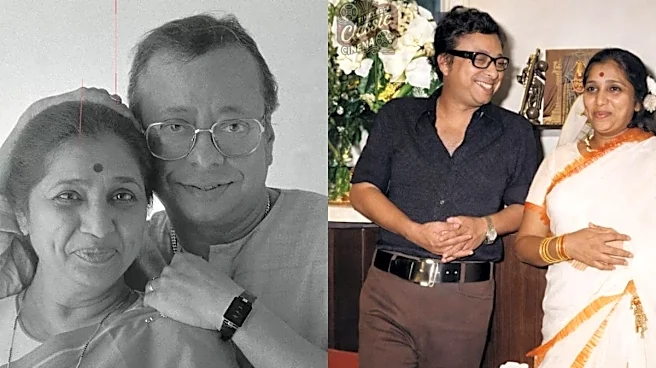
The irony is quiet, but complete. A partnership built on movement comes to rest in a song that resists movement—composed at the edge of separation, and already sounding like aftermath. After their break in 1972, Nayyar continues to compose, but something essential has withdrawn. He turns to other voices—Krishna Kalle, Dilraj Kaur—yet the music no longer carries the same charge. In later years, he remains tethered to Asha’s absence, naming her as the defining presence of his life.
What lingers between them is not resolution, but suspension.
A Life Touched by Rupture
She was still poised between girlhood and adulthood—sixteen, perhaps seventeen—when she chose to run away and marry Ganpatrao Bhosle, a ration inspector and, not incidentally, the secretary to her already celebrated elder sister, Lata Mangeshkar. Nearly twenty years older, he belonged to a different world, and what began as an act of defiance soon narrowed into something more confining.
He is said to have resented her closeness to her family, especially Lata, whose growing fame cast a long and inescapable shadow. Gradually, Asha found herself cut off, drawn into a smaller, more controlled domestic life. The marriage turned troubled—marked by frequent quarrels, emotional strain, and, by several accounts, abuse.
The breaking point came when she was asked to leave while pregnant with her third child. By then, the distance from her family had deepened into a painful silence. Between the two sisters fell a long estrangement, filled with hurt and unspoken words—an absence that would take years to heal.
“Ab Ke Baras Bhej Bhaiya Ko Babul” — Memory, Pain, and the Voice That Remembers
“Ab Ke Baras Bhej Bhaiya Ko Babul” from Bandini carries a truth that feels less performed than lived—and in many ways, it was. When Asha Bhosle first approached the song, something resisted completion. The notes were right, the phrasing exact, the structure intact—but the ache, the inner pull of the composition, remained just out of reach. I
S. D. Burman understood this instinctively. He did not intervene musically; he did not ask for correction, modulation, or emphasis. Instead, he turned her inward. He asked her to remember. By then, Asha had already lived through a quiet but devastating rupture. Her marriage to Ganpatrao Bhosle had drawn her into a space of increasing isolation—cut off from her family, estranged from Lata Mangeshkar, denied even the ordinary consolations of belonging.
To be asked to remember, then, was not an artistic exercise. It was a return. Burman urged her to sing from that place—not as a performer shaping emotion, but as someone who had known, intimately, what it meant to be kept away. To long for a home that was no longer accessible. To feel the pull of return not as nostalgia, but as need.
On screen, the song belongs not to a heroine, but to a nameless female jail inmate—one voice among many, seated within confinement, singing not for spectacle but for survival. Around her, other women listen, their stillness completing the song. And over this collective, muted ache, Shailendra’s words move with devastating simplicity: a married daughter calling out across distance, asking—this year, at least, send my brother to take me home. No metaphor, no embellishment. Only a plea shaped like a memory.
What makes the song endure is precisely this: it does not perform longing; it inhabits it. The voice does not reach outward; it folds inward, carrying with it the knowledge that some distances are not meant to be crossed, only remembered.
Around this moment, one begins to understand more clearly the full arc of her artistry.
With S. D. Burman, that inwardness does not remain confined to a single moment. It opens into a wider range from memorable “Haal Kaisa Hai Janab Ka” ,Kali Ghata Chhaye,” “Chanda Re Chanda,” “Raat Akeli Hai,” she moves across emotional worlds—folk‑rooted ache, monsoon restlessness, urban solitude—without visible transition. The voice adjusts without display, finding the centre of each mood as if it had always been there.
If Burman draws memory out of her, Madan Mohan reveals something even more difficult: restraint. In “Saba Se Yeh Keh Do,” the voice rests lightly, almost demurely, on the melody. Nothing is underlined. Nothing is pressed. The feeling is suggested, not declared. The same quiet control shapes songs like “Tere Paas Aake Mera Waqt Guzar Jaata Hai” and “Shokh Nazar Ki Bijliyan.” Even where the melody invites expansion, she resists excess. The line is held close, the emotion contained—not diminished, but refined.
What emerges across these collaborations is not versatility in the obvious sense. She does not perform difference. She absorbs it. And somewhere between Burman’s insistence on memory and Madan Mohan’s demand for restraint, the voice finds a new equilibrium—one that no longer needs to prove, only to inhabit.
R. D. Burman: From Cabaret Fire to Interior Light
When R. D. Burman enters Asha Bhosle’s musical life, the voice is already formed—rhythmic, assured, capable of inhabiting movement. But what he offers is not merely another phase. He opens a field in which that movement can turn, deepen, and finally, withdraw.
Their early work together arrives with an almost startling energy. In “O Haseena Zulfon Wali” (Teesri Manzil) and “Piya Tu Ab To Aaja” (Caravan), the voice is all motion—breath breaking into beat, syllables slipping into rhythm, the line itself becoming percussive. This is not just cabaret as a cinematic device; it is something newly alive in Hindi film music. The famous calls, the teasing hesitations, the almost playful excess—Asha does not merely render them, she animates them.
Here, she is not following the composition. She is completing it. Pancham builds the frame—electric guitar, brass, Latin percussion, a Western pulse that refuses stillness. And within that frame, Asha’s voice becomes kinetic, almost visible. It dances, it provokes, it inhabits the body of the song. If Nayyar had given her rhythm, Burman amplifies it—turns it outward, makes it spectacle.
But what is remarkable is not that she excels in this space. It is that she does not remain there. Even within this period of high energy, there are shifts—small at first, almost imperceptible. The playfulness acquires nuance, the overt seduction begins to carry an undertone of something quieter, more inward. And then, gradually, the axis changes.
By the time of Yaadon Ki Baaraat, something has turned. In “Chura Liya Hai Tumne,” the voice sheds its earlier brightness. It softens, lingers, allows pauses to lengthen. The phrasing is no longer driven by beat; it breathes. The emotion is not displayed; it is discovered, almost as if the song is being thought rather than performed.
Around it gather other shades—“Lekar Hum Deewana Dil,” with its easy, modern lightness; later, songs where desire no longer needs the language of spectacle to declare itself. What had once been external becomes interior.
And then, in the later phase of their collaboration—now deepened by life itself, by companionship, by marriage—the voice undergoes its most profound transformation. In “Mera Kuchh Saaman” (Ijaazat), Asha sings as if memory itself has taken form. The structure loosens; the song resists melody in the conventional sense. Gulzar’s words arrive as fragments—objects, recollections, unfinished thoughts—and R. D. Burman composes not around them,
The voice is stripped of ornament. It does not decorate the line; it inhabits its hesitations. Each phrase feels placed rather than sung—as if drawn out of memory and set down without insistence. There is no effort to resolve the feeling. It is allowed to remain.
In “Qatra Qatra” (Ijaazat), Gulzar writes in fragments—objects, half-recollections—while R. D. Burman leaves space around them. The composition loosens, refuses to settle. Asha does not complete it—she moves within it. Desire is no longer declared; it is broken, held in pauses, carried across breath.
This is a long distance from “Piya Tu Ab To Aaja.” And yet, it is the same voice.
What Pancham, Gulzar, and Asha arrive at together is not a new style, but a different way of making a song—words, music, and voice circling each other, leaving gaps, trusting silence. The energy that once moved outward through rhythm is now withheld, turned inward, placed with care.
The collaboration did not last long enough. What they opened remained only partially explored. Later, she would sing with Jagjit Singh, with Adnan Sami—different worlds, different idioms—but always with that same instinct: not to fill the line, but to hold it.
And in Pancham, she finds not only a composer who understands her rhythm, but one who trusts her restraint—and in that trust, the voice finds its most enduring form:
not in display, but in the ability to remain within a feeling.
Whispers, Sisters, and the Shape of Rivalry
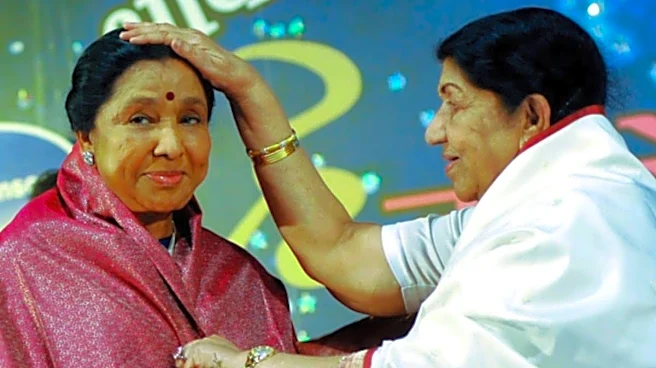
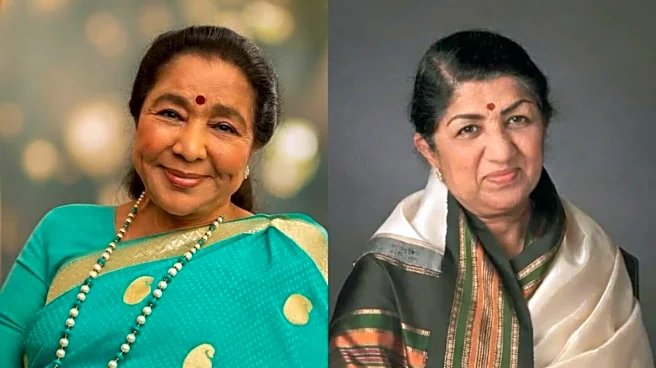
Between Asha Bhosle and Lata Mangeshkar, the rivalry existed more in public narrative than in lived exchange. The industry required it. Two voices of such scale could not be allowed to exist without comparison; they were placed into a structure of opposition. One must rise, the other yield. One must define, the other resist. The pattern repeated because it was easy to circulate and easier to sustain.
And yet, what unfolded between them did not follow that script. There were periods of distance, moments of ease, and a relationship that did not settle into a single condition. Asha would recall instances when alignments were imposed from outside, and how, later, those alignments could be set aside. What remained was not staged rivalry, but a working relationship—interrupted, resumed, never fully severed.
Still, the narrative persisted. `Repeated often enough, it began to take form.
Saaz, directed by Sai Paranjpye, shaped that form into story. With Shabana Azmi and Aruna Irani as two singing sisters, the film constructs a recognisable pattern: one established and institutionally secure; the other emerging, dependent on access, and uneven in her progression.
In the film, the younger sister—played by Shabana Azmi—moves within constraint: ambition tied to approval, talent mediated by opportunity. Songs function as exchange. Access is controlled, negotiated, and at times withheld. The elder sister’s position is not always coercive, but it determines the terms. It is a compelling construction. It is also predictable. And because it is familiar, it invites identification.
Viewers and commentators drew direct parallels—mapping the film’s structure onto Asha and Lata. The association held even as it was publicly denied. Asha herself rejected it, describing it as a constructed narrative assembled from selective fragments rather than lived fact.
Jaidev, Poetry, and the Turn to Literature
In her recordings with Jaidev, Asha Bhosle turns to Jaishankar Prasad’s Kamayani and to the poetry of Mahadevi Verma—literary works brought gently into melody without being altered. In “Tumul Kolahal…” and “Jo Tum Aa Jaate Ek Baar,” she carries these poems with quiet ease, allowing them to remain as they are.
With “Ambar Ki Ek Paak Surahi,” from Amrita Pritam in Kadambari, set by Vilayat Khan, the tone turns more sensuous, but the approach does not change. Nothing is forced—and it stays with you.
What connects these works is not display, but care in what she chooses to sing. She turns to writing of depth and feeling, and meets it with the same attention.
This is where her instinct to experiment becomes most visible—not in excess, but in restraint; not in showing, but in trusting the word. What remains is something rare:
literature held in music, without losing its quiet.
She Did Not Conclude
Time took its share. R. D. Burman—Pancham—went first. What they had made did not end; it stayed, altered, carried forward in the voice. There were other losses, including Varsha Bhosle. Some things are not spoken of fully; they remain, and the voice learns to move with them.
And still, she did not step back. She continued to sing—across decades, across changing sounds—without returning to what had already been done. “Jaanam Samjha Karo” belonged to another moment, but she entered it easily and made it her own. She appeared where she wished, with whom she wished—Sanjay Dutt, Brett Lee—without needing to justify the shift. Even in her nineties, she remained in motion—on stage, in new mediums, in unexpected collaborations, including with Gorillaz. The context changed; the voice did not.
The voice did not turn back. It did not repeat. It moved forward, finding its place each time without needing to claim it. And then Lata Mangeshkar was gone. For years, they had been heard together, placed side by side, separated and brought back again. Now there was only one voice still moving through that shared space.
Asha remained—not as memory, not as contrast, but as continuation. She was seen, one last time, without ceremony, without announcement. Nothing marked it as an ending.
There is no need to conclude her. What she leaves behind does not settle into the past; it returns, quietly—like “Jaaiye Aap Kahan Jayenge,” a voice that follows, a presence that finds you again.
/images/ppid_a911dc6a-image-177599453055636847.webp)

/images/ppid_a911dc6a-image-177598408595523390.webp)
/images/ppid_a911dc6a-image-177598761184088287.webp)
/images/ppid_a911dc6a-image-177598764535230139.webp)
/images/ppid_a911dc6a-image-17760050338606180.webp)
/images/ppid_59c68470-image-177598252683597908.webp)