/images/ppid_59c68470-image-17854075250926141.webp)

/images/ppid_59c68470-image-178541014903270235.webp)


What is the story about?
Dabur India expects to deliver double-digit revenue growth in the financial year 20260-27 (FY27), driven by a combination of pricing and volume growth, while operating margins are set to improve despite inflationary pressures, CEO Mohit Malhotra said.
Mohit Malhotra, CEO of Ghaziabad-headquartered FMCG major Dabur India, said the company remains focused on protecting market share while delivering profitable growth through premiumisation, rural expansion, e-commerce and modern trade.
He added that Dabur will maintain a balanced mix of pricing and volumes. He said that while price hikes could weigh on volumes in the near term, investments in brands are expected to support demand over time.
The company expects operating margin growth to outpace revenue growth in 2026-27. Malhotra said premium products, which are growing at nearly twice the company's average rate, are contributing 200-300 basis points to margin expansion, while calibrated price increases are helping offset higher raw material costs linked to the conflict in West Asia.
Dabur also remains positive on demand trends, particularly in rural India, where growth continues to outpace urban markets. The company is expanding its distribution network and increasing the availability of low-unit-price packs to strengthen its rural presence.
International operations, which account for around 30% of Dabur's revenue, recorded 15.5% growth during the April-June 2026 quarter, supported by strong performances in Sub-Saharan Africa, Turkey, Egypt and the Americas, despite challenges in West Asia.
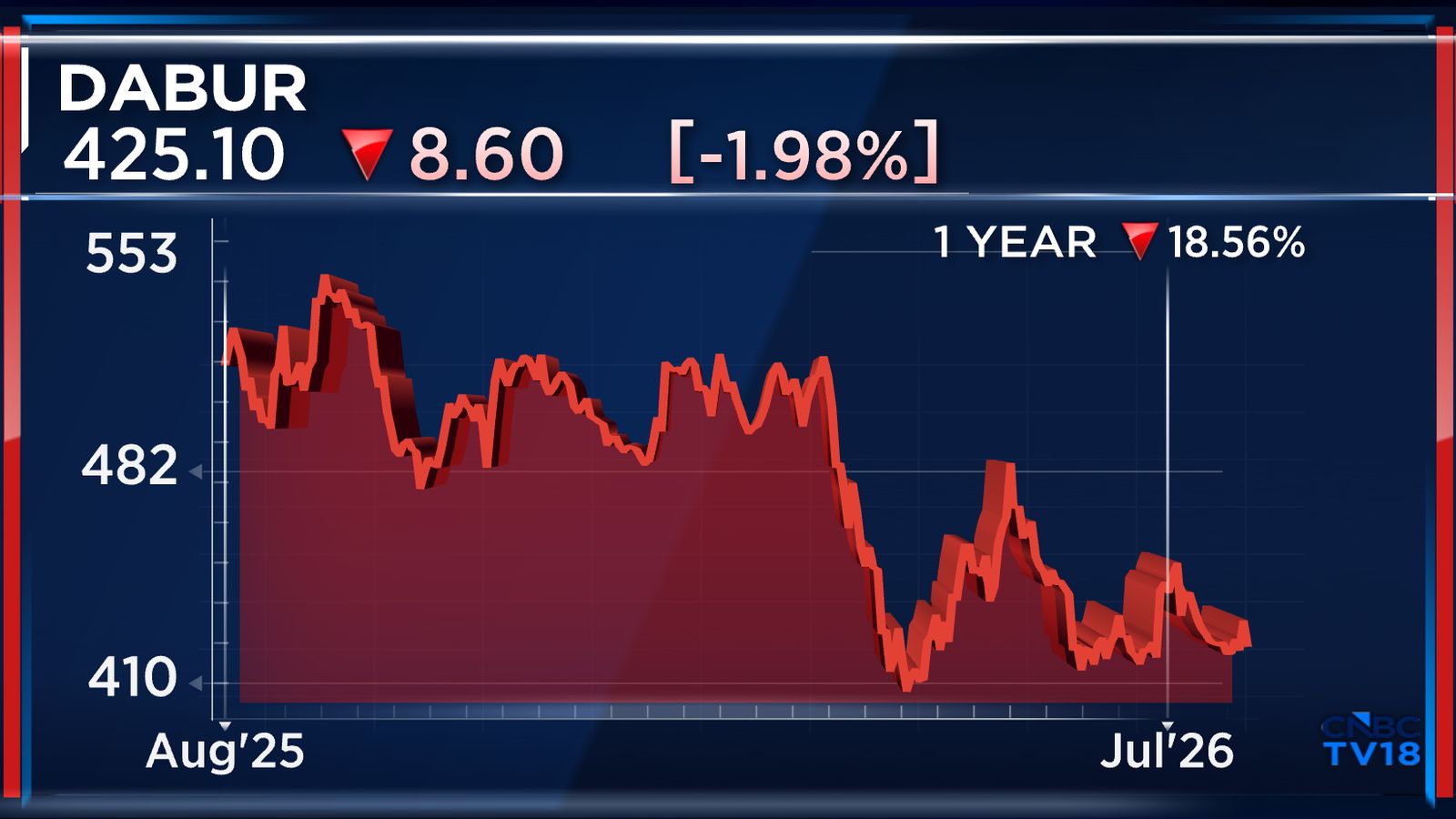
The company, which has a current market capitalisation of ₹75,428.46 crore, has seen its shares decline more than 18% over the last year.
This is an edited transcript of the interview.Q: You said that you're targeting double-digit revenue growth this year, with a large part of that coming from value as against volume. So, I just wanted to understand if you could get a little more specific about what double-digit growth means. Would it be low double digits? Are you looking at the teens? And would volumes be capped at the 5-6% mark, with the incremental growth coming from pricing, or do you expect incremental volume growth in the second half as well? A: So, as we guided before, we are targeting double-digit growth. The mix of volume and value is changing. We want to protect our market shares, which are more volume-driven. That's a good thing in the FMCG market. It has to be a balanced mix between price and volume. Focusing only on volume also creates pressure. So, a combination of volume and pricing actually works in the favour of any FMCG marketer. It also helps us deliver double-digit growth.
At this point in time, with the war continuing, I can't tell you whether it's going to be high-teen growth or not. But double-digit growth remains the target that we've set, and we'll protect our volume market shares going forward as well.
So, it'll be a mix of volume and price, and we don't want to compromise our volume market share. We'll be driving volume through rural markets, premiumisation, e-commerce and modern trade.
While there will be a price increase and some near-term pressure on volume, over a period of time, investments in our brands will help offset that.
One thing working in our favour is that due to GST, prices have come down. So even after the price increase, prices in the market are still lower than the pre-GST levels. That is helping us buffer the impact of higher prices despite the GST-related changes.
Q: You ended last year with margins of around 18.5%. The first quarter has improved to about 20%. Could you give us a sense of what you are expecting for the full year on the gross margin and EBITDA margin front, largely because input costs are fairly volatile, and premium product sales grew at twice the average growth of the company? What's the current proportion, and how much is that likely to be by the end of this year?A: So premiumisation is at 2x, and the share of premiumisation is more than 20%, ahead of our target of around 18%.
That's progressing well for us. It is leading to around 200-300 basis points of margin expansion due to the premium portfolio. Along with that, price increases are helping us fully buffer the impact of raw material inflation caused by the war.
So, we expect margins to improve further this year compared with last year. Overall, we are looking at profitable growth. The growth in operating margin should be higher than top-line growth, and profit growth should also be higher than top-line growth. That's what we've guided the market, and that's what we'll maintain.
Q: Even though the rural market continues to outperform the urban market for eight quarters now, there are concerns about El Niño and monsoon deficiency. Is it beginning to temper demand there? What are you seeing on the ground, and how do you expect the portfolio to behave in the second half of the year?A: As far as urban and rural markets are concerned, Nielsen data shows that rural is 170 basis points ahead of urban, so there is no problem.
In terms of our own data, if I look at primary, secondary and tertiary sales, rural is 550 basis points ahead of urban. The situation on the ground is that rural is firing on all cylinders, and so is urban on the back of e-commerce.
The economy is quite resilient on the ground. As for the impact of El Niño, media reports suggest it might have an impact. However, even the monsoon deficiency has narrowed to around 10-15%, which doesn't impact the kharif crop materially.
To top it up, the government has also increased MSPs. So, all this should help maintain balanced growth between urban and rural.
We are much more reliant on rural, and the expansion possibilities are huge. We currently reach around 1.3 lakh villages, while there are 6 lakh villages in India. There is huge headroom to grow. We've also created low-unit-price-point (LUPP) bundles, which will help leverage our rural distribution. So, I'm not concerned at this stage.
Q: Your international business contributes around one-third of your top line. With the developments in West Asia and the recent flare-up, was there an impact during the quarter? Do you expect any further impact? What are your growth plans for the international business?A: Our international business contributes around 30% of our revenue, and it grew 15.5% in the current quarter.
West Asia, which has been impacted by the war, contributes only around 10% of our international business, which translates to about 3% of our overall business.
Despite the war and related issues such as inflation, higher freight costs and trade disruptions, West Asia business still grew around 9%.
The rest of the geographies delivered high double-digit growth. Sub-Saharan Africa grew around 23%, Turkey 28%, Egypt 25%, and the Americas business around 17-18%.
In addition, the depreciation of the Indian rupee resulted in translation gains, which also supported growth.
Inflation remains a factor because petroleum prices have increased, for which we've taken price hikes. We continue to expect double-digit growth in the international business for the full year.
For the full interview, watch the accompanying videoCatch all the latest updates from the stock market here
Mohit Malhotra, CEO of Ghaziabad-headquartered FMCG major Dabur India, said the company remains focused on protecting market share while delivering profitable growth through premiumisation, rural expansion, e-commerce and modern trade.
He added that Dabur will maintain a balanced mix of pricing and volumes. He said that while price hikes could weigh on volumes in the near term, investments in brands are expected to support demand over time.
The company expects operating margin growth to outpace revenue growth in 2026-27. Malhotra said premium products, which are growing at nearly twice the company's average rate, are contributing 200-300 basis points to margin expansion, while calibrated price increases are helping offset higher raw material costs linked to the conflict in West Asia.
Dabur also remains positive on demand trends, particularly in rural India, where growth continues to outpace urban markets. The company is expanding its distribution network and increasing the availability of low-unit-price packs to strengthen its rural presence.
International operations, which account for around 30% of Dabur's revenue, recorded 15.5% growth during the April-June 2026 quarter, supported by strong performances in Sub-Saharan Africa, Turkey, Egypt and the Americas, despite challenges in West Asia.
The company, which has a current market capitalisation of ₹75,428.46 crore, has seen its shares decline more than 18% over the last year.
This is an edited transcript of the interview.Q: You said that you're targeting double-digit revenue growth this year, with a large part of that coming from value as against volume. So, I just wanted to understand if you could get a little more specific about what double-digit growth means. Would it be low double digits? Are you looking at the teens? And would volumes be capped at the 5-6% mark, with the incremental growth coming from pricing, or do you expect incremental volume growth in the second half as well? A: So, as we guided before, we are targeting double-digit growth. The mix of volume and value is changing. We want to protect our market shares, which are more volume-driven. That's a good thing in the FMCG market. It has to be a balanced mix between price and volume. Focusing only on volume also creates pressure. So, a combination of volume and pricing actually works in the favour of any FMCG marketer. It also helps us deliver double-digit growth.
At this point in time, with the war continuing, I can't tell you whether it's going to be high-teen growth or not. But double-digit growth remains the target that we've set, and we'll protect our volume market shares going forward as well.
So, it'll be a mix of volume and price, and we don't want to compromise our volume market share. We'll be driving volume through rural markets, premiumisation, e-commerce and modern trade.
While there will be a price increase and some near-term pressure on volume, over a period of time, investments in our brands will help offset that.
One thing working in our favour is that due to GST, prices have come down. So even after the price increase, prices in the market are still lower than the pre-GST levels. That is helping us buffer the impact of higher prices despite the GST-related changes.
Q: You ended last year with margins of around 18.5%. The first quarter has improved to about 20%. Could you give us a sense of what you are expecting for the full year on the gross margin and EBITDA margin front, largely because input costs are fairly volatile, and premium product sales grew at twice the average growth of the company? What's the current proportion, and how much is that likely to be by the end of this year?A: So premiumisation is at 2x, and the share of premiumisation is more than 20%, ahead of our target of around 18%.
That's progressing well for us. It is leading to around 200-300 basis points of margin expansion due to the premium portfolio. Along with that, price increases are helping us fully buffer the impact of raw material inflation caused by the war.
So, we expect margins to improve further this year compared with last year. Overall, we are looking at profitable growth. The growth in operating margin should be higher than top-line growth, and profit growth should also be higher than top-line growth. That's what we've guided the market, and that's what we'll maintain.
Q: Even though the rural market continues to outperform the urban market for eight quarters now, there are concerns about El Niño and monsoon deficiency. Is it beginning to temper demand there? What are you seeing on the ground, and how do you expect the portfolio to behave in the second half of the year?A: As far as urban and rural markets are concerned, Nielsen data shows that rural is 170 basis points ahead of urban, so there is no problem.
In terms of our own data, if I look at primary, secondary and tertiary sales, rural is 550 basis points ahead of urban. The situation on the ground is that rural is firing on all cylinders, and so is urban on the back of e-commerce.
The economy is quite resilient on the ground. As for the impact of El Niño, media reports suggest it might have an impact. However, even the monsoon deficiency has narrowed to around 10-15%, which doesn't impact the kharif crop materially.
To top it up, the government has also increased MSPs. So, all this should help maintain balanced growth between urban and rural.
We are much more reliant on rural, and the expansion possibilities are huge. We currently reach around 1.3 lakh villages, while there are 6 lakh villages in India. There is huge headroom to grow. We've also created low-unit-price-point (LUPP) bundles, which will help leverage our rural distribution. So, I'm not concerned at this stage.
Q: Your international business contributes around one-third of your top line. With the developments in West Asia and the recent flare-up, was there an impact during the quarter? Do you expect any further impact? What are your growth plans for the international business?A: Our international business contributes around 30% of our revenue, and it grew 15.5% in the current quarter.
West Asia, which has been impacted by the war, contributes only around 10% of our international business, which translates to about 3% of our overall business.
Despite the war and related issues such as inflation, higher freight costs and trade disruptions, West Asia business still grew around 9%.
The rest of the geographies delivered high double-digit growth. Sub-Saharan Africa grew around 23%, Turkey 28%, Egypt 25%, and the Americas business around 17-18%.
In addition, the depreciation of the Indian rupee resulted in translation gains, which also supported growth.
Inflation remains a factor because petroleum prices have increased, for which we've taken price hikes. We continue to expect double-digit growth in the international business for the full year.
For the full interview, watch the accompanying videoCatch all the latest updates from the stock market here
/images/ppid_59c68470-image-17855000233652595.webp)
/images/ppid_59c68470-image-178548003682730662.webp)
/images/ppid_59c68470-image-178549258376063710.webp)
/images/ppid_59c68470-image-178550008375083757.webp)


/images/ppid_59c68470-image-178532502776785886.webp)
/images/ppid_59c68470-image-178533753136965562.webp)
/images/ppid_59c68470-image-17853451781431742.webp)