/images/ppid_59c68470-image-178168761654114781.webp)

/images/ppid_59c68470-image-178168504353086723.webp)


What is the story about?
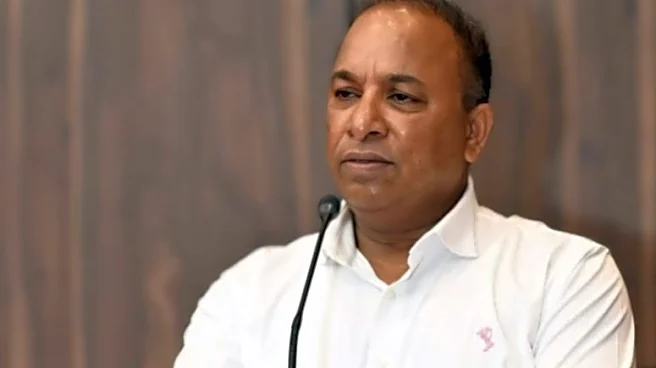
Veteran investor and Motilal Oswal Financial Services Chairman Raamdeo Agrawal remains bullish on equities, backed by strong economic activity and healthy credit growth, and expects largecaps to regain market leadership over time.
“Domestic economy is on full fire. Headlines are completely focused on to negative things, and real economy is doing very well. If you look at the credit growth of 17%, if you look at the automobile numbers, whatever high frequency data which is coming, they are looking very good,” he noted.
Agrawal added that markets have stayed resilient despite a turbulent few months. " I would not be that much worried,” he added.
According to Agrawal, FIIs hold most of their Indian portfolios in the largest banks and IT services companies, so when they pull money out of India, it is the big, liquid largecap names that absorb the selling pressure. That makes it harder for largecaps to post strong returns.
Mid- and smallcap stocks, by contrast, see comparatively little Maruti Suzuki — and in some cases foreign funds have even been buyers — because earnings growth in that segment has stayed strong.
Agrawal added, "So, broadly it's a two-speed market. But eventually, once the dust settles, the largecaps are looking very good — for their legacy, their size, their stability, their liquidity." He believes largecaps will become the new midcaps performance wise.
Asked whether his early-year call that autos would be the standout sector of 2026 still holds — a view he gave before recent geopolitical tensions.
He framed the case in terms of basic household spending priorities. Roughly half of India's manufacturing output is tied to the automobile sector, he said, and once families cover roti, kapda aur makaan — a well-known Hindi phrase for food, clothing and shelter — a vehicle is typically next on the list. He argued that demand for personal transport in India has historically been underserved relative to the size of the population.
"For the first time, you have seen the statement from Maruti — they are saying there is massive demand for entry-level cars because of the GST cut," Agrawal said, referring to Maruti Suzuki, India's largest carmaker by sales
He pointed to two forces working together: India's move to simplify its Goods and Services Tax (GST) — by cutting the rate on many goods, including small cars, from 28% to 18%; and a period of low inflation that has let the RBI keep credit flowing freely to borrowers.
Agrawal believes these factors should continue to support growth in the sector and provide a favourable backdrop for the broader market.
Watch the accompanying video
Live stock market updates—follow our blog
“Domestic economy is on full fire. Headlines are completely focused on to negative things, and real economy is doing very well. If you look at the credit growth of 17%, if you look at the automobile numbers, whatever high frequency data which is coming, they are looking very good,” he noted.
Agrawal added that markets have stayed resilient despite a turbulent few months. " I would not be that much worried,” he added.
According to Agrawal, FIIs hold most of their Indian portfolios in the largest banks and IT services companies, so when they pull money out of India, it is the big, liquid largecap names that absorb the selling pressure. That makes it harder for largecaps to post strong returns.
Mid- and smallcap stocks, by contrast, see comparatively little Maruti Suzuki — and in some cases foreign funds have even been buyers — because earnings growth in that segment has stayed strong.
Agrawal added, "So, broadly it's a two-speed market. But eventually, once the dust settles, the largecaps are looking very good — for their legacy, their size, their stability, their liquidity." He believes largecaps will become the new midcaps performance wise.
Asked whether his early-year call that autos would be the standout sector of 2026 still holds — a view he gave before recent geopolitical tensions.
He framed the case in terms of basic household spending priorities. Roughly half of India's manufacturing output is tied to the automobile sector, he said, and once families cover roti, kapda aur makaan — a well-known Hindi phrase for food, clothing and shelter — a vehicle is typically next on the list. He argued that demand for personal transport in India has historically been underserved relative to the size of the population.
"For the first time, you have seen the statement from Maruti — they are saying there is massive demand for entry-level cars because of the GST cut," Agrawal said, referring to Maruti Suzuki, India's largest carmaker by sales
He pointed to two forces working together: India's move to simplify its Goods and Services Tax (GST) — by cutting the rate on many goods, including small cars, from 28% to 18%; and a period of low inflation that has let the RBI keep credit flowing freely to borrowers.
Agrawal believes these factors should continue to support growth in the sector and provide a favourable backdrop for the broader market.
Watch the accompanying video
Live stock market updates—follow our blog