/images/ppid_59c68470-image-178636007942990646.webp)


/images/ppid_59c68470-image-178638754229343166.webp)
/images/ppid_59c68470-image-178637755649931123.webp)
What is the story about?
The debate over how India's Unified Payments Interface (UPI) should be funded has resurfaced, with One Mobikwik Systems' Co-Founder & CFO Upasana Taku arguing that current government support covers only a fraction of the cost of running the network.
"The subsidies that we have all been receiving, the banks and the fintechs so far, they barely cover 10 to 11% of these costs," Taku said.
According to Taku, the remaining costs, including servers, uptime, fraud prevention and cybersecurity, are absorbed by banks and fintechs operating on the network.
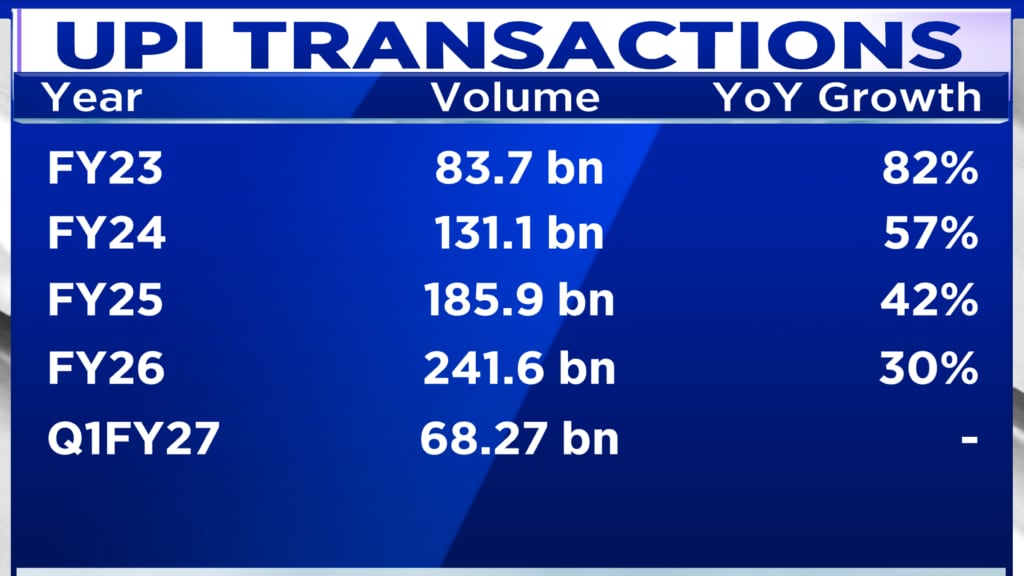
Taku said the economics are already visible in Mobikwik's financials. While UPI transaction volumes have grown 50% year-on-year, revenue has not kept pace because much of that growth has come from UPI, which currently generates little revenue for payment companies.
The government, however, has ruled out charging consumers anything for UPI transactions and recently clarified that most merhant payments will also remain free. Any future merchant discount rate, or MDR, a small fee merchants pay to accept digital payments, would only apply to a limited set of large merchants above a specified transaction threshold, and at a rate lower than what card payments already cost.
That comparison matters. Debit cards already carry a government-mandated MDR: 0.5% on transactions under ₹2,000 and 0.9% above that, while credit cards run as high as 1.8%. UPI, now the country's largest payments network by volume, currently carries none.
Former State Bank of India (SBI) chairman Dinesh Khara pointed out this isn't unprecedented. Before demonetisation in 2016, card transactions in India did carry an MDR before it was waived. He also cited Brazil and China, where digital MDR runs between 0.3% and 0.4%, yet digital payment adoption in both countries has reached around 90%. "Nevertheless, we have seen that the adoption of the digital transaction is as high as about 90% in these two countries," Khara said, arguing merchants are more likely to absorb a modest fee than fall back on costlier cash or cheque handling.
Taku suggested the industry's own proposal, from the Payments Council of India, points to a range of roughly 0.3% to 0.5% as a sustainable, nominal rate.
There's also a competition angle. Taku pushed back on the idea that MDR would only benefit large card networks, arguing the opposite is true. Without an MDR, she said, only companies with deep pockets can afford to keep growing without revenue — a dynamic that favours the three apps already controlling roughly 90% of the UPI market. A modest fee, she argued, would give smaller, independent Indian fintechs room to compete.
Watch the full conversation here
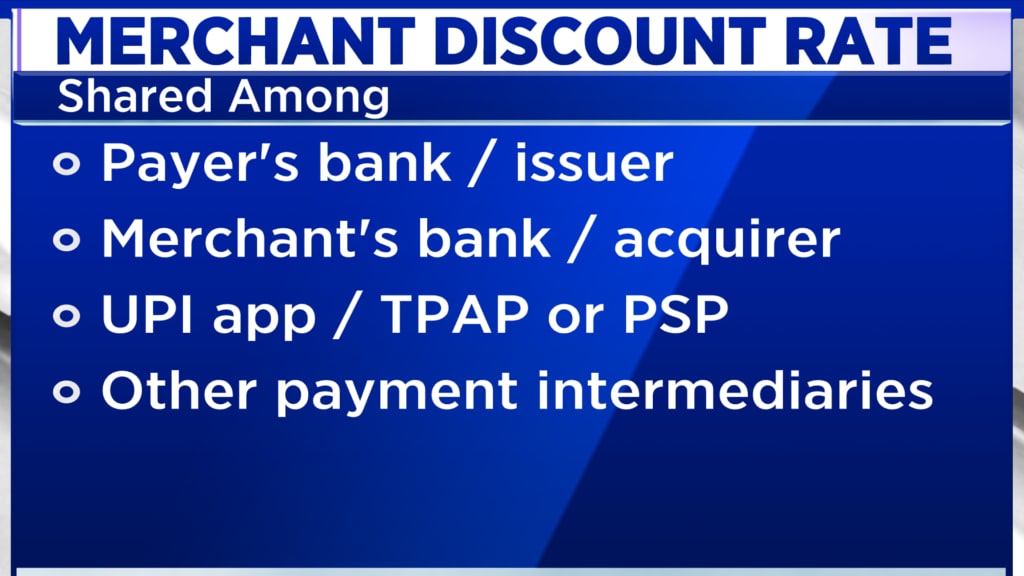
For now, consumers can expect UPI to remain free. But how the industry splits any future MDR, between fintechs, issuing banks, and settlement banks, remains open, with Khara noting it will likely come down to each player's bargaining power.
Catch all the latest updates from the stock market here
"The subsidies that we have all been receiving, the banks and the fintechs so far, they barely cover 10 to 11% of these costs," Taku said.
According to Taku, the remaining costs, including servers, uptime, fraud prevention and cybersecurity, are absorbed by banks and fintechs operating on the network.
Taku said the economics are already visible in Mobikwik's financials. While UPI transaction volumes have grown 50% year-on-year, revenue has not kept pace because much of that growth has come from UPI, which currently generates little revenue for payment companies.
The government, however, has ruled out charging consumers anything for UPI transactions and recently clarified that most merhant payments will also remain free. Any future merchant discount rate, or MDR, a small fee merchants pay to accept digital payments, would only apply to a limited set of large merchants above a specified transaction threshold, and at a rate lower than what card payments already cost.
That comparison matters. Debit cards already carry a government-mandated MDR: 0.5% on transactions under ₹2,000 and 0.9% above that, while credit cards run as high as 1.8%. UPI, now the country's largest payments network by volume, currently carries none.
Former State Bank of India (SBI) chairman Dinesh Khara pointed out this isn't unprecedented. Before demonetisation in 2016, card transactions in India did carry an MDR before it was waived. He also cited Brazil and China, where digital MDR runs between 0.3% and 0.4%, yet digital payment adoption in both countries has reached around 90%. "Nevertheless, we have seen that the adoption of the digital transaction is as high as about 90% in these two countries," Khara said, arguing merchants are more likely to absorb a modest fee than fall back on costlier cash or cheque handling.
Taku suggested the industry's own proposal, from the Payments Council of India, points to a range of roughly 0.3% to 0.5% as a sustainable, nominal rate.
There's also a competition angle. Taku pushed back on the idea that MDR would only benefit large card networks, arguing the opposite is true. Without an MDR, she said, only companies with deep pockets can afford to keep growing without revenue — a dynamic that favours the three apps already controlling roughly 90% of the UPI market. A modest fee, she argued, would give smaller, independent Indian fintechs room to compete.
Watch the full conversation here
For now, consumers can expect UPI to remain free. But how the industry splits any future MDR, between fintechs, issuing banks, and settlement banks, remains open, with Khara noting it will likely come down to each player's bargaining power.
Catch all the latest updates from the stock market here

/images/ppid_59c68470-image-178638010047851091.webp)
/images/ppid_59c68470-image-178644752333049772.webp)
/images/ppid_59c68470-image-178644506666835434.webp)
/images/ppid_59c68470-image-178642508010327466.webp)
/images/ppid_59c68470-image-178626752569246676.webp)
/images/ppid_59c68470-image-178635252553666015.webp)