/images/ppid_59c68470-image-178546003049574517.webp)




What is the story about?
Infosys CEO Salil Parekh believes the Indian IT story is far from over, with artificial intelligence (AI) emerging as the biggest growth driver for the industry over the coming years.
Responding to concerns that AI could disrupt traditional IT services, Parekh dismissed the notion that the industry's best days are behind it and said: Indian IT "bilkul, bilkul zinda hai" (Absolutely, absolutely it's alive).
The Bengaluru-based technology services company is entering the AI era from a position of strength. While global clients remain focussed on costs because of an uneven macroeconomic environment, Parekh expects technology spending to improve as economic conditions stabilise, creating fresh opportunities for AI-led transformation.
He said Infosys has consistently believed that enterprises will continue to need technology partners that understand their businesses, data and operating environments while helping them deploy AI at scale.
"We've always had the view that the work we do for large companies... requires that as they bring in new foundation models, that we, given that we know the context, what's going on, the landscape in a company, that we can help," Parekh said. "There were different views externally, but we seem to be seeing that coming back."
The comments come at a pivotal moment for Infosys, as Parekh prepares to hand over to CEO designate Ashiss Kumar Dash, a 30-year company veteran. Dash will succeed Parekh as Managing Director and CEO from April 1, 2027, after Parekh completes his second term.
Parekh said the timing is appropriate as Infosys enters its next phase of growth. "We have leaders in the market across delivery, across all of our functions, so I feel really good that this is a great time to have that sort of completion of my second term and have a new person running the show no."
Parekh expects AI to be a key driver of Infosys' growth over the medium to long term, describing the current period as "really the start of the AI expansion." AI revenue has grown at a double-digit pace sequentially for several quarters and now accounts for over 8% of the company's business on a standalone basis, he said — "already a very large part of what we are doing."
The company is working across AI agents, application modernisation and coding tools, while partnering with multiple foundation model providers to help clients build enterprise AI solutions.
In the April–June quarter (Q1FY27), Infosys reported revenue of ₹48,211 crore, while net profit stood at ₹7,769 crore. The company's EBIT margin for the quarter came in at 21.1%.
The company narrowed its FY27 revenue growth guidance to 1.5%–3% in constant currency terms from its earlier forecast of 1.5%–3.5%. However, it maintained its FY27 EBIT margin guidance at 20%–22%.
Parekh's comments land against a backdrop of renewed investor appetite for Indian IT. The Nifty IT index rallied nearly 19% in July — outperforming all 15 Nifty sectoral indices and on track for its sharpest monthly outperformance against the benchmark in 13 years — with Infosys shares up around 15% over the same period.
Brokerage firm Jefferies also expects the recent sell-off in AI-linked stocks to reverse, which could provide a tactical boost to Indian IT stocks.
The optimism echoes a wider theme in enterprise AI spending. Sylvain Duranton, Managing Director and Senior Partner at BCG X, told CNBC-TV18 that global AI investment is still climbing despite growing scrutiny over returns: "The peak is ahead of us... I don't see any signs of hesitation."
A BCG survey of 1,800 C-suite executives found companies expect to double resources dedicated to AI transformation between 2025 and 2026, with 94% of CEOs saying they'd keep investing even without seeing expected returns.
Duranton also highlighted token costs as an emerging consideration for enterprises echoing Parekh's view that clients are increasingly focused on using the most appropriate AI models for different tasks to improve efficiency.
Infosys' current market capitalisation is ₹4,67,838.84 crore.
Responding to concerns that AI could disrupt traditional IT services, Parekh dismissed the notion that the industry's best days are behind it and said: Indian IT "bilkul, bilkul zinda hai" (Absolutely, absolutely it's alive).
The Bengaluru-based technology services company is entering the AI era from a position of strength. While global clients remain focussed on costs because of an uneven macroeconomic environment, Parekh expects technology spending to improve as economic conditions stabilise, creating fresh opportunities for AI-led transformation.
He said Infosys has consistently believed that enterprises will continue to need technology partners that understand their businesses, data and operating environments while helping them deploy AI at scale.
"We've always had the view that the work we do for large companies... requires that as they bring in new foundation models, that we, given that we know the context, what's going on, the landscape in a company, that we can help," Parekh said. "There were different views externally, but we seem to be seeing that coming back."
The comments come at a pivotal moment for Infosys, as Parekh prepares to hand over to CEO designate Ashiss Kumar Dash, a 30-year company veteran. Dash will succeed Parekh as Managing Director and CEO from April 1, 2027, after Parekh completes his second term.
Parekh said the timing is appropriate as Infosys enters its next phase of growth. "We have leaders in the market across delivery, across all of our functions, so I feel really good that this is a great time to have that sort of completion of my second term and have a new person running the show no."
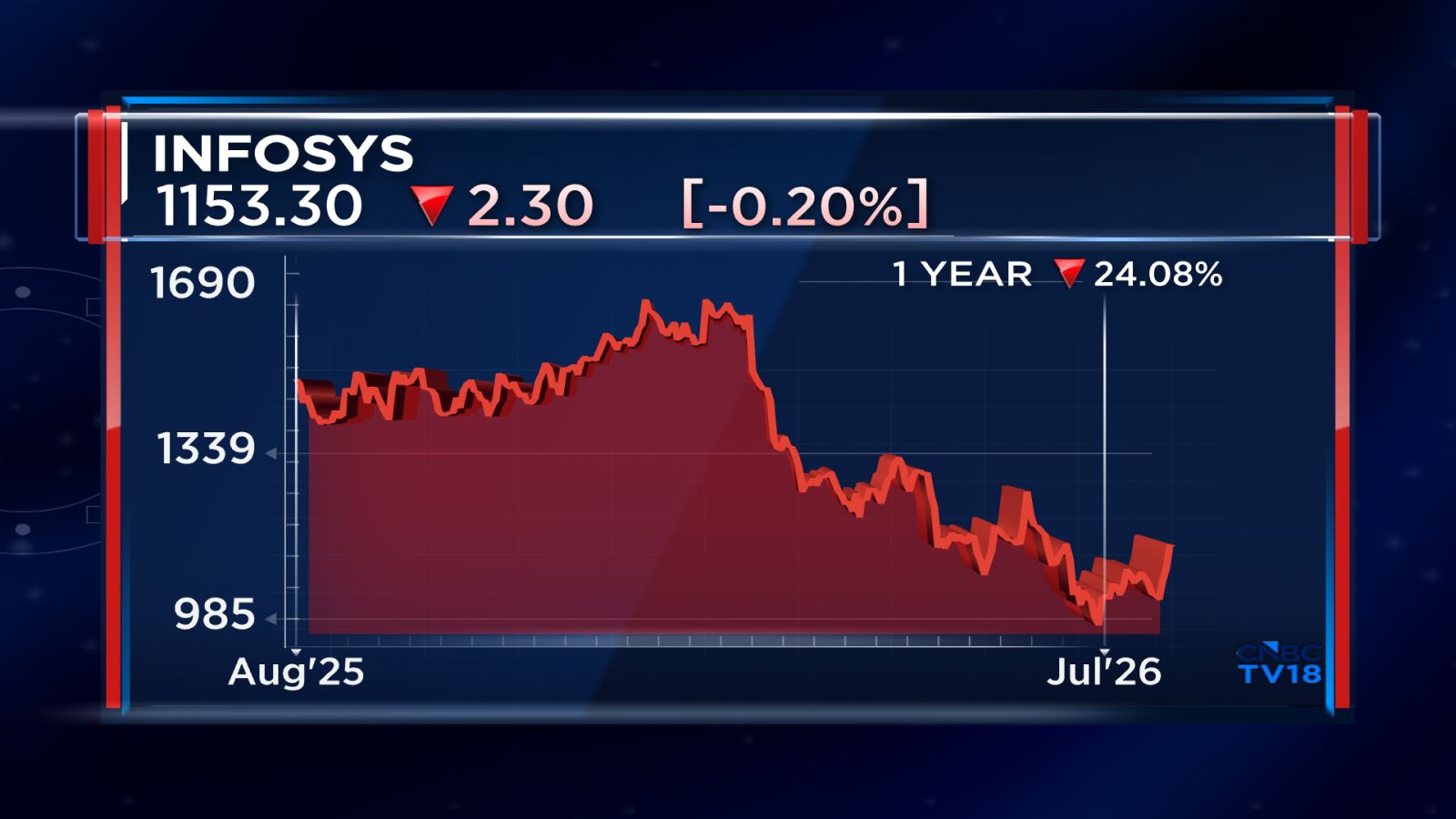
The stock was trading at ₹1,153.30 at 2:53 pm on the NSE and has declined more than 24% over the past year.
Parekh expects AI to be a key driver of Infosys' growth over the medium to long term, describing the current period as "really the start of the AI expansion." AI revenue has grown at a double-digit pace sequentially for several quarters and now accounts for over 8% of the company's business on a standalone basis, he said — "already a very large part of what we are doing."
The company is working across AI agents, application modernisation and coding tools, while partnering with multiple foundation model providers to help clients build enterprise AI solutions.
In the April–June quarter (Q1FY27), Infosys reported revenue of ₹48,211 crore, while net profit stood at ₹7,769 crore. The company's EBIT margin for the quarter came in at 21.1%.
The company narrowed its FY27 revenue growth guidance to 1.5%–3% in constant currency terms from its earlier forecast of 1.5%–3.5%. However, it maintained its FY27 EBIT margin guidance at 20%–22%.
Parekh's comments land against a backdrop of renewed investor appetite for Indian IT. The Nifty IT index rallied nearly 19% in July — outperforming all 15 Nifty sectoral indices and on track for its sharpest monthly outperformance against the benchmark in 13 years — with Infosys shares up around 15% over the same period.
Brokerage firm Jefferies also expects the recent sell-off in AI-linked stocks to reverse, which could provide a tactical boost to Indian IT stocks.
The optimism echoes a wider theme in enterprise AI spending. Sylvain Duranton, Managing Director and Senior Partner at BCG X, told CNBC-TV18 that global AI investment is still climbing despite growing scrutiny over returns: "The peak is ahead of us... I don't see any signs of hesitation."
A BCG survey of 1,800 C-suite executives found companies expect to double resources dedicated to AI transformation between 2025 and 2026, with 94% of CEOs saying they'd keep investing even without seeing expected returns.
Duranton also highlighted token costs as an emerging consideration for enterprises echoing Parekh's view that clients are increasingly focused on using the most appropriate AI models for different tasks to improve efficiency.
Infosys' current market capitalisation is ₹4,67,838.84 crore.