


What is the story about?
JSW Steel expects its profitability to improve in the October-December quarter as higher steel prices are likely to more than offset rising input costs, according to Jayant Acharya, Joint Managing Director & CEO of JSW Steel.
The company also expects stronger domestic demand, higher overseas volumes and continued capacity expansion to support growth in the second half of the financial year.
Speaking after the company's July-September 2026 quarter earnings, Acharya said steel price increases implemented over the past few months will be fully reflected in the current quarter. While coking coal and other raw material costs have risen, he expects margins to improve sequentially.
He added that coking coal costs are expected to increase by around $25 per tonne sequentially, along with higher iron ore and other input costs. Despite that, the company expects profitability to improve.
JSW Steel reported stronger operational performance during the quarter, supported by the ramp-up of Blast Furnace 3 at Vijayanagar, which helped increase steel volumes both sequentially and year-on-year.
Acharya said overseas operations are expected to contribute more meaningfully in the second half of the year. Modernisation work at the company's Ohio facility has been completed, while upgrades at Baytown, Texas, are expected to finish by the end of October, enabling higher production volumes.
The company also announced around ₹30,000 crore of fresh capital expenditure approvals during the quarter, including the second phase of its Odisha expansion, capacity additions at Vijayanagar and Dolvi, expansion of coal operations in Mozambique, and iron ore mining projects in Goa and Karnataka.
Acharya said JSW Steel now has around ₹1.48 lakh crore of approved capital expenditure to be executed over the next five to six years, in line with its long-term growth strategy.
The balance sheet has also strengthened following debt reduction. Net debt has declined to around ₹44,000 crore, while the company's net debt-to-EBITDA ratio has fallen to 1.28 times, its lowest level to date.
[faq type="interview" title="This is an edited transcript of the interview."][ques][/ques][ans][/ans][/faq][faq type="interview"][ques]Despite higher coking coal costs and a challenging global environment, what is your outlook for JSW Steel's margins and operations in the October-December quarter?[/ques][ans]We did a very good operational performance amidst a challenging quarter and geopolitical environment. Our volumes have gone up sequentially and year-on-year, driven by the startup of Blast Furnace 3 at Vijayanagar, and that's ramping up quite well. From a pricing point of view, as you asked, prices have gone up towards the end of the last quarter and in October as well. So, the carry-forward impact of these price increases will fully reflect in the October-December quarter. So, you will see that as a positive. It will be offset by an increase in cost. We are looking at a roughly $25 per tonne increase in coking coal costs from Q2 to Q3. That would also impact our costs, and there are some other items which would also go up. So, input costs, in general, are up. Last quarter, our coking coal cost went up by about $10.[/ans][/faq][faq type="interview"][ques]What about quantifying that for us, sir? We have got the number in terms of coking coal cost going up by $25 per tonne. How much will pricing move up?[/ques][ans]It will be difficult for me to give you a number as to what it will move up by. But price increases took place during September and October, and to some extent in August as well. That will fully play out in this October-December quarter. So that will give you a positive. It will be offset by higher coking coal costs and an increase in iron ore and other material costs, but it will still add to the EBITDA margin for the October-December quarter compared with Q2.[/ans][/faq][faq type="interview"][ques]So, what you're telling us is that the consolidated EBITDA per tonne will improve in Q3 compared with Q2, give and take the cost increases as well as the price increases.[/ques][ans]It should be a little better as we should be able to fully offset the cost and add a little bit to the margin.[/ans][/faq][faq type="interview"][ques]What about your overseas operations? You had indicated to us in the past that the US as well as Europe were showing signs of improvement. And you told us that things would get better from here. If I do just a rough calculation, the overseas operations are contributing around ₹250 crore, a little more than that, on a quarterly run rate. Will this continue? Will it get better?[/ques][ans]It will get better. If you recall, the Ohio and Baytown facilities in Texas were both undergoing upgradation and modernisation. We completed the Ohio modernization phase in the last quarter, and that is now ramping up. So additional volumes will be seen from Ohio in the second half of this year. The Baytown modernisation is expected to be completed by the end of October, and that again will give us additional volumes in the second half of this year. So, while in Q2 we saw an improved operational performance, it was about $19 million in the US operations and about €7 million in the Italian operations. Both have shown a good increase. We expect the volumes to pick up in H2, and that would further improve the profitability of the US operations especially, and the Italian operations after the signing of the Environmental Product Declaration (EPD).[/ans][/faq][faq type="interview"][ques]You would be best placed to give us a sense of demand. How is demand on the ground? There is various commentary suggesting there may be signs of softness in various pockets of India. According to you, how is demand? Is it holding up well, or are you seeing some signs of softness?[/ques][ans]I would say demand is holding up very well. India, as a country, has navigated the geopolitical challenges that the world has faced very well. Public CapEx continues to be strong. Private CapEx has picked up. We see growth across industry and services. That is also reflected in steel demand. Steel demand went up by 7.5% in the first half of this year. We expect a slightly better performance in the second half in terms of volume. So, we see a good second half ahead. We should end this year with incremental demand growth of roughly 13 million to 14 million tonne.[/ans][/faq][faq type="interview"][ques]Give us a sense of your expansion because you have announced various expansions during this quarter itself. How do you see that translating into CapEx for this year, and what does it mean in terms of debt?[/ques][ans]We have announced a couple of CapEx projects. The primary one is the Odisha Phase 2 project, which would add 5 million tonne of capacity. We have announced multiple projects across Vijayanagar and Dolvi. In JSW Vijayanagar Metallics Ltd. (JVML), we have announced a pellet plant, a new converter and caster, which would increase the melting capacity. In Dolvi, we are adding a caster, which would be able to use slabs from the Odisha Phase 2 operations, and we have added a cold rolling complex at our Vasind facility. In addition to that, we have approved additional CapEx in Mozambique for expanding the total clean coal output to approximately 9 million tonne. There is also some iron ore CapEx for mines in Goa and Karnataka. All this put together, roughly ₹30,000 crore of CapEx has been approved in this quarter. As of October 1, the total CapEx pending on the books will be about ₹1.48 lakh crore, and this will be spent over a period of five to six years, in line with the growth projections we have shared.[/ans][/faq][faq type="interview"][ques]What about the net debt number? That's come down a little bit. You have done that deal with regard to BPSL as well. That has deleveraged the book to a large extent. How do you see the debt number moving from here on?[/ques][ans]Our debt has come down to about ₹44,000 crore. Our net debt-to-EBITDA is down to 1.28x, which is the lowest ever. Our debt-to-equity is also at 0.39x, so both are very strong. From a balance sheet point of view, it enables us to focus on our growth without any concern and with greater confidence, as we see India continuing to grow.[/ans][/faq][faq type="interview"][ques]A quick question with regard to China. Exports do continue from there. Our government has done a good job in protecting the domestic industry, but how do you see trends coming out of China?[/ques][ans]China's production of steel and its consumption have both come down. Steel production has come down by about 3%, whereas consumption has fallen by 4%. So, you see additional volumes entering the export market. But what is interesting to note is that China is exporting a lot of indirect steel. Engineering exports from China have risen sharply, and that is again manufacturing in China for the world market. To that extent, it has made up part of the shortfall in domestic demand. As we go forward, we see China reducing production every year to some extent, and with some of the new policy proposals it has undertaken, I think investment and infrastructure will improve, and that will drive more steel demand. So domestic consumption should stabilise, and therefore exports out of China should moderate.[/ans][/faq]
For the full interview, watch the accompanying video
Catch all the latest updates from the stock market here
The company also expects stronger domestic demand, higher overseas volumes and continued capacity expansion to support growth in the second half of the financial year.
Speaking after the company's July-September 2026 quarter earnings, Acharya said steel price increases implemented over the past few months will be fully reflected in the current quarter. While coking coal and other raw material costs have risen, he expects margins to improve sequentially.
He added that coking coal costs are expected to increase by around $25 per tonne sequentially, along with higher iron ore and other input costs. Despite that, the company expects profitability to improve.
JSW Steel reported stronger operational performance during the quarter, supported by the ramp-up of Blast Furnace 3 at Vijayanagar, which helped increase steel volumes both sequentially and year-on-year.
Acharya said overseas operations are expected to contribute more meaningfully in the second half of the year. Modernisation work at the company's Ohio facility has been completed, while upgrades at Baytown, Texas, are expected to finish by the end of October, enabling higher production volumes.
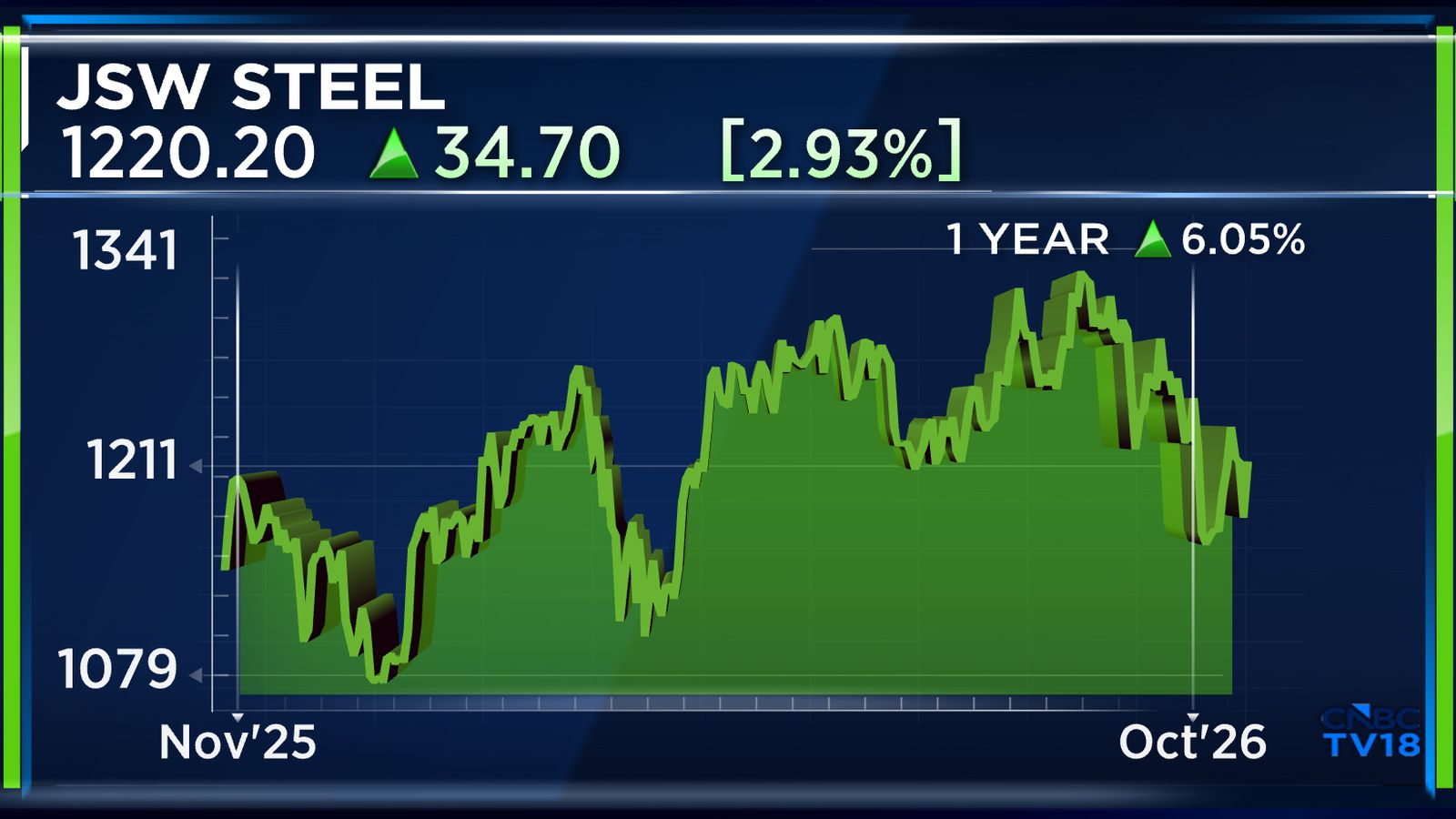
JSW Steel shares were trading at ₹1,219.10 as of 10:30 am on the NSE. The company, which has a current market capitalisation of ₹2,98,345.38 crore, has seen its shares gain more than 6% over the last year.
The company also announced around ₹30,000 crore of fresh capital expenditure approvals during the quarter, including the second phase of its Odisha expansion, capacity additions at Vijayanagar and Dolvi, expansion of coal operations in Mozambique, and iron ore mining projects in Goa and Karnataka.
Acharya said JSW Steel now has around ₹1.48 lakh crore of approved capital expenditure to be executed over the next five to six years, in line with its long-term growth strategy.
The balance sheet has also strengthened following debt reduction. Net debt has declined to around ₹44,000 crore, while the company's net debt-to-EBITDA ratio has fallen to 1.28 times, its lowest level to date.
[faq type="interview" title="This is an edited transcript of the interview."][ques][/ques][ans][/ans][/faq][faq type="interview"][ques]Despite higher coking coal costs and a challenging global environment, what is your outlook for JSW Steel's margins and operations in the October-December quarter?[/ques][ans]We did a very good operational performance amidst a challenging quarter and geopolitical environment. Our volumes have gone up sequentially and year-on-year, driven by the startup of Blast Furnace 3 at Vijayanagar, and that's ramping up quite well. From a pricing point of view, as you asked, prices have gone up towards the end of the last quarter and in October as well. So, the carry-forward impact of these price increases will fully reflect in the October-December quarter. So, you will see that as a positive. It will be offset by an increase in cost. We are looking at a roughly $25 per tonne increase in coking coal costs from Q2 to Q3. That would also impact our costs, and there are some other items which would also go up. So, input costs, in general, are up. Last quarter, our coking coal cost went up by about $10.[/ans][/faq][faq type="interview"][ques]What about quantifying that for us, sir? We have got the number in terms of coking coal cost going up by $25 per tonne. How much will pricing move up?[/ques][ans]It will be difficult for me to give you a number as to what it will move up by. But price increases took place during September and October, and to some extent in August as well. That will fully play out in this October-December quarter. So that will give you a positive. It will be offset by higher coking coal costs and an increase in iron ore and other material costs, but it will still add to the EBITDA margin for the October-December quarter compared with Q2.[/ans][/faq][faq type="interview"][ques]So, what you're telling us is that the consolidated EBITDA per tonne will improve in Q3 compared with Q2, give and take the cost increases as well as the price increases.[/ques][ans]It should be a little better as we should be able to fully offset the cost and add a little bit to the margin.[/ans][/faq][faq type="interview"][ques]What about your overseas operations? You had indicated to us in the past that the US as well as Europe were showing signs of improvement. And you told us that things would get better from here. If I do just a rough calculation, the overseas operations are contributing around ₹250 crore, a little more than that, on a quarterly run rate. Will this continue? Will it get better?[/ques][ans]It will get better. If you recall, the Ohio and Baytown facilities in Texas were both undergoing upgradation and modernisation. We completed the Ohio modernization phase in the last quarter, and that is now ramping up. So additional volumes will be seen from Ohio in the second half of this year. The Baytown modernisation is expected to be completed by the end of October, and that again will give us additional volumes in the second half of this year. So, while in Q2 we saw an improved operational performance, it was about $19 million in the US operations and about €7 million in the Italian operations. Both have shown a good increase. We expect the volumes to pick up in H2, and that would further improve the profitability of the US operations especially, and the Italian operations after the signing of the Environmental Product Declaration (EPD).[/ans][/faq][faq type="interview"][ques]You would be best placed to give us a sense of demand. How is demand on the ground? There is various commentary suggesting there may be signs of softness in various pockets of India. According to you, how is demand? Is it holding up well, or are you seeing some signs of softness?[/ques][ans]I would say demand is holding up very well. India, as a country, has navigated the geopolitical challenges that the world has faced very well. Public CapEx continues to be strong. Private CapEx has picked up. We see growth across industry and services. That is also reflected in steel demand. Steel demand went up by 7.5% in the first half of this year. We expect a slightly better performance in the second half in terms of volume. So, we see a good second half ahead. We should end this year with incremental demand growth of roughly 13 million to 14 million tonne.[/ans][/faq][faq type="interview"][ques]Give us a sense of your expansion because you have announced various expansions during this quarter itself. How do you see that translating into CapEx for this year, and what does it mean in terms of debt?[/ques][ans]We have announced a couple of CapEx projects. The primary one is the Odisha Phase 2 project, which would add 5 million tonne of capacity. We have announced multiple projects across Vijayanagar and Dolvi. In JSW Vijayanagar Metallics Ltd. (JVML), we have announced a pellet plant, a new converter and caster, which would increase the melting capacity. In Dolvi, we are adding a caster, which would be able to use slabs from the Odisha Phase 2 operations, and we have added a cold rolling complex at our Vasind facility. In addition to that, we have approved additional CapEx in Mozambique for expanding the total clean coal output to approximately 9 million tonne. There is also some iron ore CapEx for mines in Goa and Karnataka. All this put together, roughly ₹30,000 crore of CapEx has been approved in this quarter. As of October 1, the total CapEx pending on the books will be about ₹1.48 lakh crore, and this will be spent over a period of five to six years, in line with the growth projections we have shared.[/ans][/faq][faq type="interview"][ques]What about the net debt number? That's come down a little bit. You have done that deal with regard to BPSL as well. That has deleveraged the book to a large extent. How do you see the debt number moving from here on?[/ques][ans]Our debt has come down to about ₹44,000 crore. Our net debt-to-EBITDA is down to 1.28x, which is the lowest ever. Our debt-to-equity is also at 0.39x, so both are very strong. From a balance sheet point of view, it enables us to focus on our growth without any concern and with greater confidence, as we see India continuing to grow.[/ans][/faq][faq type="interview"][ques]A quick question with regard to China. Exports do continue from there. Our government has done a good job in protecting the domestic industry, but how do you see trends coming out of China?[/ques][ans]China's production of steel and its consumption have both come down. Steel production has come down by about 3%, whereas consumption has fallen by 4%. So, you see additional volumes entering the export market. But what is interesting to note is that China is exporting a lot of indirect steel. Engineering exports from China have risen sharply, and that is again manufacturing in China for the world market. To that extent, it has made up part of the shortfall in domestic demand. As we go forward, we see China reducing production every year to some extent, and with some of the new policy proposals it has undertaken, I think investment and infrastructure will improve, and that will drive more steel demand. So domestic consumption should stabilise, and therefore exports out of China should moderate.[/ans][/faq]
For the full interview, watch the accompanying video
Catch all the latest updates from the stock market here