/images/ppid_59c68470-image-177868757085455196.webp)

/images/ppid_a911dc6a-image-177859504138356113.webp)

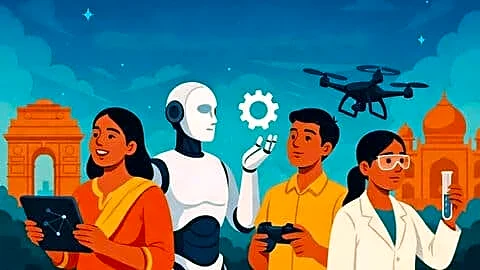
The debate around artificial intelligence (AI) replacing human jobs has never been louder. But Stephen Chin, Vice President – Developer Relations at Neo4j, has a more nuanced message for the developer community: AI will not take your job, but a developer who knows how to use AI will.
"Software developers who don't adapt and don't learn AI are the ones who are losing out," Chin told CNBC-TV18 on the sidelines of the Great International Developer Summit 2026 (GIDS 2026). "The folks who will be successful
are the ones who are upskilling, learning new AI technologies, and putting together all the tools they need."
Chin did not mince words on the state of the developer ecosystem. He pointed out that placement rates for computer science graduates have dropped sharply since ChatGPT arrived, and the reason is not that companies need fewer engineers. The expectations have simply changed.
"Most students graduating from computer science took a classic course and never learned to use AI tools," he said. "Companies interview them, ask them to use Claude Code or Cursor to solve a problem, and they say — oh, we were not allowed to use AI in school, that is cheating. So they are not getting the job."
His advice to universities is direct: reform the curriculum. And his advice to parents is equally clear — get your children fluent in AI tools early.
"Give them a Copilot subscription, let them play around with Claude Code. If you encourage them to become fluent in AI, they will have an advantage. They will graduate as AI engineers who are better than today's senior developers."
AI augments humans, it does not replace them
On the bigger question of whether AI will eventually replace human workers altogether, Chin drew an interesting parallel. He said that humans tend to attribute qualities to things that merely appear human-like — but that does not make them human.
ALSO READ | AI may not eliminate white-collar jobs as fast as feared: Raghuram Rajan
"AI is very good at certain types of problems. LLMs have been trained on data sets that dwarf anything a human is exposed to in a lifetime. But what they are not good at is complex reasoning, understanding requirements, and having accountability," he said. "That is where humans come in. AI augments humans — it does not replace them."
He also flagged a nuanced finding that often gets overlooked: experienced developers working on familiar code bases are actually slightly slower when using AI tools. "There is a trade-off. Junior developers get a lot of additional capabilities, and experienced developers on new code bases can get up to speed quickly. But an experienced developer on a familiar code base? Slightly slower with AI."
One of the most significant shifts Chin highlighted is the move from AI experimentation to AI in production. For years, companies were running pilots and proofs of concept that never made it to real-world deployment. That is now changing.
"The big shift this year has been from people just trying things with AI — and a lot of projects failing — to having successful deployments where AI is actually powering enterprise and production systems," he said.
A key reason many early deployments failed, according to Chin, was the over-reliance on generic RAG — retrieval augmented generation — systems, which struggle with accuracy and explainability.
Increasingly, companies are moving towards agentic architectures backed by knowledge graphs and graph databases, which give AI systems a structured, relationship-aware layer of data to work with.
"Even Anthropic and a bunch of other AI companies have recommendations on how to use knowledge graphs as part of architecture," he said. "It moves from research to being an enabler for getting applications to deployment." Neo4j counts AbbVie, Pfizer, and Daimler among its customers who have used this approach to get to production AI faster.
On AI costs: Do not panic, but be smart
With Indian firms increasingly tying up with AI providers like Anthropic, concerns around subscription and token costs are growing. Chin acknowledged the pressure but said the trajectory is moving in the right direction.
"The costs of LLMs are declining over time as models get more efficient," he said. "Initially a lot of token costs were subsidised — OpenAI has been running at a loss for a while. But as models get more efficient and competition increases, token costs will come down."
ALSO READ |AI vs jobs: AI can’t be a free pass for layoffs, China courts signal in landmark rulings
In the meantime, his advice is to use smarter architectures. "If you use a better knowledge layer — like a graph database — you can use a smaller, less expensive model and still get results comparable to the very latest AI model. You save costs today, and in the future, costs will fall anyway."
Which sectors stand to gain the most
Healthcare, financial services, supply chain, customer service, and legal research are among the sectors Chin sees benefiting most from AI adoption.
"In financial services, the way you win at trading or fraud detection is by analysing large data sets, finding patterns quickly, and reacting faster than others," he explained. "A faster system that can process more data gives you a real competitive advantage."
On the question of trust in AI for high-stakes decisions, he was measured. "Even humans make mistakes. For mission-critical AI systems, you want a human in the middle reviewing final transactions." He pointed to context graphs — which allow AI systems to learn from previous decisions over time — as the architecture that makes AI more reliable in sensitive domains like credit approvals or fraud detection.
Chin's message for Indian companies looking to accelerate AI adoption is clear: close the skills gap, build the right architecture, and stop treating AI as either a silver bullet or a threat.
"AI already has a bunch of very practical, pragmatic uses," he said. "The systems are here to stay because they are transforming both development and business — but in good ways, where you get better efficiency, better productivity, and can do more with less."
ALSO READ | AI could add over $500 billion to India's economy by 2030: Study
For developers sitting on the fence, his parting advice is direct: own your code, use AI everywhere it makes sense, and never let the output of an AI tool leave your hands without understanding it. "You are the developer. You are responsible for the code. Treat everything — the code you write and the code AI writes — as your work product, and hold it to a high standard."
/images/ppid_a911dc6a-image-177867203980912983.webp)

/images/ppid_59c68470-image-177856756356445462.webp)
/images/ppid_a911dc6a-image-177867206857339185.webp)
/images/ppid_a911dc6a-image-177866507138941194.webp)
/images/ppid_59c68470-image-17786526175919285.webp)
/images/ppid_a911dc6a-image-177858454562922923.webp)
/images/ppid_59c68470-image-177867752280842722.webp)
/images/ppid_59c68470-image-177856756928099119.webp)