/images/ppid_59c68470-image-178886505579052038.webp)



/images/ppid_59c68470-image-178858755229223709.webp)
What is the story about?
When markets turn shaky, investors often look to large caps for some downside support. But is size alone enough? Fund managers say the more interesting opportunities are in large companies that have underperformed, trade at relatively low valuations and remain under-owned, while also generating strong cash flows and dividends.
“We have essentially taken the largecap names in the portfolio because they are all available at anywhere between 4 to 6% dividend yield and similar free cash flow yields,” said V Srivatsa, EVP-Equity at UTI AMC.
Srivatsa acknowledged that the near-term outlook for these companies may remain challenging as they face pressure from their top clients and some amount of deflation. But if spending and revenue growth improve even modestly over the next 3-4 years, it could lead to a meaningful outperformance given the low valuations.
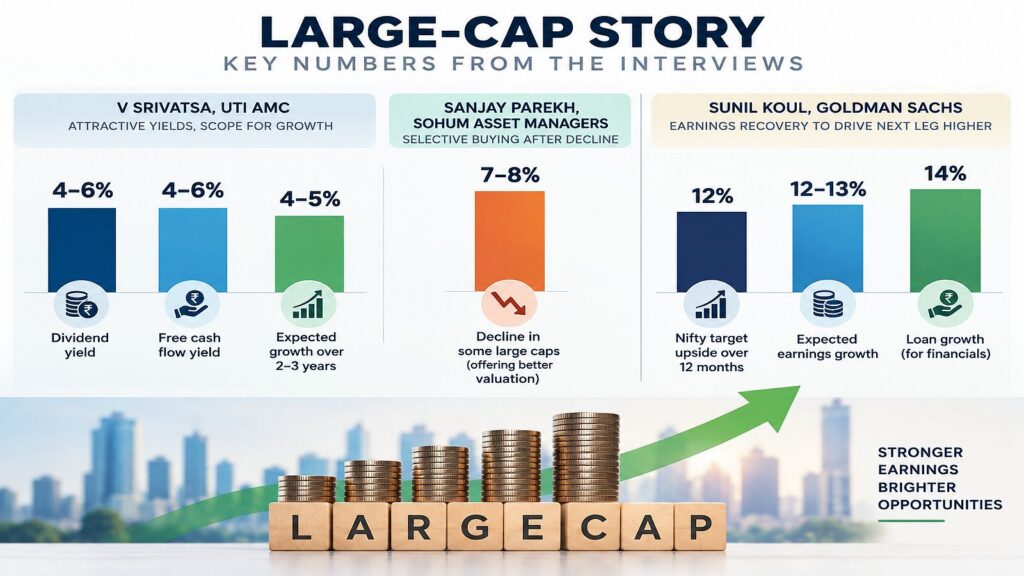
“So the current valuation hardly factors in any growth in the longer term, and we do believe that there would be a reasonable amount of growth, though it may not be as high as what they have done in the past, but even a 4 to 5% kind of a growth over the next two, three years would ensure that these stocks can outperform meaningfully, given the given the fact that their valuations are at rock bottom,” said Srivatsa.
Why large caps are back on the radar
Chintan Haria of ICICI Prudential AMC said he is overweight large caps, pointing to three factors he looks for in stocks that could perform well: underperformance, undervaluation and under-ownership.
“Underperformance, undervaluation, and under ownership, three things which you look for in something which will do well in the next two years, you find that in large caps,” Haria said in an interaction with CNBC-TV18 on August 14.
Large caps are trading at less than 10-year valuations, while money has continued to flow into mid- and small-cap stocks. Large caps have also faced sustained foreign investor selling, leaving them relatively under-owned.
Foreign selling may no longer be the same drag
George Joseph of ASK Investment Managers also noted that large caps had underperformed sharply as foreign institutional investor selling weighed on the segment.
“FII selling was the biggest selling point... large cap segment underperforming massively. Now, that has tamed down,” he said in a chat with CNBC-TV18 on August 24.
With selling pressure easing, Joseph said India's positioning within emerging markets has improved and the currency remains reasonably stable, creating a better backdrop for foreign flows to return. “So some flows can come back... good situation where large caps can come back strongly.”
Not every large cap is a buy
The case for large caps does not mean investors should simply buy the biggest companies.
Haria cautioned against large-cap segments that have already delivered strong outperformance and attracted significant investor ownership, including metals, defence, some capital goods and power.
Instead, he favours directing incremental money towards large caps that have lagged the market, particularly where valuations remain attractive and earnings could improve.
For earnings, Haria pointed to consumer and technology companies, as well as some large energy companies, as areas that could benefit. He also sees cash-rich IT companies as attractive, given their ability to generate cash, undertake buybacks and benefit from the growing use of artificial intelligence.
Joseph is also looking at established large-cap companies that have a proven track record but are available at attractive valuations after a prolonged period of underperformance. He sees opportunities particularly in private banks, IT and pharma.
Sanjay Parekh, Founder and CIO of Sohum Asset Managers, pointed out, “Some of the larger caps, it's 7-8% down, you get it in the way of valuation. So, bottom up, we nibble a bit in telecom, we nibble a bit in banks, because we really believe, and as we are getting money as well, it'd be better deployed where there's reasonable valuation. There's ample choice in large cap.”
The broader takeaway is that investors should not equate large size with safety. The stronger opportunities lie in finding companies where valuations have fallen faster than the underlying business.
Catch all the latest updates from the stock market here
“We have essentially taken the largecap names in the portfolio because they are all available at anywhere between 4 to 6% dividend yield and similar free cash flow yields,” said V Srivatsa, EVP-Equity at UTI AMC.
Srivatsa acknowledged that the near-term outlook for these companies may remain challenging as they face pressure from their top clients and some amount of deflation. But if spending and revenue growth improve even modestly over the next 3-4 years, it could lead to a meaningful outperformance given the low valuations.
“So the current valuation hardly factors in any growth in the longer term, and we do believe that there would be a reasonable amount of growth, though it may not be as high as what they have done in the past, but even a 4 to 5% kind of a growth over the next two, three years would ensure that these stocks can outperform meaningfully, given the given the fact that their valuations are at rock bottom,” said Srivatsa.
Why large caps are back on the radar
Chintan Haria of ICICI Prudential AMC said he is overweight large caps, pointing to three factors he looks for in stocks that could perform well: underperformance, undervaluation and under-ownership.
“Underperformance, undervaluation, and under ownership, three things which you look for in something which will do well in the next two years, you find that in large caps,” Haria said in an interaction with CNBC-TV18 on August 14.
Large caps are trading at less than 10-year valuations, while money has continued to flow into mid- and small-cap stocks. Large caps have also faced sustained foreign investor selling, leaving them relatively under-owned.
Foreign selling may no longer be the same drag
George Joseph of ASK Investment Managers also noted that large caps had underperformed sharply as foreign institutional investor selling weighed on the segment.
“FII selling was the biggest selling point... large cap segment underperforming massively. Now, that has tamed down,” he said in a chat with CNBC-TV18 on August 24.
With selling pressure easing, Joseph said India's positioning within emerging markets has improved and the currency remains reasonably stable, creating a better backdrop for foreign flows to return. “So some flows can come back... good situation where large caps can come back strongly.”
Not every large cap is a buy
The case for large caps does not mean investors should simply buy the biggest companies.
Haria cautioned against large-cap segments that have already delivered strong outperformance and attracted significant investor ownership, including metals, defence, some capital goods and power.
Instead, he favours directing incremental money towards large caps that have lagged the market, particularly where valuations remain attractive and earnings could improve.
For earnings, Haria pointed to consumer and technology companies, as well as some large energy companies, as areas that could benefit. He also sees cash-rich IT companies as attractive, given their ability to generate cash, undertake buybacks and benefit from the growing use of artificial intelligence.
Joseph is also looking at established large-cap companies that have a proven track record but are available at attractive valuations after a prolonged period of underperformance. He sees opportunities particularly in private banks, IT and pharma.
Sanjay Parekh, Founder and CIO of Sohum Asset Managers, pointed out, “Some of the larger caps, it's 7-8% down, you get it in the way of valuation. So, bottom up, we nibble a bit in telecom, we nibble a bit in banks, because we really believe, and as we are getting money as well, it'd be better deployed where there's reasonable valuation. There's ample choice in large cap.”
The broader takeaway is that investors should not equate large size with safety. The stronger opportunities lie in finding companies where valuations have fallen faster than the underlying business.
Catch all the latest updates from the stock market here
/images/ppid_59c68470-image-178879505850468066.webp)
/images/ppid_59c68470-image-178885005558696718.webp)
/images/ppid_59c68470-image-178885755832915051.webp)
/images/ppid_59c68470-image-178880008594447409.webp)
/images/ppid_59c68470-image-178877006063023419.webp)
/images/ppid_59c68470-image-178879003160795863.webp)


/images/ppid_59c68470-image-178885758972212140.webp)