/images/ppid_59c68470-image-177934515536569131.webp)


/images/ppid_59c68470-image-17790950918163784.webp)
/images/ppid_59c68470-image-177909006623962743.webp)
What is the story about?
Nissan Joseph, Chief Executive Officer of Metro Brands, expects the business to continue delivering mid-teen revenue growth while maintaining margins in the 29-31% range, even as the company prepares for higher input costs linked to geopolitical tensions and rising oil prices.
He said Metro Brands is targeting around 15% overall growth, with 30-40% expected to come from same-store sales growth and another 30-40% from new store additions. He added that the company will continue opening stores selectively rather than pursuing aggressive expansion targets, adding that the focus remains on profitable, meaningful stores.
Metro Brands, one of India’s largest footwear and accessories retailers, crossed the 1,000-store milestone after opening a net 124 stores last year. Joseph said the company continues to see expansion opportunities across multiple banners and has sufficient capital to support future growth.
Addressing concerns around inflation and supply disruptions, Joseph said Metro Brands buys products nearly six months in advance, limiting the immediate impact of rising oil prices. “You’re not going to see any immediate price increases,” he said, adding that the company may pass on higher costs selectively if needed.
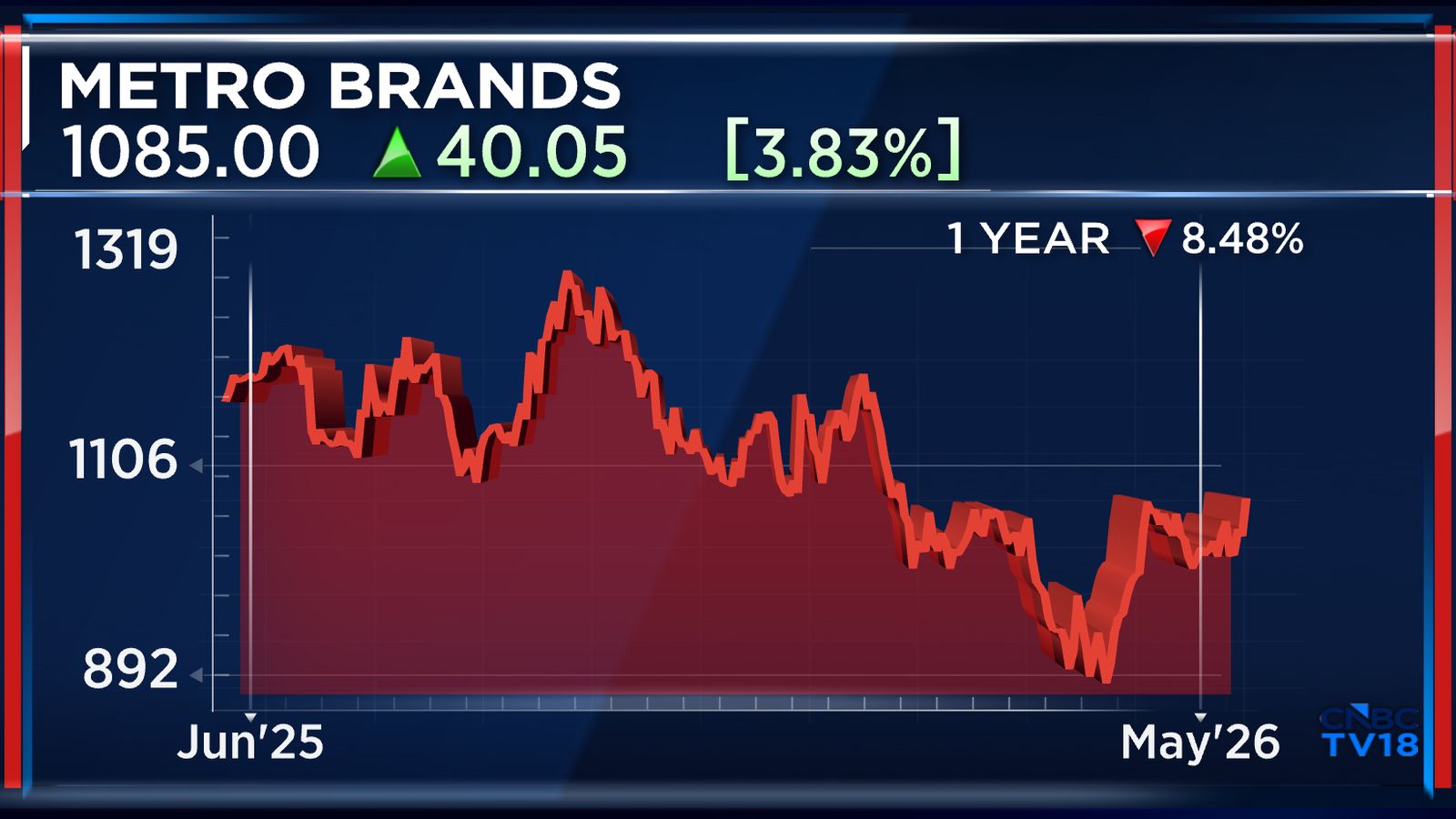
Metro Brands currently has a market capitalisation of ₹29,477.52 crore. The stock has declined more than 8% over the past year.
This is an edited transcript of the interview.Q: In the past, we've spoken about your revenue number compounding in double digits; mid-double digits is what you have spoken about, and EBITDA margin targets have been around 30% for the coming year. What do you expect in terms of growth? 15, 20% seems gettable.
A: This tailwind of the economy rising, and then we have the tailwind of premiumisation going on, along with the fact that we've got multiple banners that cater to different segments of the Indian population. However, as we all know, there's a crisis going on that we're trying to also make sure that we are ready for to mitigate any near-term input costs that may come up, and we're prepared for the short term, at least.
But overall, on a long-term basis, Metro has always delivered mid-double-digit growth, with margins continuing in the 29 to 31% mark, and that's a guidance we're pretty comfortable with for a period of time. It's not always every single quarter.
Q: You are saying, in terms of growth, mid-teen growth, and in terms of margins, holding around 30% odd should be gettable, right?
A: That's always been what we do.
Q: Earlier, you used to do around 23-24% margins, which have come down to around 20%. So nobody's questioning the growth, but some analysts track that particular factor. So, could you tell us what the guidance on that basis is?
A: That continues, that will hover around 20%. It gets affected by the number of new stores we have, because of the Ind AS reporting that we do. A better measure for our growth, and looking at our profitability of operations, would be the EBITDA number, which has outpaced our revenue growth almost consistently, and has held in that 30% range. We don't see any fluctuations to that. Our gross margins have held up through the quarters, and we see that continuing as well.
Also Watch | Metro Brands, Jubilant FoodWorks fairly priced; Apollo Hospitals a strong compounder: Dipan Mehta
Q: You mentioned this conflict. In what way is it impacting you? You got 1000 plus stores. One thing we've heard is some labour shortages. Is that something you've seen at your stores as well?
A: There are several factors that come into this. One of them is that input costs are going to rise, because a lot of the products we deal with have petroleum bases to them, so that's one. We have freight costs that continue to go up because of petroleum as well, and then you also have the fact that there's revenue from expatriate money coming back into the country that's going to be affected.
Overall, there's going to be some effects on the demand in the country. Having said that, though, we weathered the COVID storm better than any other company out there, having posted a profit during the COVID year, and we're taking some of the same, very similar steps to ensure that there's business continuity without seeing any spikes in our operations, whether it be in input cost or whether it be in other costs related to it. We prepare for the worst and hope for the best.
Q: Is there any pricing? Do you take price hikes? So, what you're telling us in terms of margins and growth, etc. is accounting for this price increase.
A: We buy products six months out in advance. So, we get prices for today for six months out; you're not going to see any immediate price increases. You're going to see the normal inflationary price increases, nothing out of the ordinary, but a lot depends on how long we see this inflated cost of oil and other input costs.
So, overall, though, I feel confident that if we do have input costs rising, we'll be able to offset that with price increases across certain sectors and certain markets. So it's not going to be detrimental to our business in total, but at the same time, when there are short-term winds blowing, you have to watch for those.
Q: Just some numbers: the same store sales growth in Q4 and FY26?
A: What we guide is an overall growth percentage, which we target at about 15% and that somewhere between 30% and 40% of it comes from same-store growth, while another 30 to 40% comes from new stores, and then you get the rest from the annualisation effect of stores that were opened in the previous years. So, that's how we disclose our numbers. Overall, though, we'll continue to see our business grow in that mid-teen range. There's no reason for us to believe that, barring something unusual, which of course, there's always that possibility, but barring something unusual, we should be on track for that.
Q: What about the target store additions for FY27 and e-commerce? How much do you think it will contribute to your overall top line by the end of next year?
A: What we've seen from a new store-opening perspective is that last year we opened a net of 124 stores. I believe it is 140-odd stores, but as retail progresses, you close out stores, or you relocate stores. So, 124 net stores were open, crossing the 1000-store mark, which is one of the highest numbers of openings we've had as a company in our history, and that's followed by the previous year, when we also had a significant number of openings.
So, we're going to see that there are growth possibilities because we have multiple banners, but at the same time, we're not going to rush to open stores and hit a target and open stores for the sake of opening stores. What we want to do, as you've seen, is open profitable, meaningful stores, and wherever that opportunity presents itself, however much that is, thanks to the fact that we have adequate capital to support us, we'll be able to open as many stores as we feel is correct for the market.
Q: E-commerce, how much will it contribute?
A: E-commerce was at 10% a couple of years ago. It's now risen to 12, and we anticipate that it will continue to grow. The good news is that it's not coming at a cannibalistic level of taking away sales from our brick-and-mortar stores, but it's going to hover between 12 and 15% over a period of time. Some quarters will touch 14%, there are quarters when it'll touch 12%, one thing I do want to point out, that last quarter was the quarter that we were talking about, is an end-of-season sale quarter, and the fact that we've been able to maintain margins and grow not only the e-com business but also the brick-and-mortar business is commendable, given the state of where things are in the economy in general.
For the full interview, watch the accompanying videoQ: I was looking into the operating cash flow that came down a little bit this year, though your growth has been pretty strong. That's because inventory days have spiked up as well by around 15-18 days. Where does this number settle at?
A: When we look at the future, we're buying for stores that we're going to open in the next quarter. So, it's not always just for your operating business. We have a number of new banners, and as you mentioned earlier, we are opening two of our Fila stores.
For growth, you need more inventory than your normal day-to-day operation. So that's number one. And then, secondly, as I mentioned before, we do plan on carrying some inventories from time to time in excess of what we need, if we anticipate price hikes, if we anticipate certain disruptions coming to the business, so it's a combination of all of those things. Typically, we want to run about two times stock turns, so we need about six months' worth of inventory to run a healthy business.
Catch all the latest updates from the stock market here
He said Metro Brands is targeting around 15% overall growth, with 30-40% expected to come from same-store sales growth and another 30-40% from new store additions. He added that the company will continue opening stores selectively rather than pursuing aggressive expansion targets, adding that the focus remains on profitable, meaningful stores.
Metro Brands, one of India’s largest footwear and accessories retailers, crossed the 1,000-store milestone after opening a net 124 stores last year. Joseph said the company continues to see expansion opportunities across multiple banners and has sufficient capital to support future growth.
Addressing concerns around inflation and supply disruptions, Joseph said Metro Brands buys products nearly six months in advance, limiting the immediate impact of rising oil prices. “You’re not going to see any immediate price increases,” he said, adding that the company may pass on higher costs selectively if needed.
Metro Brands currently has a market capitalisation of ₹29,477.52 crore. The stock has declined more than 8% over the past year.
This is an edited transcript of the interview.Q: In the past, we've spoken about your revenue number compounding in double digits; mid-double digits is what you have spoken about, and EBITDA margin targets have been around 30% for the coming year. What do you expect in terms of growth? 15, 20% seems gettable.
A: This tailwind of the economy rising, and then we have the tailwind of premiumisation going on, along with the fact that we've got multiple banners that cater to different segments of the Indian population. However, as we all know, there's a crisis going on that we're trying to also make sure that we are ready for to mitigate any near-term input costs that may come up, and we're prepared for the short term, at least.
But overall, on a long-term basis, Metro has always delivered mid-double-digit growth, with margins continuing in the 29 to 31% mark, and that's a guidance we're pretty comfortable with for a period of time. It's not always every single quarter.
Q: You are saying, in terms of growth, mid-teen growth, and in terms of margins, holding around 30% odd should be gettable, right?
A: That's always been what we do.
Q: Earlier, you used to do around 23-24% margins, which have come down to around 20%. So nobody's questioning the growth, but some analysts track that particular factor. So, could you tell us what the guidance on that basis is?
A: That continues, that will hover around 20%. It gets affected by the number of new stores we have, because of the Ind AS reporting that we do. A better measure for our growth, and looking at our profitability of operations, would be the EBITDA number, which has outpaced our revenue growth almost consistently, and has held in that 30% range. We don't see any fluctuations to that. Our gross margins have held up through the quarters, and we see that continuing as well.
Also Watch | Metro Brands, Jubilant FoodWorks fairly priced; Apollo Hospitals a strong compounder: Dipan Mehta
Q: You mentioned this conflict. In what way is it impacting you? You got 1000 plus stores. One thing we've heard is some labour shortages. Is that something you've seen at your stores as well?
A: There are several factors that come into this. One of them is that input costs are going to rise, because a lot of the products we deal with have petroleum bases to them, so that's one. We have freight costs that continue to go up because of petroleum as well, and then you also have the fact that there's revenue from expatriate money coming back into the country that's going to be affected.
Overall, there's going to be some effects on the demand in the country. Having said that, though, we weathered the COVID storm better than any other company out there, having posted a profit during the COVID year, and we're taking some of the same, very similar steps to ensure that there's business continuity without seeing any spikes in our operations, whether it be in input cost or whether it be in other costs related to it. We prepare for the worst and hope for the best.
Q: Is there any pricing? Do you take price hikes? So, what you're telling us in terms of margins and growth, etc. is accounting for this price increase.
A: We buy products six months out in advance. So, we get prices for today for six months out; you're not going to see any immediate price increases. You're going to see the normal inflationary price increases, nothing out of the ordinary, but a lot depends on how long we see this inflated cost of oil and other input costs.
So, overall, though, I feel confident that if we do have input costs rising, we'll be able to offset that with price increases across certain sectors and certain markets. So it's not going to be detrimental to our business in total, but at the same time, when there are short-term winds blowing, you have to watch for those.
Q: Just some numbers: the same store sales growth in Q4 and FY26?
A: What we guide is an overall growth percentage, which we target at about 15% and that somewhere between 30% and 40% of it comes from same-store growth, while another 30 to 40% comes from new stores, and then you get the rest from the annualisation effect of stores that were opened in the previous years. So, that's how we disclose our numbers. Overall, though, we'll continue to see our business grow in that mid-teen range. There's no reason for us to believe that, barring something unusual, which of course, there's always that possibility, but barring something unusual, we should be on track for that.
Q: What about the target store additions for FY27 and e-commerce? How much do you think it will contribute to your overall top line by the end of next year?
A: What we've seen from a new store-opening perspective is that last year we opened a net of 124 stores. I believe it is 140-odd stores, but as retail progresses, you close out stores, or you relocate stores. So, 124 net stores were open, crossing the 1000-store mark, which is one of the highest numbers of openings we've had as a company in our history, and that's followed by the previous year, when we also had a significant number of openings.
So, we're going to see that there are growth possibilities because we have multiple banners, but at the same time, we're not going to rush to open stores and hit a target and open stores for the sake of opening stores. What we want to do, as you've seen, is open profitable, meaningful stores, and wherever that opportunity presents itself, however much that is, thanks to the fact that we have adequate capital to support us, we'll be able to open as many stores as we feel is correct for the market.
Q: E-commerce, how much will it contribute?
A: E-commerce was at 10% a couple of years ago. It's now risen to 12, and we anticipate that it will continue to grow. The good news is that it's not coming at a cannibalistic level of taking away sales from our brick-and-mortar stores, but it's going to hover between 12 and 15% over a period of time. Some quarters will touch 14%, there are quarters when it'll touch 12%, one thing I do want to point out, that last quarter was the quarter that we were talking about, is an end-of-season sale quarter, and the fact that we've been able to maintain margins and grow not only the e-com business but also the brick-and-mortar business is commendable, given the state of where things are in the economy in general.
For the full interview, watch the accompanying videoQ: I was looking into the operating cash flow that came down a little bit this year, though your growth has been pretty strong. That's because inventory days have spiked up as well by around 15-18 days. Where does this number settle at?
A: When we look at the future, we're buying for stores that we're going to open in the next quarter. So, it's not always just for your operating business. We have a number of new banners, and as you mentioned earlier, we are opening two of our Fila stores.
For growth, you need more inventory than your normal day-to-day operation. So that's number one. And then, secondly, as I mentioned before, we do plan on carrying some inventories from time to time in excess of what we need, if we anticipate price hikes, if we anticipate certain disruptions coming to the business, so it's a combination of all of those things. Typically, we want to run about two times stock turns, so we need about six months' worth of inventory to run a healthy business.
Catch all the latest updates from the stock market here
/images/ppid_59c68470-image-177934252865195081.webp)
/images/ppid_59c68470-image-177927753491958063.webp)




/images/ppid_59c68470-image-177910252903766647.webp)
/images/ppid_59c68470-image-177909252727277681.webp)
/images/ppid_59c68470-image-177918265334174517.webp)
/images/ppid_59c68470-image-177919757067033311.webp)
/images/ppid_59c68470-image-177913002372055905.webp)