



What is the story about?
Pine Labs remains confident of meeting its financial year 2026-27 (FY27) growth guidance and expects a stronger second half of the fiscal, supported by festive demand, higher monetisation of its payments network and continued growth in Unified Payments Interface (UPI) transactions.
Sameer Kamath, CFO of Pine Labs, the Indian financial technology and merchant commerce company, said the company is comfortable with its outlook after reporting revenue growth of about 24% for the July-September quarter. He added that the business is seeing traction across payment flows, digital services and issuance, while investments in technology and international markets continue.
The company continues to guide for 2026-27 revenue growth of around 23-23.5% while maintaining adjusted margin guidance of around 21%.
[faq type="interview" title="This is an edited transcript of the interview."][ques][/ques][ans][/ans][/faq][faq type="interview"][ques]Are you maintaining your FY27 revenue guidance of 21% to 23.5%?[/ques][ans]Yes. We have seen good growth in our flow-based business, which is about 25%. Overall, our digital business has grown at 21% and our issuance business has grown at about 31%. I believe that what we have created helps us maintain that guidance. We have slightly beaten that guidance in the second quarter, which is otherwise a weak quarter from a full seasonality perspective, keeping those margins intact. We are fairly confident about our second half looking from where we are here on.[/ans][/faq][faq type="interview"][ques]You are doing about ₹20,000 crore in monthly UPI GTV. Is this lower than your expectation of ₹25,000 crore to ₹30,000 crore?[/ques][ans]This is an average number. We keep growing on a monthly basis, not a quarterly basis on UPI. Our UPI volumes have been growing at a tick rate of about 70%, and 70% of our GTV which happens on point of sale happens through UPI. That is a number which is growing at a meaningful pace. These are average numbers. Actually, our exit quarter would be at a higher number than ₹25,000 crore. This is an average we will give for the first half, which we believe will grow at about 70% going forward, and that is the guidance we have given in the earnings release as well.[/ans][/faq][faq type="interview"][ques]Your margin guidance is 21%, but the first half margins are 18%. What are the levers to achieve your guidance, and do you think margins can expand further in FY28 versus FY27?[/ques][ans]Typically, the second half is better because the festive season comes in and a lot of our flow-based businesses get traction. That is one reason why our value-added services and businesses would grow faster. Over the last five years, our flow-based businesses, where we have laid the rails and are now monetising, used to be about 55% of our topline and have gone up to over 60% of our topline. That has translated into our earnings before interest, taxes, depreciation, and amortisation (EBITDA) margins going up from about 12% to the 20% range. Plus, our international business, where we have been putting in investments, has scaled up. We have seen significant scale-up happening in Dubai, where we are doing about one lakh transactions on a daily basis, and a lot of traction in Southeast Asia. All of these initiatives will pan out and grow. That is the confidence we get as we look at the direction going forward for the second half and also for FY28.[/ans][/faq][faq type="interview"][ques]Directionally, will FY28 margins be higher than FY27?[/ques][ans]Directionally, the answer is yes. We will calibrate that to the growth opportunities. UPI has come up as an opportunity which we are monetising at scale. There are new geographies where we are doubling down. That is a calibrated answer where we see topline growth and the ability to get meaningful market share and presence. We will invest in those geographies as we have always been doing, and we report our numbers on a full basis, including all the investments we put in, including tech, offshore, and new businesses like online. All of those will get factored into the reported margins. As margins continue to expand, new investments which are factored into the margins will do so as we see the growth opportunities going.[/ans][/faq][faq type="interview"][ques]Analysts point out that there is a growth-margin trade-off. Would you characterise it like that?[/ques][ans]I would look at it this way: building a business, you are seeing size, scale and the ability to penetrate. We are very calibrated about those investments, and most of those investments in the past have yielded results. Whenever we see growth opportunities, we will invest, but we will keep an eye on profitability. We are continuing to deliver very strong margins. It is not a trade-off that we are doing new things to get more margins. Our core business profitability is rising. All of these are new opportunities where we are still maintaining a higher margin than what we were doing in earlier years.[/ans][/faq][faq type="interview"][ques]Where do you see indirect costs stabilising, given they have moved up on a sequential basis?[/ques][ans]You should look at indirect costs in two line items. One is we are a tech company, so one of our largest costs is cloud and the whole tech cost. We have always guided that cost will variabilise to the topline. We are making a lot of investments into artificial intelligence (AI). Cloud costs will move up in that direction, but it is within a range that we have been seeing. A lot of our incremental people cost deployment has happened in the front-end sales force. Our headcount has gone up by about 500 people year-on-year, and 90% of that headcount is in the ground staff. Our mid-market segment, which is the next segment of growth for us, is seeing meaningful traction. That segment has grown by 50% in terms of our DCPs. We believe that is a segment which requires investment for field staff as it lays the way for new flow-based and other value-added services income, as we have done in our enterprise segment where we continue to hold our market share and grow meaningfully by other value-added services coming there. Those investments will continue. While indirect costs as a percentage have remained more or less the same, it is a reflection of those investments made in tech, people at the frontline level, and some marketing to get our ground presence clear.[/ans][/faq][faq type="interview"][ques]Do you have any idea when the merchant discount rate (MDR) on UPI is coming?[/ques][ans]I do not want to speculate on something which I do not have control of. What we are excited about is the size and scale at which we are building a UPI business. Anything which comes in is a positive for us, but we continue to build our business. That is what is in our control.[/ans][/faq]
For the full interview, watch the accompanying video
Catch all the latest updates from the stock market here
Sameer Kamath, CFO of Pine Labs, the Indian financial technology and merchant commerce company, said the company is comfortable with its outlook after reporting revenue growth of about 24% for the July-September quarter. He added that the business is seeing traction across payment flows, digital services and issuance, while investments in technology and international markets continue.
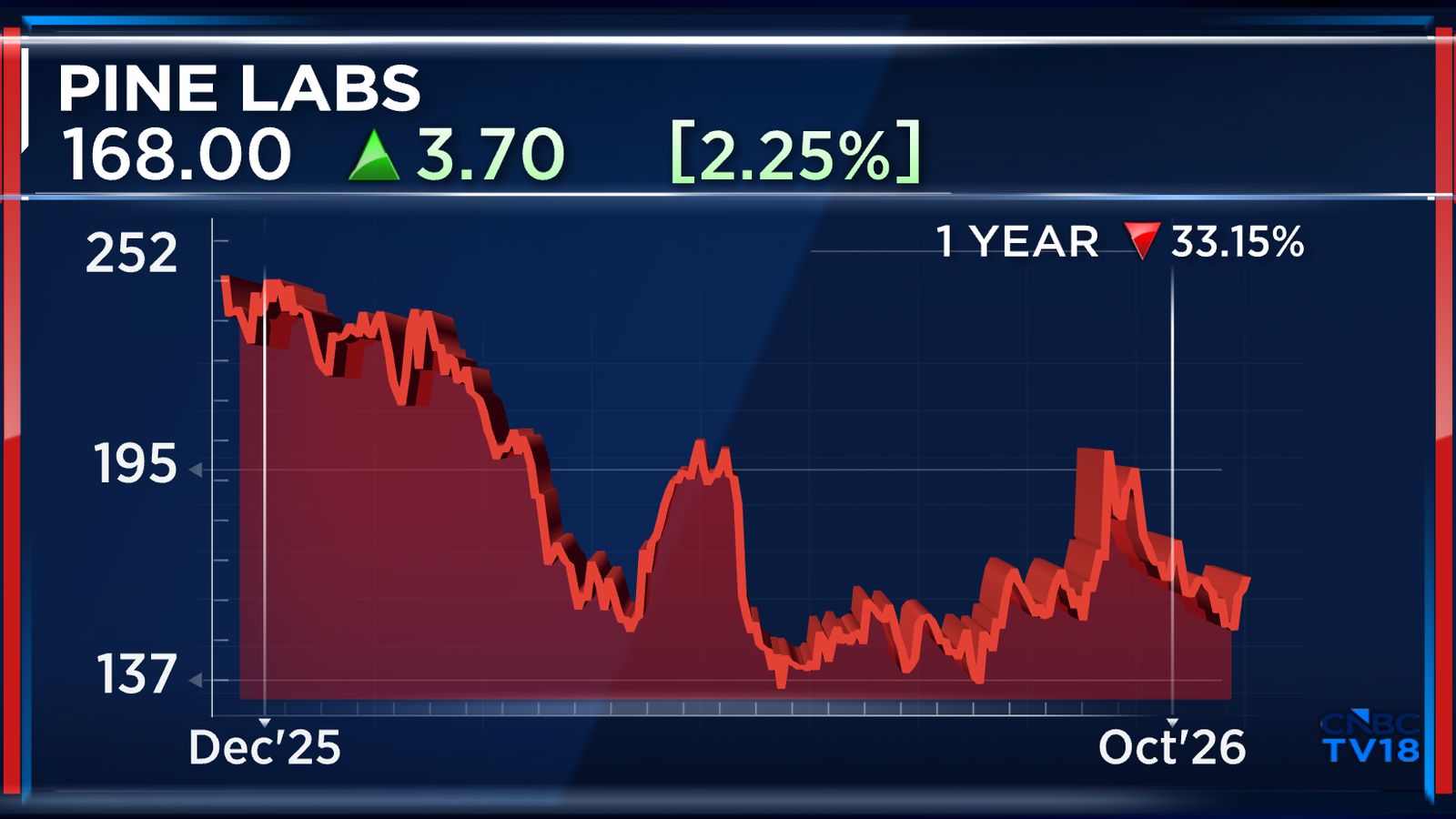
Pine Labs shares were trading at ₹162.52 on the NSE at 9:16 am. The company has a market capitalisation of ₹18,972.52 crore, while the stock has declined more than 33% over the past year.
The company continues to guide for 2026-27 revenue growth of around 23-23.5% while maintaining adjusted margin guidance of around 21%.
[faq type="interview" title="This is an edited transcript of the interview."][ques][/ques][ans][/ans][/faq][faq type="interview"][ques]Are you maintaining your FY27 revenue guidance of 21% to 23.5%?[/ques][ans]Yes. We have seen good growth in our flow-based business, which is about 25%. Overall, our digital business has grown at 21% and our issuance business has grown at about 31%. I believe that what we have created helps us maintain that guidance. We have slightly beaten that guidance in the second quarter, which is otherwise a weak quarter from a full seasonality perspective, keeping those margins intact. We are fairly confident about our second half looking from where we are here on.[/ans][/faq][faq type="interview"][ques]You are doing about ₹20,000 crore in monthly UPI GTV. Is this lower than your expectation of ₹25,000 crore to ₹30,000 crore?[/ques][ans]This is an average number. We keep growing on a monthly basis, not a quarterly basis on UPI. Our UPI volumes have been growing at a tick rate of about 70%, and 70% of our GTV which happens on point of sale happens through UPI. That is a number which is growing at a meaningful pace. These are average numbers. Actually, our exit quarter would be at a higher number than ₹25,000 crore. This is an average we will give for the first half, which we believe will grow at about 70% going forward, and that is the guidance we have given in the earnings release as well.[/ans][/faq][faq type="interview"][ques]Your margin guidance is 21%, but the first half margins are 18%. What are the levers to achieve your guidance, and do you think margins can expand further in FY28 versus FY27?[/ques][ans]Typically, the second half is better because the festive season comes in and a lot of our flow-based businesses get traction. That is one reason why our value-added services and businesses would grow faster. Over the last five years, our flow-based businesses, where we have laid the rails and are now monetising, used to be about 55% of our topline and have gone up to over 60% of our topline. That has translated into our earnings before interest, taxes, depreciation, and amortisation (EBITDA) margins going up from about 12% to the 20% range. Plus, our international business, where we have been putting in investments, has scaled up. We have seen significant scale-up happening in Dubai, where we are doing about one lakh transactions on a daily basis, and a lot of traction in Southeast Asia. All of these initiatives will pan out and grow. That is the confidence we get as we look at the direction going forward for the second half and also for FY28.[/ans][/faq][faq type="interview"][ques]Directionally, will FY28 margins be higher than FY27?[/ques][ans]Directionally, the answer is yes. We will calibrate that to the growth opportunities. UPI has come up as an opportunity which we are monetising at scale. There are new geographies where we are doubling down. That is a calibrated answer where we see topline growth and the ability to get meaningful market share and presence. We will invest in those geographies as we have always been doing, and we report our numbers on a full basis, including all the investments we put in, including tech, offshore, and new businesses like online. All of those will get factored into the reported margins. As margins continue to expand, new investments which are factored into the margins will do so as we see the growth opportunities going.[/ans][/faq][faq type="interview"][ques]Analysts point out that there is a growth-margin trade-off. Would you characterise it like that?[/ques][ans]I would look at it this way: building a business, you are seeing size, scale and the ability to penetrate. We are very calibrated about those investments, and most of those investments in the past have yielded results. Whenever we see growth opportunities, we will invest, but we will keep an eye on profitability. We are continuing to deliver very strong margins. It is not a trade-off that we are doing new things to get more margins. Our core business profitability is rising. All of these are new opportunities where we are still maintaining a higher margin than what we were doing in earlier years.[/ans][/faq][faq type="interview"][ques]Where do you see indirect costs stabilising, given they have moved up on a sequential basis?[/ques][ans]You should look at indirect costs in two line items. One is we are a tech company, so one of our largest costs is cloud and the whole tech cost. We have always guided that cost will variabilise to the topline. We are making a lot of investments into artificial intelligence (AI). Cloud costs will move up in that direction, but it is within a range that we have been seeing. A lot of our incremental people cost deployment has happened in the front-end sales force. Our headcount has gone up by about 500 people year-on-year, and 90% of that headcount is in the ground staff. Our mid-market segment, which is the next segment of growth for us, is seeing meaningful traction. That segment has grown by 50% in terms of our DCPs. We believe that is a segment which requires investment for field staff as it lays the way for new flow-based and other value-added services income, as we have done in our enterprise segment where we continue to hold our market share and grow meaningfully by other value-added services coming there. Those investments will continue. While indirect costs as a percentage have remained more or less the same, it is a reflection of those investments made in tech, people at the frontline level, and some marketing to get our ground presence clear.[/ans][/faq][faq type="interview"][ques]Do you have any idea when the merchant discount rate (MDR) on UPI is coming?[/ques][ans]I do not want to speculate on something which I do not have control of. What we are excited about is the size and scale at which we are building a UPI business. Anything which comes in is a positive for us, but we continue to build our business. That is what is in our control.[/ans][/faq]
For the full interview, watch the accompanying video
Catch all the latest updates from the stock market here