/images/ppid_59c68470-image-178470252554916605.webp)

/images/ppid_59c68470-image-178470005883059347.webp)
/images/ppid_59c68470-image-178470015846491281.webp)
/images/ppid_59c68470-image-17847000307277992.webp)


What is the story about?
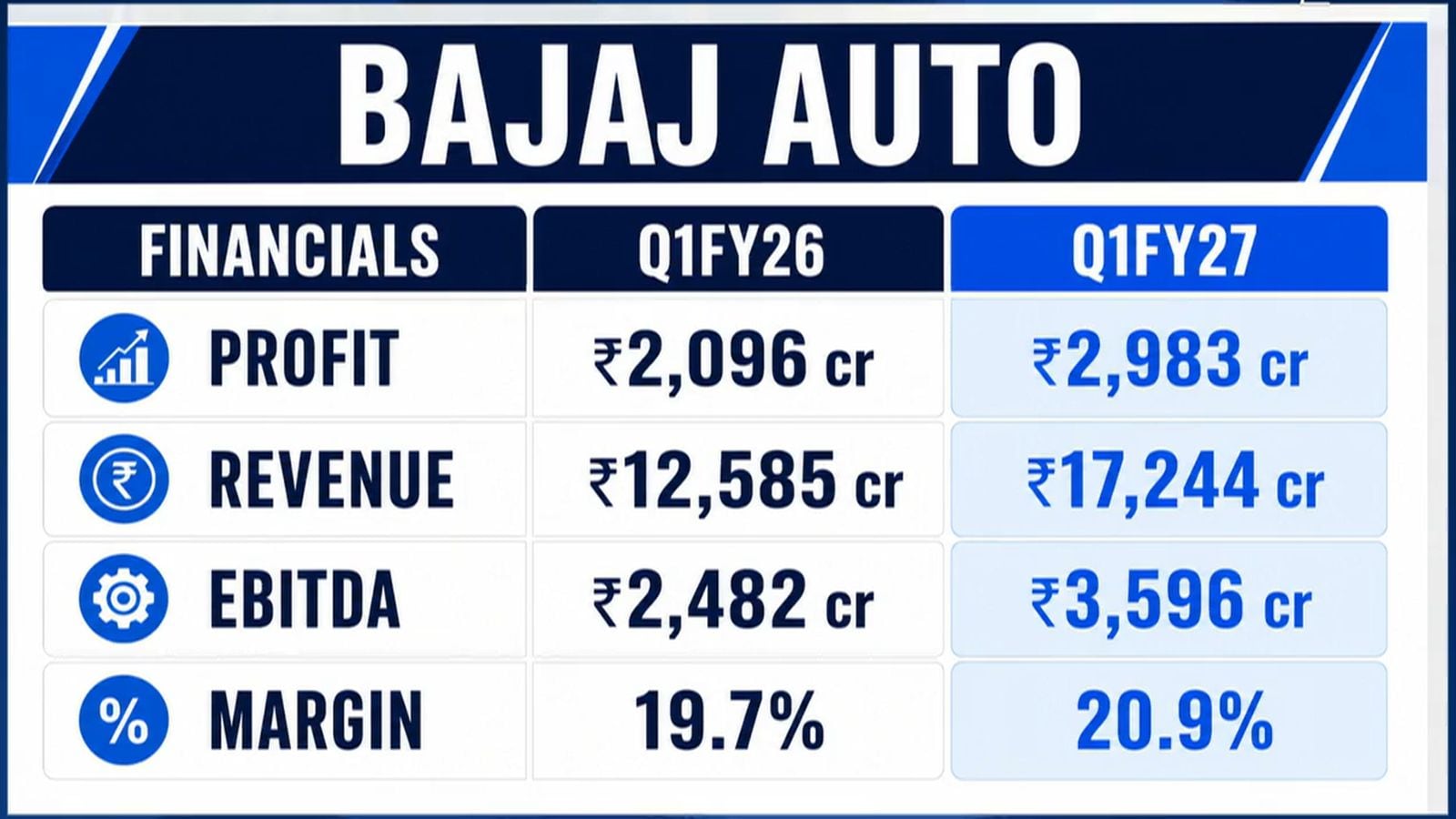
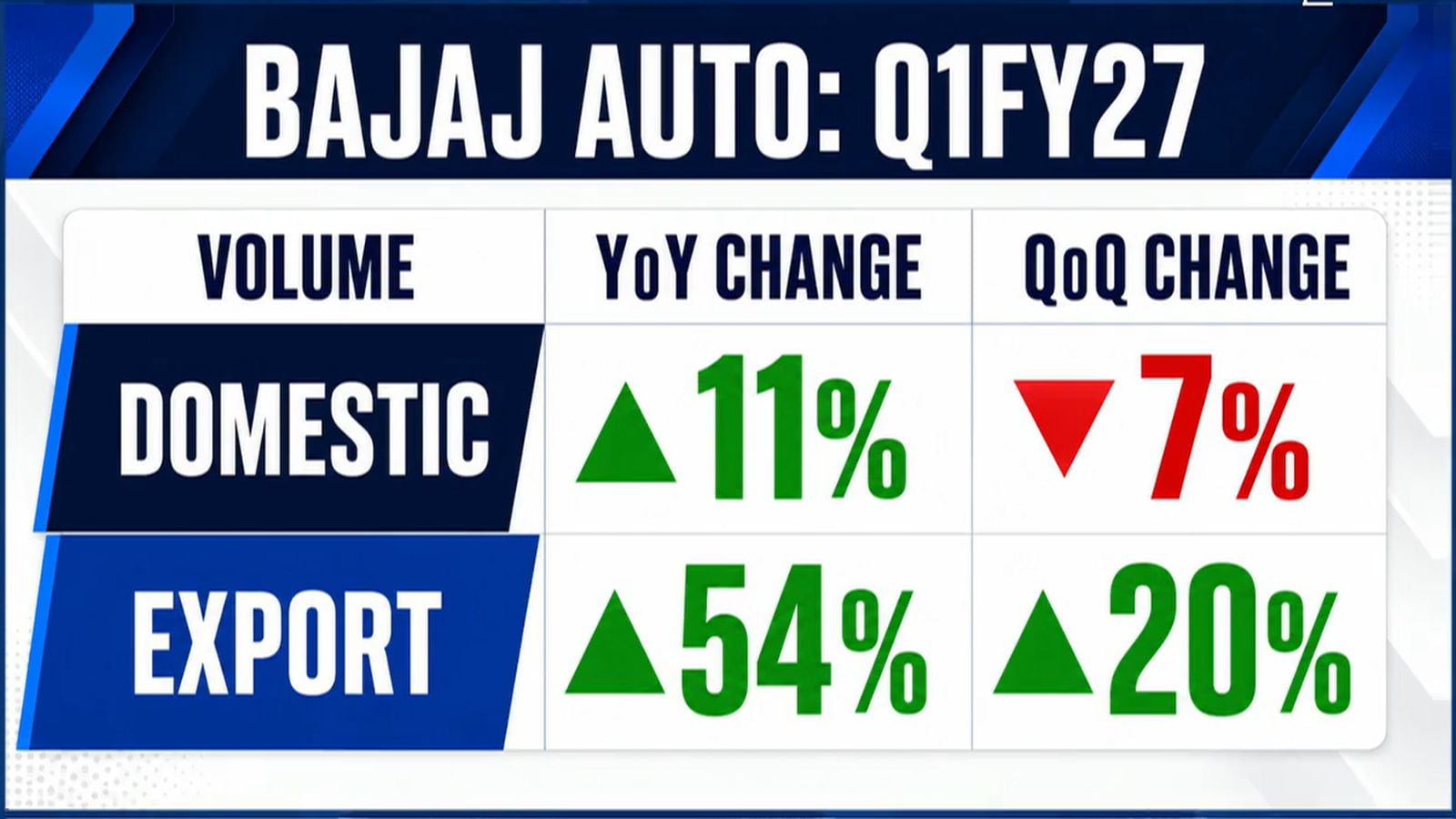
Bajaj Auto expects exports to remain above 250,000 units in the coming quarters as demand across key international markets continues to support growth, said Rakesh Sharma, Joint Managing Director of the Indian automotive manufacturing company.
He said the company is also preparing to expand production capacity as demand for electric vehicles, premium motorcycles and exports continues to rise.
Despite logistics disruptions linked to the West Asia crisis, he said underlying demand remains healthy across markets including Africa and Latin America. Looking ahead, Bajaj Auto plans to increase its annual production capacity from about 7 million units to more than 9 million units.
Sharma said the company's key growth drivers remain exports, electric vehicles and motorcycles above 150cc. He added that the company faced capacity constraints in electric two-wheelers, premium motorcycles and larger three-wheelers during the April-June 2026 quarter. On electric vehicles, Sharma estimated that almost 80% of buyers are shifting from Internal Combustion Engine (ICE) scooters to electric scooters rather than motorcycles.
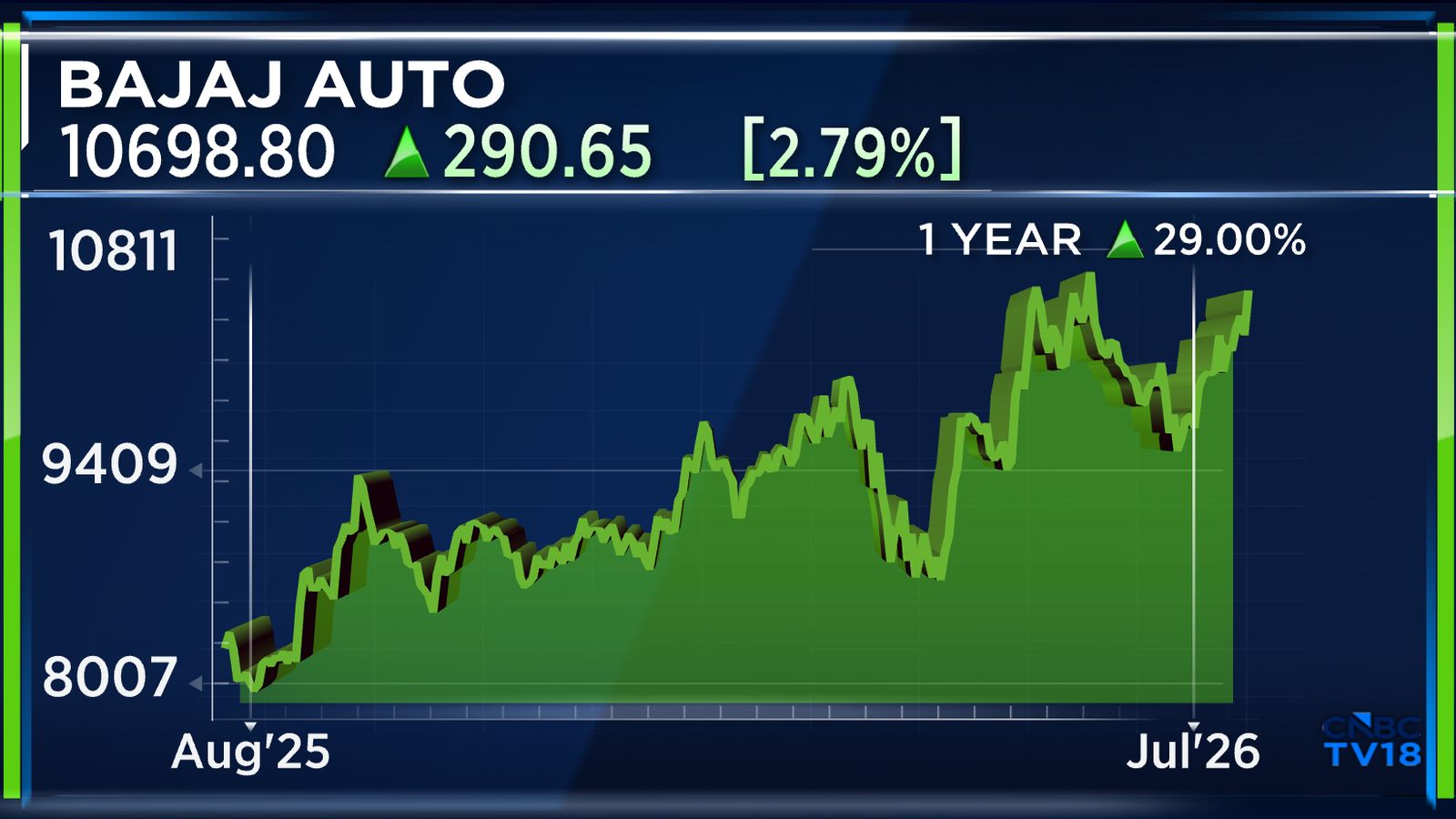
Bajaj Auto has a market capitalisation of ₹2,98,801.36 crore. The company's shares have gained more than 29% over the last year.
This is an edited transcript of the interview.Q: Exports are still growing strongly, and you're confident of the 2.5 lakh run rate continuing month after month going ahead. So, what are we seeing in the export market, and is there a possibility that your overall volume growth for the year will be higher now? I was looking at a JM Financial note, and they're saying the company's volume growth, driven by exports, could be 14% this year versus their earlier expectation of 11%. A: Yes, the exports came in very strongly. It was the highlight of the quarter, despite the West Asia crisis, which has had a severe impact on logistics. Our exposure to West Asia is less than 3%, so not from a sales point of view, but from a point of view of servicing all the demand that we were getting. I would say both logistics and supply chain difficulties impaired availability by 10% to 15%. So, we were looking at about 100,000 to 120,000 units more.
Looking ahead, and hoping that logistics conditions improve, we should be breaching the 250,000 mark during the balance of this quarter, and hopefully continuing into quarter three.
Q: And for the full year, do you think you can push volumes to the low teens kind of volume growth, with exports and domestic business combined?A: I must say that the segments we are participating in are looking very promising because you've seen that exports have moved up from 200,000 to 250,000 or so. The electric segment, both for three-wheelers and two-wheelers, is a very strong segment for us. In three-wheelers, e-autos have doubled. The industry has doubled.
In electric scooters, the industry is growing by 70%.
The third segment, besides exports and electric vehicles, is the sports bikes - the 150cc-plus segment. If you see, the two-wheelers are growing at – in quarter one, the VAHAN registrations grew at about 14%.
But with an industry as large and as diverse as this, a singular number hides a lot of meaningful content because electric two-wheelers, which account for around 175,000 units, are growing at 70%, 100cc bikes are growing at 3%, and 150cc-plus bikes are growing at 25%. So, there is an enormous diversity, which is now getting reflected. So a singular number hides valuable interpretation.
So, when we sort of peel the onion, the segments in which we are aggressively participating in - exports, the 150cc-plus segment, and electric - are all looking promising. But how this will all combine, and what will be the final growth number with so much volatility, I wouldn't hazard a guess. We are taking it month by month and quarter by quarter.
Q: That 250,000 export number is now sustainable, right? We will see that every month.A: The forward view is suggesting that certainly we should be breaching 250,000 in the short term. Let's see how it goes from October, November, and December, which is a bit of a slowdown in exports from a seasonal point of view because of Christmas and related holidays. We are not shipping so much to Latin American markets during that period. But yeah, it's looking promising, and there are a couple of reasons for that.
The first one is that despite the crisis, I must say we've all been surprised by the resilience that many markets have demonstrated internationally. Africa has come back, led by Nigeria. The industry in Africa is growing at almost 50%. The currencies are a little bit up and down compared to the US dollar, but nevertheless, it's growing at 50%, and we have grown our retail sales there by 100%, again led by Nigeria.
Latin America's growth has come down, but it is still in a good growth zone, growing at 5% to 6%, and our retail sales there are growing at 30%. Asia is a little bit muted, largely because of the Indian subcontinent. But places like the Philippines, where we have a very good footprint, are doing well.
So, the underlying demand is strong, and our competitive position allows us to get a disproportionate share of the growth. Therefore, we are quite optimistic about exports remaining at this level.
Q: Chetak is also now EBITDA-positive. The electric segment is growing pretty fast. Are ICE scooter users buying electric vehicles, or are motorcycle users also shifting to electric scooters? Which one is it? Is it both? Is it predominantly one?A: I would say it is very difficult to quantify it precisely. But on the basis of whatever research we do, and if you look at some of the reasons why this is happening, it suggests that most of the cannibalisation is occurring in the ICE scooter segment.
To begin with, if you see the performance of electric scooters and ICE scooters, it is very much in the same zone, in the sense that the usage is limited. An average user is riding about 30 to 40 kilometers, which is very comfortably covered by an electric scooter.
If you look at motorcycles, motorcycles tend to be used for much longer distances, and that is where range anxiety comes in. So, it would be difficult to imagine a person who's riding long distances shifting to electric scooters. But having said that, some motorcycles are obviously used for short distances. There are delivery people, etc. But then those people are riding 12 hours, and then again range anxiety comes in.
So, I would say 80% or so - if I were to hazard a number - almost 80%. As you said, predominantly the movement is from ICE scooters to electric scooters.
Q: Demand is an issue, right? You've got more capacity coming up. Others are also adding capacity. Could you give us a sense of where we are and where we will be - for Bajaj Auto and the industry as a whole, in terms of capacity?A: It's difficult for me to comment about what the others would do, but I would certainly say that demand for our products challenged our capacity quite significantly in quarter one. Some of it was, of course, because of the disruption everyone faced in April and May on account of LPG shortages, manpower migration and stuff like that.
Nevertheless, there are three areas where we are really getting challenged on capacity. One is the electric two-wheelers, which we just spoke about. Then there are also the high-end bikes - our 250cc-plus bikes, both in the KTM, Triumph, and Pulsar brands. The third area is a few sub-segments in the three-wheeler business, particularly the larger-format three-wheelers, where we have been doing extremely well, both on the electric and ICE side in India and overseas.
So, these are the three areas where we are undertaking capacity expansion, and even a slightly longer-term forward view suggests that we have to undertake a substantial increase in capacity. Our capacity is about 7 million units per annum, and we think that we have to increase it by 25% and go beyond 9 million. That is the kind of demand outlook we are seeing for our segments.
For the full interview, watch the accompanying videoCatch all the latest updates from the stock market here
He said the company is also preparing to expand production capacity as demand for electric vehicles, premium motorcycles and exports continues to rise.
Despite logistics disruptions linked to the West Asia crisis, he said underlying demand remains healthy across markets including Africa and Latin America. Looking ahead, Bajaj Auto plans to increase its annual production capacity from about 7 million units to more than 9 million units.
Sharma said the company's key growth drivers remain exports, electric vehicles and motorcycles above 150cc. He added that the company faced capacity constraints in electric two-wheelers, premium motorcycles and larger three-wheelers during the April-June 2026 quarter. On electric vehicles, Sharma estimated that almost 80% of buyers are shifting from Internal Combustion Engine (ICE) scooters to electric scooters rather than motorcycles.
Bajaj Auto has a market capitalisation of ₹2,98,801.36 crore. The company's shares have gained more than 29% over the last year.
This is an edited transcript of the interview.Q: Exports are still growing strongly, and you're confident of the 2.5 lakh run rate continuing month after month going ahead. So, what are we seeing in the export market, and is there a possibility that your overall volume growth for the year will be higher now? I was looking at a JM Financial note, and they're saying the company's volume growth, driven by exports, could be 14% this year versus their earlier expectation of 11%. A: Yes, the exports came in very strongly. It was the highlight of the quarter, despite the West Asia crisis, which has had a severe impact on logistics. Our exposure to West Asia is less than 3%, so not from a sales point of view, but from a point of view of servicing all the demand that we were getting. I would say both logistics and supply chain difficulties impaired availability by 10% to 15%. So, we were looking at about 100,000 to 120,000 units more.
Looking ahead, and hoping that logistics conditions improve, we should be breaching the 250,000 mark during the balance of this quarter, and hopefully continuing into quarter three.
Q: And for the full year, do you think you can push volumes to the low teens kind of volume growth, with exports and domestic business combined?A: I must say that the segments we are participating in are looking very promising because you've seen that exports have moved up from 200,000 to 250,000 or so. The electric segment, both for three-wheelers and two-wheelers, is a very strong segment for us. In three-wheelers, e-autos have doubled. The industry has doubled.
In electric scooters, the industry is growing by 70%.
The third segment, besides exports and electric vehicles, is the sports bikes - the 150cc-plus segment. If you see, the two-wheelers are growing at – in quarter one, the VAHAN registrations grew at about 14%.
But with an industry as large and as diverse as this, a singular number hides a lot of meaningful content because electric two-wheelers, which account for around 175,000 units, are growing at 70%, 100cc bikes are growing at 3%, and 150cc-plus bikes are growing at 25%. So, there is an enormous diversity, which is now getting reflected. So a singular number hides valuable interpretation.
So, when we sort of peel the onion, the segments in which we are aggressively participating in - exports, the 150cc-plus segment, and electric - are all looking promising. But how this will all combine, and what will be the final growth number with so much volatility, I wouldn't hazard a guess. We are taking it month by month and quarter by quarter.
Q: That 250,000 export number is now sustainable, right? We will see that every month.A: The forward view is suggesting that certainly we should be breaching 250,000 in the short term. Let's see how it goes from October, November, and December, which is a bit of a slowdown in exports from a seasonal point of view because of Christmas and related holidays. We are not shipping so much to Latin American markets during that period. But yeah, it's looking promising, and there are a couple of reasons for that.
The first one is that despite the crisis, I must say we've all been surprised by the resilience that many markets have demonstrated internationally. Africa has come back, led by Nigeria. The industry in Africa is growing at almost 50%. The currencies are a little bit up and down compared to the US dollar, but nevertheless, it's growing at 50%, and we have grown our retail sales there by 100%, again led by Nigeria.
Latin America's growth has come down, but it is still in a good growth zone, growing at 5% to 6%, and our retail sales there are growing at 30%. Asia is a little bit muted, largely because of the Indian subcontinent. But places like the Philippines, where we have a very good footprint, are doing well.
So, the underlying demand is strong, and our competitive position allows us to get a disproportionate share of the growth. Therefore, we are quite optimistic about exports remaining at this level.
Q: Chetak is also now EBITDA-positive. The electric segment is growing pretty fast. Are ICE scooter users buying electric vehicles, or are motorcycle users also shifting to electric scooters? Which one is it? Is it both? Is it predominantly one?A: I would say it is very difficult to quantify it precisely. But on the basis of whatever research we do, and if you look at some of the reasons why this is happening, it suggests that most of the cannibalisation is occurring in the ICE scooter segment.
To begin with, if you see the performance of electric scooters and ICE scooters, it is very much in the same zone, in the sense that the usage is limited. An average user is riding about 30 to 40 kilometers, which is very comfortably covered by an electric scooter.
If you look at motorcycles, motorcycles tend to be used for much longer distances, and that is where range anxiety comes in. So, it would be difficult to imagine a person who's riding long distances shifting to electric scooters. But having said that, some motorcycles are obviously used for short distances. There are delivery people, etc. But then those people are riding 12 hours, and then again range anxiety comes in.
So, I would say 80% or so - if I were to hazard a number - almost 80%. As you said, predominantly the movement is from ICE scooters to electric scooters.
Q: Demand is an issue, right? You've got more capacity coming up. Others are also adding capacity. Could you give us a sense of where we are and where we will be - for Bajaj Auto and the industry as a whole, in terms of capacity?A: It's difficult for me to comment about what the others would do, but I would certainly say that demand for our products challenged our capacity quite significantly in quarter one. Some of it was, of course, because of the disruption everyone faced in April and May on account of LPG shortages, manpower migration and stuff like that.
Nevertheless, there are three areas where we are really getting challenged on capacity. One is the electric two-wheelers, which we just spoke about. Then there are also the high-end bikes - our 250cc-plus bikes, both in the KTM, Triumph, and Pulsar brands. The third area is a few sub-segments in the three-wheeler business, particularly the larger-format three-wheelers, where we have been doing extremely well, both on the electric and ICE side in India and overseas.
So, these are the three areas where we are undertaking capacity expansion, and even a slightly longer-term forward view suggests that we have to undertake a substantial increase in capacity. Our capacity is about 7 million units per annum, and we think that we have to increase it by 25% and go beyond 9 million. That is the kind of demand outlook we are seeing for our segments.
For the full interview, watch the accompanying videoCatch all the latest updates from the stock market here