/images/ppid_59c68470-image-178472006820053227.webp)

/images/ppid_59c68470-image-178474255998695767.webp)
/images/ppid_59c68470-image-178462256455320631.webp)
/images/ppid_59c68470-image-17847150993348698.webp)
What is the story about?
Atlanta Electricals expects to maintain its 40% annual growth trajectory as demand from power transmission, renewable energy and battery energy storage projects continues to drive order inflows, said Chairman and Managing Director Niral Patel.
The Gujarat-headquartered transformer manufacturer expects margins to remain stable as it expands into higher-voltage products and ramps up manufacturing capacity.
He said Atlanta Electricals expects continued demand from state transmission utilities, renewable energy projects and battery energy storage systems, adding that the company booked a record ₹974 crore of orders during the June quarter, the highest in the past two years.
Patel said the company's shift towards 220 kV and 400 kV transformer products should support future growth while helping maintain profitability. The margins are expected to remain stable, he said, noting that higher-margin products are likely to offset increased research and development spending.
He also said the company is not concerned about additional competition following the entry of a Chinese transformer manufacturer into India, as industry demand remains strong and existing capacities are unlikely to materially change the market.
The company reported its April-June 2026 quarter results on July 21, 2026.
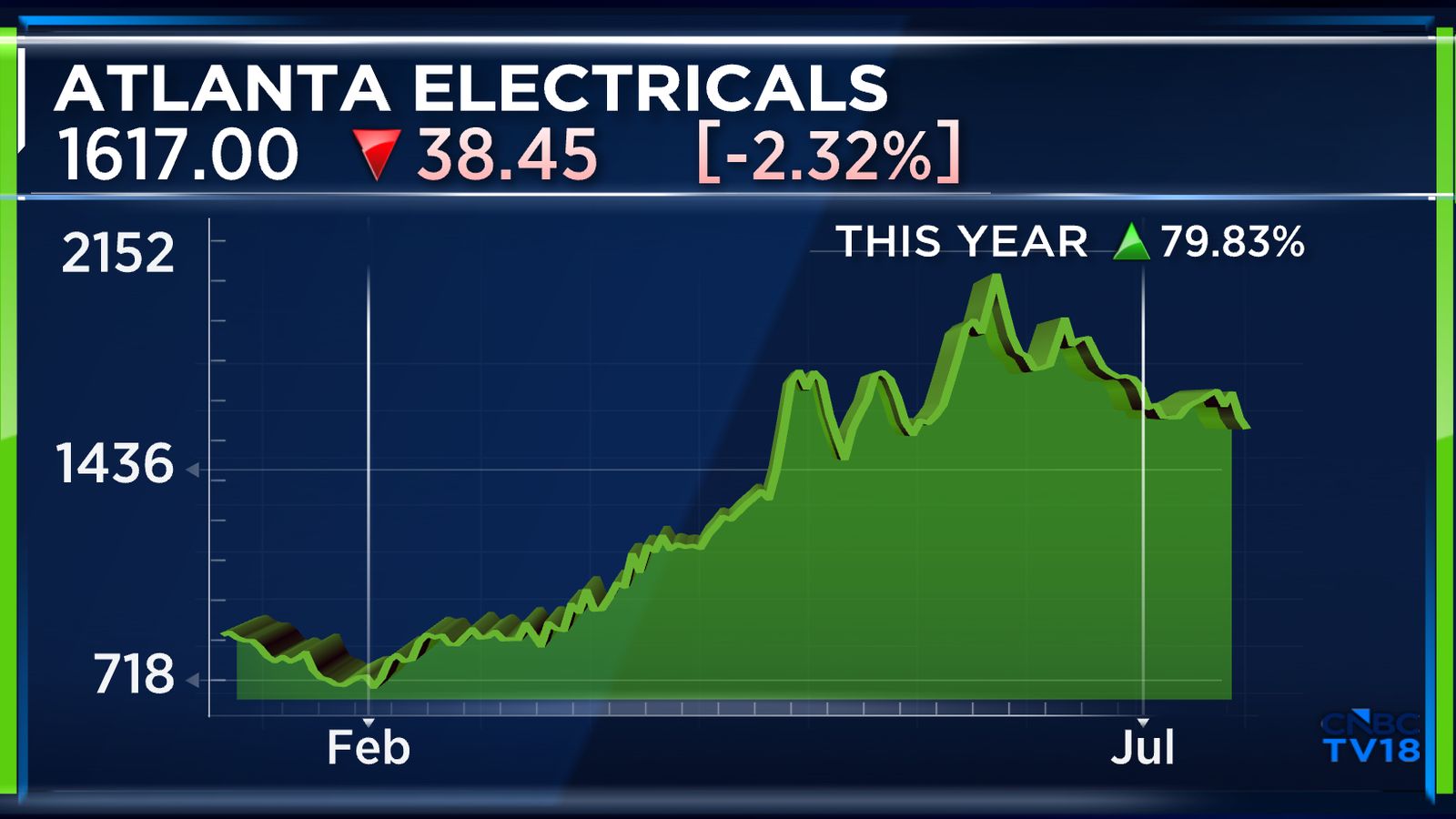
Atlanta Electricals, which manufactures power and special-duty transformers, has a market capitalisation of ₹12,434.18 crore. The company's shares have gained more than 79% so far this year.
This is an edited transcript of the interview.Q: A 45% top-line growth is what we've seen as far as quarter one is concerned. Do you attribute this mainly to higher capacities? For FY27, given that you started quarter one on a strong note, give us the outlook or the guidance for the top line, EBITDA, EBITDA margin, and PAT.A: We've started with a very strong performance in both execution and order booking. We were able to maintain steady growth in the last quarter, wherein the revenue from operations jumped by about 48%. The gross profit grew by about 55% on a year-on-year basis, while the order book reached an all-time high in this particular quarter at about ₹974 crore, with orders booked during the quarter.
This improvement is structural and reflects improved operational efficiency and a gradual shift towards higher kV class products, specifically 220 kV class products.
Q: What is the guidance? A: Ever since we went public, we've been maintaining a 40% compounded annual growth rate (CAGR) guidance on a year-on-year basis, and that's exactly what the company is striving to do. As of today, we have been able to achieve it.
Q: Are you going to stick to the 16.5% to 17.5% EBITDA margin band, or could you improve on that?A: The company is in the phase of certain technological developments, infusing newer products and higher kV class products. So, with all those research and development costs, we expect the margins to be fairly stable because the higher kV class products will have incremental margins, which can be offset by the R&D costs. So yes, margins are expected to remain stable.
Q: A lot of your order book this time, and the 25% sequential jump, is also because of the RRVPNL order, which itself has contributed close to ₹300 crore. Now, how healthy is the demand looking currently? What's the kind of order inflow that you have had this time around, or if not this time around, at least in the first month of the second quarter? What's the demand situation looking like on the ground?A: The demand situation is quite exciting. There's a huge level of demand coming in from the state transmission companies, the renewable sector, and battery energy storage systems. So yes, the demand is pretty good. These are exciting times for the industry. It looks quite robust.
A ₹974 crore order book in one quarter is the highest that we've achieved in the last two years, so we are achieving these milestones, and we would ensure that these milestones and targets are almost doubling every year.
Q: I also want to understand, as far as the approval that you've got from Powergrid is concerned, for setting up a new facility. What kind of capex does it entail? What does it add to your capacity, and what is the incremental capex turnover or top-line growth you can expect from there?A: So, we have already done the capex. The capex for Unit 5 and Unit 4, the Bhopal facility, is already finished. The plants are commissioned, and the plants have received Powergrid approval. We have also applied for vendor development approval from Powergrid, and we are hopeful of receiving approval soon to start the establishment of the 400 kV class facility with Powergrid.
Q: There have been quite a lot of headlines, especially in terms of allowing Chinese players to enter the market - companies with a presence in India are already talking about significantly ramping up capacity. What does it do to your prices? So, how much of your order book is currently booked, or what kind of bookings have you seen? And are you worried about competition?A: We are not too worried about the competition from Chinese companies being allowed. Typically, there's only one transformer manufacturer that has been allowed by the Indian government, and it is operating on Indian soil. To our knowledge, it has already received a lot of orders, so we don't see much disturbance in the market. Also, the type of requirement that is there in the industry means such capacities would not make a huge difference, which is what we anticipate.
Q: The demand from transmission expansion, renewable integration, BESS, data centers, and exports—all of it. Now, which of these segments is actually contributing meaningfully to your growth? Because there is a lot of chatter about all of these segments almost every other day. And what exactly do you see as the bigger opportunity for you going forward?A: We've been witnessing strong demand growth in the power transformer segment over the past couple of years, and that is specifically due to renewable energy expansion. The new growth drivers, like battery energy storage systems, data centers, and EV charging networks, will also keep the momentum going.
Eventually, all of this is going to flow into the transmission sector, and hence the transmission sector also needs the transformer products that we make. So, directly or indirectly, all these sectors will depend on the transmission network, and that's where Atlanta has a very strong foothold in almost 19 states and three Union Territories.
For the full interview, watch the accompanying videoCatch all the latest updates from the stock market here
The Gujarat-headquartered transformer manufacturer expects margins to remain stable as it expands into higher-voltage products and ramps up manufacturing capacity.
He said Atlanta Electricals expects continued demand from state transmission utilities, renewable energy projects and battery energy storage systems, adding that the company booked a record ₹974 crore of orders during the June quarter, the highest in the past two years.
Patel said the company's shift towards 220 kV and 400 kV transformer products should support future growth while helping maintain profitability. The margins are expected to remain stable, he said, noting that higher-margin products are likely to offset increased research and development spending.
He also said the company is not concerned about additional competition following the entry of a Chinese transformer manufacturer into India, as industry demand remains strong and existing capacities are unlikely to materially change the market.
The company reported its April-June 2026 quarter results on July 21, 2026.
Atlanta Electricals, which manufactures power and special-duty transformers, has a market capitalisation of ₹12,434.18 crore. The company's shares have gained more than 79% so far this year.
This is an edited transcript of the interview.Q: A 45% top-line growth is what we've seen as far as quarter one is concerned. Do you attribute this mainly to higher capacities? For FY27, given that you started quarter one on a strong note, give us the outlook or the guidance for the top line, EBITDA, EBITDA margin, and PAT.A: We've started with a very strong performance in both execution and order booking. We were able to maintain steady growth in the last quarter, wherein the revenue from operations jumped by about 48%. The gross profit grew by about 55% on a year-on-year basis, while the order book reached an all-time high in this particular quarter at about ₹974 crore, with orders booked during the quarter.
This improvement is structural and reflects improved operational efficiency and a gradual shift towards higher kV class products, specifically 220 kV class products.
Q: What is the guidance? A: Ever since we went public, we've been maintaining a 40% compounded annual growth rate (CAGR) guidance on a year-on-year basis, and that's exactly what the company is striving to do. As of today, we have been able to achieve it.
Q: Are you going to stick to the 16.5% to 17.5% EBITDA margin band, or could you improve on that?A: The company is in the phase of certain technological developments, infusing newer products and higher kV class products. So, with all those research and development costs, we expect the margins to be fairly stable because the higher kV class products will have incremental margins, which can be offset by the R&D costs. So yes, margins are expected to remain stable.
Q: A lot of your order book this time, and the 25% sequential jump, is also because of the RRVPNL order, which itself has contributed close to ₹300 crore. Now, how healthy is the demand looking currently? What's the kind of order inflow that you have had this time around, or if not this time around, at least in the first month of the second quarter? What's the demand situation looking like on the ground?A: The demand situation is quite exciting. There's a huge level of demand coming in from the state transmission companies, the renewable sector, and battery energy storage systems. So yes, the demand is pretty good. These are exciting times for the industry. It looks quite robust.
A ₹974 crore order book in one quarter is the highest that we've achieved in the last two years, so we are achieving these milestones, and we would ensure that these milestones and targets are almost doubling every year.
Q: I also want to understand, as far as the approval that you've got from Powergrid is concerned, for setting up a new facility. What kind of capex does it entail? What does it add to your capacity, and what is the incremental capex turnover or top-line growth you can expect from there?A: So, we have already done the capex. The capex for Unit 5 and Unit 4, the Bhopal facility, is already finished. The plants are commissioned, and the plants have received Powergrid approval. We have also applied for vendor development approval from Powergrid, and we are hopeful of receiving approval soon to start the establishment of the 400 kV class facility with Powergrid.
Q: There have been quite a lot of headlines, especially in terms of allowing Chinese players to enter the market - companies with a presence in India are already talking about significantly ramping up capacity. What does it do to your prices? So, how much of your order book is currently booked, or what kind of bookings have you seen? And are you worried about competition?A: We are not too worried about the competition from Chinese companies being allowed. Typically, there's only one transformer manufacturer that has been allowed by the Indian government, and it is operating on Indian soil. To our knowledge, it has already received a lot of orders, so we don't see much disturbance in the market. Also, the type of requirement that is there in the industry means such capacities would not make a huge difference, which is what we anticipate.
Q: The demand from transmission expansion, renewable integration, BESS, data centers, and exports—all of it. Now, which of these segments is actually contributing meaningfully to your growth? Because there is a lot of chatter about all of these segments almost every other day. And what exactly do you see as the bigger opportunity for you going forward?A: We've been witnessing strong demand growth in the power transformer segment over the past couple of years, and that is specifically due to renewable energy expansion. The new growth drivers, like battery energy storage systems, data centers, and EV charging networks, will also keep the momentum going.
Eventually, all of this is going to flow into the transmission sector, and hence the transmission sector also needs the transformer products that we make. So, directly or indirectly, all these sectors will depend on the transmission network, and that's where Atlanta has a very strong foothold in almost 19 states and three Union Territories.
For the full interview, watch the accompanying videoCatch all the latest updates from the stock market here


/images/ppid_59c68470-image-178489009130889079.webp)




/images/ppid_59c68470-image-178471753516219887.webp)
/images/ppid_59c68470-image-178473502065626796.webp)
/images/ppid_59c68470-image-178471255945836649.webp)