/images/ppid_59c68470-image-177848756513990241.webp)


/images/ppid_59c68470-image-177822255909794469.webp)
/images/ppid_59c68470-image-177821269245987862.webp)
What is the story about?
Tata Consumer Products expects double-digit revenue growth in the financial year 2026-27 (FY27) while maintaining margin expansion and strong growth in new-age channels, Managing Director & CEO Sunil D’Souza said after the company reported its January-March 2026 quarter earnings.
“Nothing changes in the guidance that we've given. We will plan on revenue growth and improve EBITDA a bit ahead of top line,” D’Souza said, adding that growth businesses will continue to expand at 30% and contribute more than 30% of the India business.
D’Souza said quick commerce and e-commerce contributed 21% of fourth-quarter sales and grew nearly 60% during FY26, while quick commerce alone doubled. “If the consumer is shifting to quick commerce, we will be there,” he said. He also said the company remains confident about international operations despite supply chain disruptions linked to the Middle East, adding that “we've had six successive quarters of market share gain.”
The company reported 18% top-line growth and 27% earnings before interest, taxes, depreciation, and amortisation (EBITDA) growth in the January-March quarter, while full-year revenue growth stood at 15%.
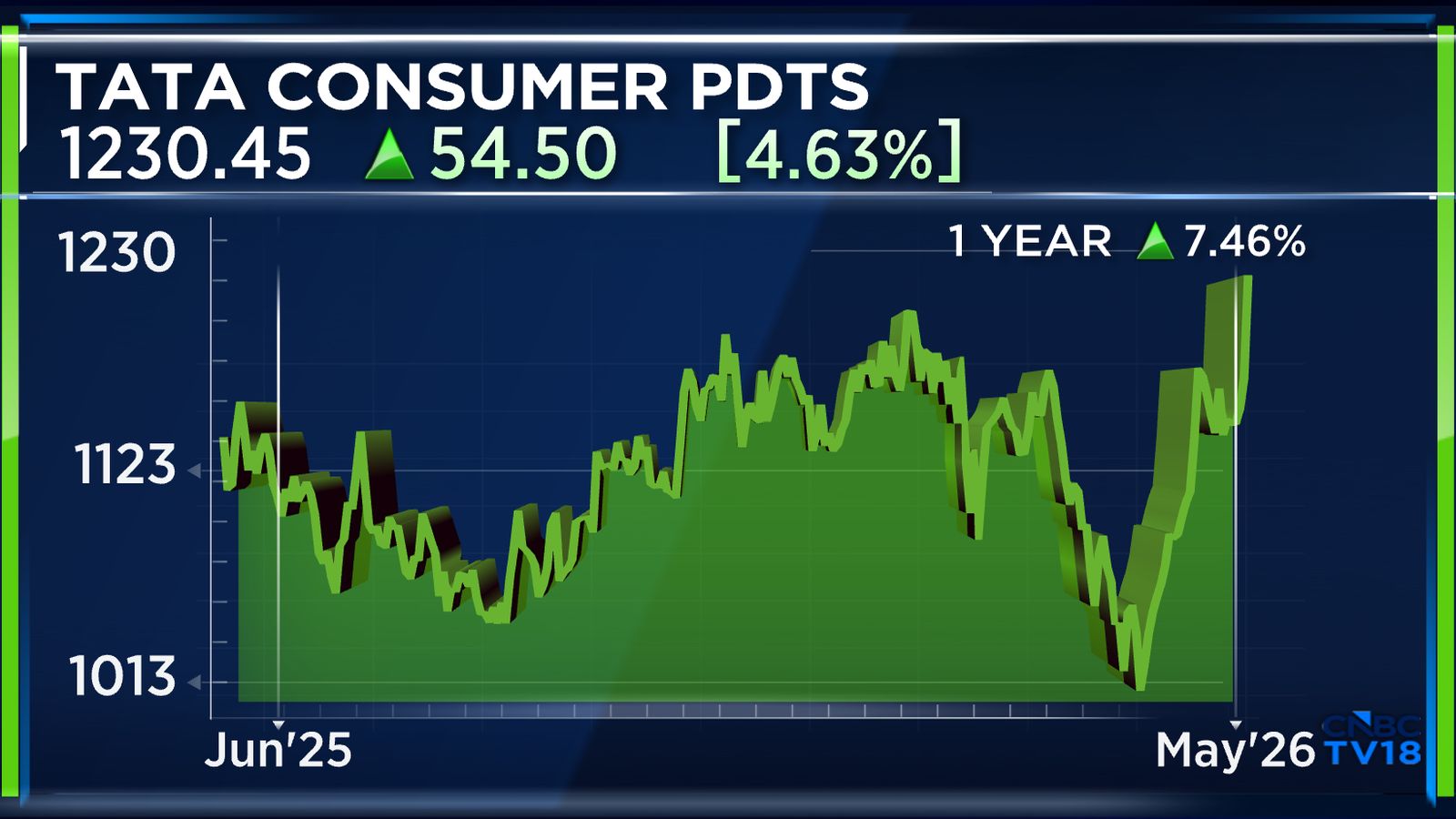
Tata Consumer Products, which has a market capitalisation of ₹1,21,666.62 crore, has seen its shares rise more than 7% over the last year.
This is an edited transcript of the interview.Q: 15% revenue growth in FY26, you've crossed the magical mark of ₹20,000 crore. Let's start with the basics. What are you targeting for in FY27 when it comes to revenues, margins as well as volumes?A: We had a good quarter. This Q4FY26 saw 18% top-line growth and 27% EBITDA growth. And as you mentioned, it was a 15% top-line growth for the full year with a 12% EBITDA growth, with broad-based growth across all the business segments.
For the year, beverages have grown 8%, salt has grown 14%, Sampann has grown 49%, for the quarter, ready-to-drink is up 23%, organic business is up 24%, and international has come to the party. For the quarter, with 30% top-line growth in the US, 17% in the UK and 19% in Canada. Overall, even for the full year, they've been good.
Financial metrics are also looking good. Our RoCE has gone up 110 bps. Today, our working capital is less than what it was six years ago. We are now at 21 days. India is at minus two. We're getting scale leverage, with 220 bps of cost leverage on the P&L if I exclude raw materials. Channels are firing. The channels of the future, whether quick commerce, are growing at 60%. Innovation contributes 4.5%, very strong results.
Q: What we want to know is what lies ahead.A: Nothing changes in the guidance that we've given. We will deliver double-digit revenue growth. We will improve EBITDA slightly ahead of the top line. Our innovation-to-sales ratio will continue at a 5% target. We will continue to expand distribution and focus on the channels of the future. All in all, we are just focusing on basics — product, branding, distribution and innovation.
For the full interview, watch the accompanying video Q: Double-digit revenue growth, EBITDA ahead of revenue growth and innovation-to-sales at 5% — these three points?A: And the other piece is we've got a set of growth businesses. They will continue to grow at 30%, contributing to 30% plus of the India business. That is where the top-line growth gets powered up, while the base business continues to provide the margin leverage.
Q: And on the growth businesses themselves, I had to ask you this because, in the fourth quarter, there was strong growth coming in from Sampann, with 69% growth. Obviously, that is an outlier that will perhaps normalise to 30%. Similarly, your ready-to-drink segment was up 23%, and there wasn't much growth in Capital Foods or Organic India either. So, do you think all of these, which were underperformers, will normalise back to 30%, and what grew above 30% will come back to 30% as well?A: Overall, we hope to grow Sampann above 30%, but the guidance we've kept is for 30%. Ready-to-drink will continue to grow at 30%. Capital Foods and Organic India faced very specific issues. We had large-scale supply issues. Organic India, roughly 50% of the business comes from international markets, and in Capital Foods, roughly 20% comes from international markets. While India grew double digits, the international business was impacted because supply chains got completely out of sync.
In March, even for the US, we do a lot of transshipments via the Middle East, and that went out of sync. In April, there was a catch-up. So, we remain confident of driving 30% plus growth for Capital Foods and Organic India as we go forward.
Q: In e-commerce and q-commerce, they're 19% of your total mix, and they grew, to a large extent, on a lower base, by 50-60% in FY26. What's the contribution heading to, point number one, and what's the growth rate?A: Overall, quick commerce and e-commerce contributed to roughly 21% in Q4 versus 15% in the same quarter last year, and it overall grew at close to 60% for the year. Quick commerce grew 100%.
Also Read | Bank of Baroda raises loan growth guidance to 12-14%, expects stable deposit costs
Now, yes, I wouldn't try to put a forecast on it. Just that in markets like China, quick commerce and e-commerce are roughly 30% to 40% in the grocery category. So, that's where we are headed. Our job is very simple. We remain focused on making sure we delight the consumer wherever the consumer is. If the consumer is shifting to quick commerce, we will be there.
And by the way, we are market leaders in tea, while overall, we are number two. We are market leaders in tea on e-commerce and quick commerce. That shows the strength of our brands and the fact that if we close distribution gaps, we are in a good place. So, I would say you would see very high growth for quick commerce for some time.
Q: What was interesting? Two things. One, you said newer channels accounted for about ₹200 crore in annual run rate in the fourth quarter. Where does that number settle at, say, three to five years from now? How much do you expect coming in from there? And the second part — you said that to ensure more focus on growth businesses in tea and salt-dominant markets, this is with regards to GT expansion. So, together, both of these will be how much?A: We've incubated three new channels last year. That was the vending business. We had started a food service business, and we started a pharma channel. Now all these three have an annual run rate of close to ₹300 crore — ₹100 crore for vending, ₹170 crore for food service and ₹30 crore for pharma.
I would say you would see strong 25-30% growth in these channels continuously as we go forward because the addressable markets in all three of these places are very significant. So, I wouldn't pull back on these channels, per se.
Q: What about Starbucks? It grew by close to 7% in quarter four and for the year. The number of stores added was around 23. Are you slowing down a little bit there? What kind of additions are you looking at for this year, and what kind of growth?A: The good part is this is the third quarter of same-store sales growth for Starbucks. There was a bit of pressure, I would say, for one year to 18 months coming into Q1. After that, we started to see the consumer come back into discretionary spending. You'd seen the pressure across all QSRs, and we had recalibrated store openings when we saw that happen.
Also Read | Biocon sees strong biosimilars momentum, expects merger synergies to aid margins: CEO Shreehas Tambe
Now that we're seeing the consumer come back, you will start to see an acceleration in stores. Apart from just the base stores, we are also focused on growing the brand as well. So, you'll see Reserve stores also coming up. We had one in Mumbai, we opened one in Gurugram, and now we have opened one in Kolkata. So, Starbucks, secularly, coffee will grow in India — in-home and out-of-home — and therefore we see no reason to slow down.
Q: A two-part question. One is in international business. Fourth quarter grew at around 11% in constant currency. The Street was working with a slightly higher number because of the West Asia crisis, etc. If you could give us a sense of how the international business is likely to pan out this year. And in India itself, on a consumer sentiment basis, given the comments that have come in from the Prime Minister and the increase in raw material prices, etc., do you think the growth path that we are on could face some hurdles? In India, give us a sense.A: So, let me answer the India question first – the good part is I am not in the discretionary space. I am in the essential consumer food and beverage space. Therefore, the impact on us will not be as pronounced as it may be for some of the discretionary spaces.
Number two, I'm not sure how to model for any disruption which happens. We've already tackled supply chain issues, we've tackled fuel issues, moved from liquefied petroleum gas (LPG) to dual burners, and wherever we had found other LPG sources. If prices continue to go up, if costs continue to mount up, we remain confident in our portfolio, the brand equity and our execution to take calibrated price hikes to make sure margins remain on track. So, for me, it is not a big worry. I would take a call as and when I see it starting to impact margins.
On the international piece, we had very good growth for the quarter overall. In the base businesses, the US grew 30%, the UK grew 17%, and Canada grew 19%. In the UK and Canada, we saw volume growth as well. Even for the full year, the US grew 24%.
So, I would say, broadly, we've always said the international businesses will grow at mid-to-high single digits on the top line. We've done better than that, and this will continue to improve as coffee prices start to soften in the US, which is the primary impact on the P&L, both for the US and for TCPL overall. So, we remain confident. And by the way, in history, we've had six successive quarters of market share gain, so we remain confident of our international business.
Catch all the latest updates from the stock market here
“Nothing changes in the guidance that we've given. We will plan on revenue growth and improve EBITDA a bit ahead of top line,” D’Souza said, adding that growth businesses will continue to expand at 30% and contribute more than 30% of the India business.
D’Souza said quick commerce and e-commerce contributed 21% of fourth-quarter sales and grew nearly 60% during FY26, while quick commerce alone doubled. “If the consumer is shifting to quick commerce, we will be there,” he said. He also said the company remains confident about international operations despite supply chain disruptions linked to the Middle East, adding that “we've had six successive quarters of market share gain.”
The company reported 18% top-line growth and 27% earnings before interest, taxes, depreciation, and amortisation (EBITDA) growth in the January-March quarter, while full-year revenue growth stood at 15%.
Tata Consumer Products, which has a market capitalisation of ₹1,21,666.62 crore, has seen its shares rise more than 7% over the last year.
This is an edited transcript of the interview.Q: 15% revenue growth in FY26, you've crossed the magical mark of ₹20,000 crore. Let's start with the basics. What are you targeting for in FY27 when it comes to revenues, margins as well as volumes?A: We had a good quarter. This Q4FY26 saw 18% top-line growth and 27% EBITDA growth. And as you mentioned, it was a 15% top-line growth for the full year with a 12% EBITDA growth, with broad-based growth across all the business segments.
For the year, beverages have grown 8%, salt has grown 14%, Sampann has grown 49%, for the quarter, ready-to-drink is up 23%, organic business is up 24%, and international has come to the party. For the quarter, with 30% top-line growth in the US, 17% in the UK and 19% in Canada. Overall, even for the full year, they've been good.
Financial metrics are also looking good. Our RoCE has gone up 110 bps. Today, our working capital is less than what it was six years ago. We are now at 21 days. India is at minus two. We're getting scale leverage, with 220 bps of cost leverage on the P&L if I exclude raw materials. Channels are firing. The channels of the future, whether quick commerce, are growing at 60%. Innovation contributes 4.5%, very strong results.
Q: What we want to know is what lies ahead.A: Nothing changes in the guidance that we've given. We will deliver double-digit revenue growth. We will improve EBITDA slightly ahead of the top line. Our innovation-to-sales ratio will continue at a 5% target. We will continue to expand distribution and focus on the channels of the future. All in all, we are just focusing on basics — product, branding, distribution and innovation.
For the full interview, watch the accompanying video Q: Double-digit revenue growth, EBITDA ahead of revenue growth and innovation-to-sales at 5% — these three points?A: And the other piece is we've got a set of growth businesses. They will continue to grow at 30%, contributing to 30% plus of the India business. That is where the top-line growth gets powered up, while the base business continues to provide the margin leverage.
Q: And on the growth businesses themselves, I had to ask you this because, in the fourth quarter, there was strong growth coming in from Sampann, with 69% growth. Obviously, that is an outlier that will perhaps normalise to 30%. Similarly, your ready-to-drink segment was up 23%, and there wasn't much growth in Capital Foods or Organic India either. So, do you think all of these, which were underperformers, will normalise back to 30%, and what grew above 30% will come back to 30% as well?A: Overall, we hope to grow Sampann above 30%, but the guidance we've kept is for 30%. Ready-to-drink will continue to grow at 30%. Capital Foods and Organic India faced very specific issues. We had large-scale supply issues. Organic India, roughly 50% of the business comes from international markets, and in Capital Foods, roughly 20% comes from international markets. While India grew double digits, the international business was impacted because supply chains got completely out of sync.
In March, even for the US, we do a lot of transshipments via the Middle East, and that went out of sync. In April, there was a catch-up. So, we remain confident of driving 30% plus growth for Capital Foods and Organic India as we go forward.
Q: In e-commerce and q-commerce, they're 19% of your total mix, and they grew, to a large extent, on a lower base, by 50-60% in FY26. What's the contribution heading to, point number one, and what's the growth rate?A: Overall, quick commerce and e-commerce contributed to roughly 21% in Q4 versus 15% in the same quarter last year, and it overall grew at close to 60% for the year. Quick commerce grew 100%.
Also Read | Bank of Baroda raises loan growth guidance to 12-14%, expects stable deposit costs
Now, yes, I wouldn't try to put a forecast on it. Just that in markets like China, quick commerce and e-commerce are roughly 30% to 40% in the grocery category. So, that's where we are headed. Our job is very simple. We remain focused on making sure we delight the consumer wherever the consumer is. If the consumer is shifting to quick commerce, we will be there.
And by the way, we are market leaders in tea, while overall, we are number two. We are market leaders in tea on e-commerce and quick commerce. That shows the strength of our brands and the fact that if we close distribution gaps, we are in a good place. So, I would say you would see very high growth for quick commerce for some time.
Q: What was interesting? Two things. One, you said newer channels accounted for about ₹200 crore in annual run rate in the fourth quarter. Where does that number settle at, say, three to five years from now? How much do you expect coming in from there? And the second part — you said that to ensure more focus on growth businesses in tea and salt-dominant markets, this is with regards to GT expansion. So, together, both of these will be how much?A: We've incubated three new channels last year. That was the vending business. We had started a food service business, and we started a pharma channel. Now all these three have an annual run rate of close to ₹300 crore — ₹100 crore for vending, ₹170 crore for food service and ₹30 crore for pharma.
I would say you would see strong 25-30% growth in these channels continuously as we go forward because the addressable markets in all three of these places are very significant. So, I wouldn't pull back on these channels, per se.
Q: What about Starbucks? It grew by close to 7% in quarter four and for the year. The number of stores added was around 23. Are you slowing down a little bit there? What kind of additions are you looking at for this year, and what kind of growth?A: The good part is this is the third quarter of same-store sales growth for Starbucks. There was a bit of pressure, I would say, for one year to 18 months coming into Q1. After that, we started to see the consumer come back into discretionary spending. You'd seen the pressure across all QSRs, and we had recalibrated store openings when we saw that happen.
Also Read | Biocon sees strong biosimilars momentum, expects merger synergies to aid margins: CEO Shreehas Tambe
Now that we're seeing the consumer come back, you will start to see an acceleration in stores. Apart from just the base stores, we are also focused on growing the brand as well. So, you'll see Reserve stores also coming up. We had one in Mumbai, we opened one in Gurugram, and now we have opened one in Kolkata. So, Starbucks, secularly, coffee will grow in India — in-home and out-of-home — and therefore we see no reason to slow down.
Q: A two-part question. One is in international business. Fourth quarter grew at around 11% in constant currency. The Street was working with a slightly higher number because of the West Asia crisis, etc. If you could give us a sense of how the international business is likely to pan out this year. And in India itself, on a consumer sentiment basis, given the comments that have come in from the Prime Minister and the increase in raw material prices, etc., do you think the growth path that we are on could face some hurdles? In India, give us a sense.A: So, let me answer the India question first – the good part is I am not in the discretionary space. I am in the essential consumer food and beverage space. Therefore, the impact on us will not be as pronounced as it may be for some of the discretionary spaces.
Number two, I'm not sure how to model for any disruption which happens. We've already tackled supply chain issues, we've tackled fuel issues, moved from liquefied petroleum gas (LPG) to dual burners, and wherever we had found other LPG sources. If prices continue to go up, if costs continue to mount up, we remain confident in our portfolio, the brand equity and our execution to take calibrated price hikes to make sure margins remain on track. So, for me, it is not a big worry. I would take a call as and when I see it starting to impact margins.
On the international piece, we had very good growth for the quarter overall. In the base businesses, the US grew 30%, the UK grew 17%, and Canada grew 19%. In the UK and Canada, we saw volume growth as well. Even for the full year, the US grew 24%.
So, I would say, broadly, we've always said the international businesses will grow at mid-to-high single digits on the top line. We've done better than that, and this will continue to improve as coffee prices start to soften in the US, which is the primary impact on the P&L, both for the US and for TCPL overall. So, we remain confident. And by the way, in history, we've had six successive quarters of market share gain, so we remain confident of our international business.
Catch all the latest updates from the stock market here
/images/ppid_59c68470-image-177824253672236851.webp)
/images/ppid_59c68470-image-17783475317608092.webp)


/images/ppid_59c68470-image-177826256220159018.webp)

/images/ppid_59c68470-image-177822011944186471.webp)
/images/ppid_59c68470-image-177824253571877272.webp)
/images/ppid_59c68470-image-177822502705012714.webp)