/images/ppid_59c68470-image-17822825653161231.webp)

/images/ppid_59c68470-image-17822250425461008.webp)
/images/ppid_59c68470-image-178238505802646524.webp)



What is the story about?
Patanjali Foods, an Indore-based FMCG company, expects a delayed monsoon and weak rural demand to weigh on its packaged foods business over the next two quarters, even as gains in its edible oil segment help cushion the impact, CEO Sanjeev Asthana said.
“There is a challenge on the delayed Patanjali Foods, and it will definitely impact both the sowing, the commodity inflation that companies have to deal with, and certainly from the performance perspective, it will have an impact,” Asthana said.
Patanjali Foods holds long positions in edible oil — meaning it benefits when prices for the commodity rise, since it both produces and uses it across its food businesses. Asthana said this works as a natural hedge: gains on the oil side help offset the higher input costs the same inflation creates in the company's other packaged food categories.
"Net-net, the impact on us will be lesser, but overall I am anticipating that it will be a challenging time ahead, certainly for this quarter and the next one," he said.
He added that edible oil demand, which was soft for three months last quarter, is now recovering. "Till June it's a slower quarter in terms of the volumes, but July onwards is a peak demand period when it starts to build up," Asthana said.
Patanjali Foods had earlier guided for 3–5% volume growth in edible oils, 8–10% growth in its broader packaged foods (FMCG) business, and 15% growth in beauty and personal care, along with 12–15% EBITDA growth.
Asthana said the company remains on track to meet those targets overall, helped by continued expansion into new distribution areas. But he flagged the staples category — items like packaged grains and flour — as the most exposed to rural stress.
“I am positive that we will have good growth in the HPC (health and personal care) category, food, and especially... I anticipate that there will be some stress" in staples, he said. "But we are pretty much on course to achieve our growth in the EBITDA as well as the overall margin construct for the company."
He pointed to the company's oral care brands, including Dant Kanti, as a bright spot largely insulated from monsoon and commodity swings, citing strong demand for new toothpaste variants and toothbrushes. He said he expects the oral care category — the company's largest within health and personal care — to grow more than 15%.
Competition in the FMCG space is intensifying with larger players expanding aggressively. Asthana described Reliance as a formidable competitor but said Patanjali Foods remains confident about its positioning in health, wellness, Ayurveda and products with an Indian identity.
He added that the overall market continues to expand, creating opportunities for multiple players.
Patanjali Foods' current market capitalisation is ₹44,770.23 crore.
For the entire discussion, watch the accompanying video
For the entire discussion, watch the accompanying video
“There is a challenge on the delayed Patanjali Foods, and it will definitely impact both the sowing, the commodity inflation that companies have to deal with, and certainly from the performance perspective, it will have an impact,” Asthana said.
Patanjali Foods holds long positions in edible oil — meaning it benefits when prices for the commodity rise, since it both produces and uses it across its food businesses. Asthana said this works as a natural hedge: gains on the oil side help offset the higher input costs the same inflation creates in the company's other packaged food categories.
"Net-net, the impact on us will be lesser, but overall I am anticipating that it will be a challenging time ahead, certainly for this quarter and the next one," he said.
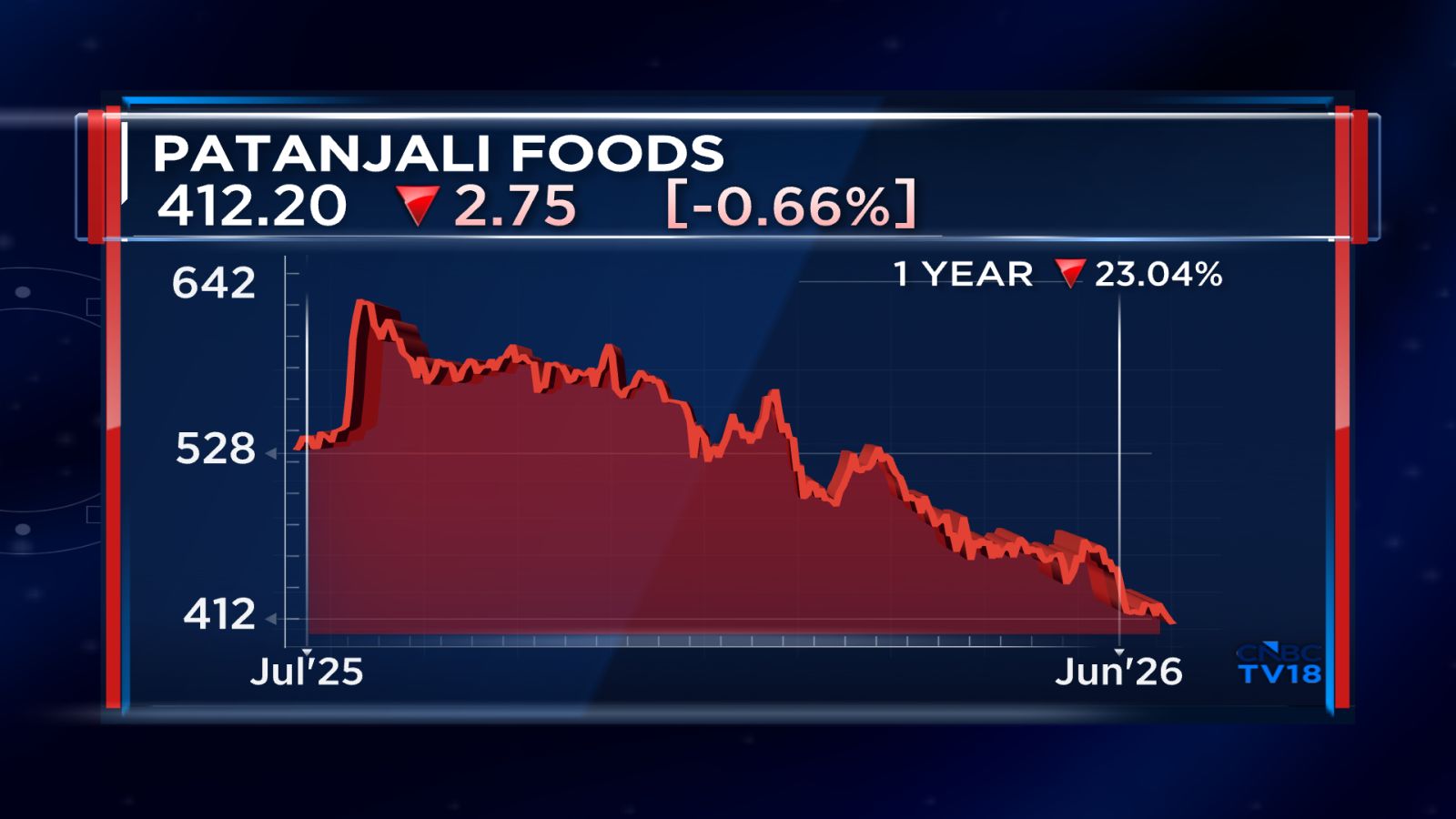
The stock was trading at ₹411.30 at 10:33 am on the NSE and has declined more than 23% over the past year.
He added that edible oil demand, which was soft for three months last quarter, is now recovering. "Till June it's a slower quarter in terms of the volumes, but July onwards is a peak demand period when it starts to build up," Asthana said.
Patanjali Foods had earlier guided for 3–5% volume growth in edible oils, 8–10% growth in its broader packaged foods (FMCG) business, and 15% growth in beauty and personal care, along with 12–15% EBITDA growth.
Asthana said the company remains on track to meet those targets overall, helped by continued expansion into new distribution areas. But he flagged the staples category — items like packaged grains and flour — as the most exposed to rural stress.
“I am positive that we will have good growth in the HPC (health and personal care) category, food, and especially... I anticipate that there will be some stress" in staples, he said. "But we are pretty much on course to achieve our growth in the EBITDA as well as the overall margin construct for the company."
He pointed to the company's oral care brands, including Dant Kanti, as a bright spot largely insulated from monsoon and commodity swings, citing strong demand for new toothpaste variants and toothbrushes. He said he expects the oral care category — the company's largest within health and personal care — to grow more than 15%.
Competition in the FMCG space is intensifying with larger players expanding aggressively. Asthana described Reliance as a formidable competitor but said Patanjali Foods remains confident about its positioning in health, wellness, Ayurveda and products with an Indian identity.
He added that the overall market continues to expand, creating opportunities for multiple players.
Patanjali Foods' current market capitalisation is ₹44,770.23 crore.
For the entire discussion, watch the accompanying video
For the entire discussion, watch the accompanying video
/images/ppid_59c68470-image-178241253017594448.webp)




/images/ppid_59c68470-image-178237259004995227.webp)

/images/ppid_59c68470-image-178230752452694739.webp)
/images/ppid_59c68470-image-178221013419533430.webp)