/images/ppid_59c68470-image-177484507849262403.webp)

/images/ppid_59c68470-image-177509753338848771.webp)


What is the story about?
Brokerage firm Goldman Sachs, in a note on oil marketing companies (OMCs), said the recent ₹10 per litre cut in excise duty on petrol and diesel offers some relief, although earnings pressure remains elevated.
Prior to the escalation in the Middle East conflict, the breakeven level for a normalised integrated margin of OMCs was estimated at around $70 per barrel of Dubai crude. However, a weaker rupee has since reduced this to $67 per barrel.
Following the excise duty cut, the breakeven improves to $78 per barrel, which still remains below current crude prices of around $122 per barrel, the brokerage said in its note.
Even after these adjustments, Goldman Sachs said the EBITDA loss run-rate for integrated OMCs remains elevated and is higher than the peak losses seen in CY22.
ALSO READ | HDFC Bank valuations at 16-year low; JPM upgrades, Jefferies sees 64% upside
For Hindustan Petroleum Corporation Ltd., the export duty on diesel offers partial support through lower domestic product prices, the brokerage added.
However, with Brent crude estimated at $80 per barrel in CY27 by its commodities team, Goldman Sachs believes the risk-reward remains constrained, given structurally higher crude prices and limited pricing flexibility for OMCs.
Among the OMCs, Goldman Sachs sees the least favourable risk-reward for Indian Oil Corporation Ltd., with an implied downside of 49% in a bear-case scenario and 20% in the base case.
The brokerage maintains a 'Neutral' stance on Bharat Petroleum Corporation Ltd. and Hindustan Petroleum Corporation Ltd.
Separately, Citigroup said the fuel tax changes announced by the government provide meaningful relief to OMCs, while capping refining upside for Reliance Industries Limited.
The key policy changes include a ₹10 per litre cut in excise duty on petrol and diesel, which has not been passed on to retail prices and therefore helps reduce marketing losses for OMCs.
Additionally, the government has imposed an export duty of ₹21.5 per litre on diesel and ₹29.5 per litre on jet fuel.
This move is expected to limit refining upside for Reliance Industries to the extent of its domestic sales to OMCs, assuming its SEZ refinery remains exempt — clarity on this is still awaited.
Notably, the absence of a windfall tax on upstream companies marks a shift from past policy trends and could allow Oil and Natural Gas Corporation to fully benefit from elevated crude prices.
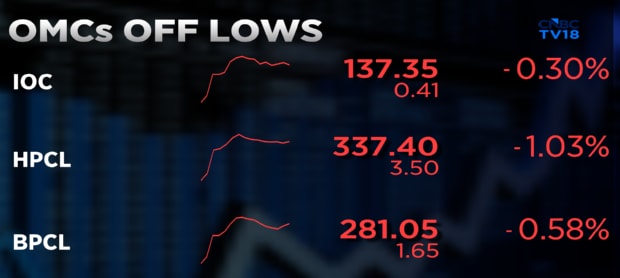
Shares of OMCs such as Hindustan Petroleum Corporation, Bharat Petroleum Corporation, and Indian Oil Corporation were trading lower on Monday, March 30.
Prior to the escalation in the Middle East conflict, the breakeven level for a normalised integrated margin of OMCs was estimated at around $70 per barrel of Dubai crude. However, a weaker rupee has since reduced this to $67 per barrel.
Following the excise duty cut, the breakeven improves to $78 per barrel, which still remains below current crude prices of around $122 per barrel, the brokerage said in its note.
Even after these adjustments, Goldman Sachs said the EBITDA loss run-rate for integrated OMCs remains elevated and is higher than the peak losses seen in CY22.
ALSO READ | HDFC Bank valuations at 16-year low; JPM upgrades, Jefferies sees 64% upside
For Hindustan Petroleum Corporation Ltd., the export duty on diesel offers partial support through lower domestic product prices, the brokerage added.
However, with Brent crude estimated at $80 per barrel in CY27 by its commodities team, Goldman Sachs believes the risk-reward remains constrained, given structurally higher crude prices and limited pricing flexibility for OMCs.
Among the OMCs, Goldman Sachs sees the least favourable risk-reward for Indian Oil Corporation Ltd., with an implied downside of 49% in a bear-case scenario and 20% in the base case.
The brokerage maintains a 'Neutral' stance on Bharat Petroleum Corporation Ltd. and Hindustan Petroleum Corporation Ltd.
Separately, Citigroup said the fuel tax changes announced by the government provide meaningful relief to OMCs, while capping refining upside for Reliance Industries Limited.
The key policy changes include a ₹10 per litre cut in excise duty on petrol and diesel, which has not been passed on to retail prices and therefore helps reduce marketing losses for OMCs.
Additionally, the government has imposed an export duty of ₹21.5 per litre on diesel and ₹29.5 per litre on jet fuel.
This move is expected to limit refining upside for Reliance Industries to the extent of its domestic sales to OMCs, assuming its SEZ refinery remains exempt — clarity on this is still awaited.
Notably, the absence of a windfall tax on upstream companies marks a shift from past policy trends and could allow Oil and Natural Gas Corporation to fully benefit from elevated crude prices.
Shares of OMCs such as Hindustan Petroleum Corporation, Bharat Petroleum Corporation, and Indian Oil Corporation were trading lower on Monday, March 30.


/images/ppid_59c68470-image-177510004043424139.webp)
/images/ppid_59c68470-image-177510007937157741.webp)


/images/ppid_59c68470-image-1775100045256933.webp)

/images/ppid_a911dc6a-image-177509853563140334.webp)

/images/ppid_a911dc6a-image-177509852786823248.webp)
/images/ppid_59c68470-image-177509753477068076.webp)